

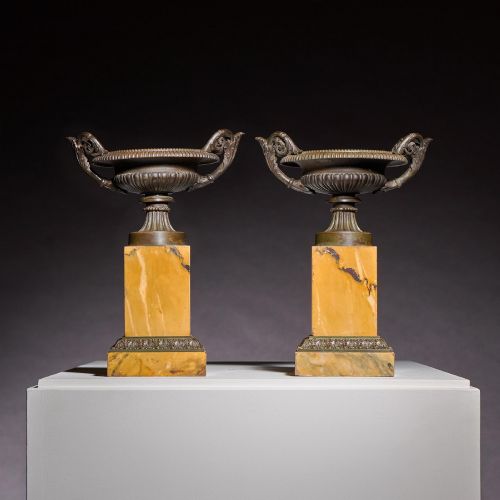
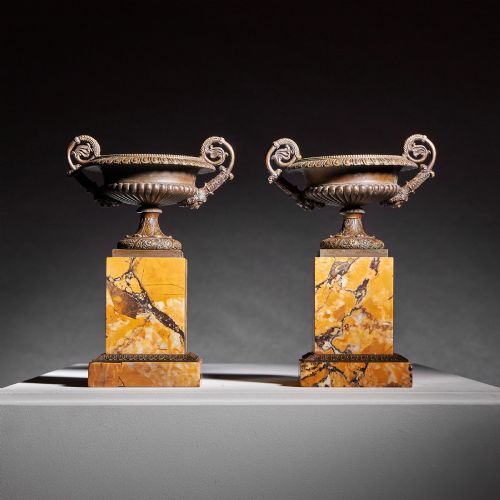
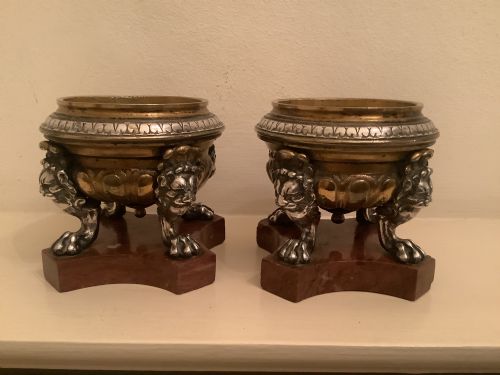
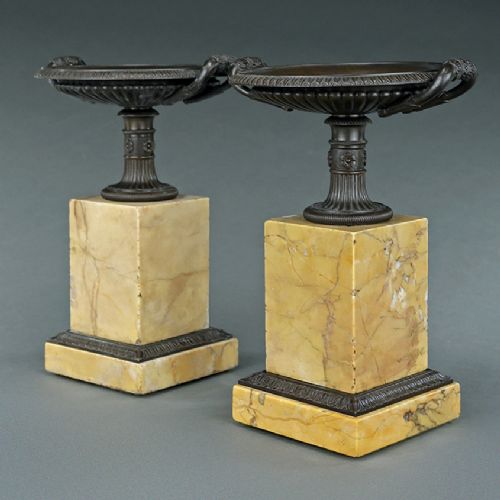

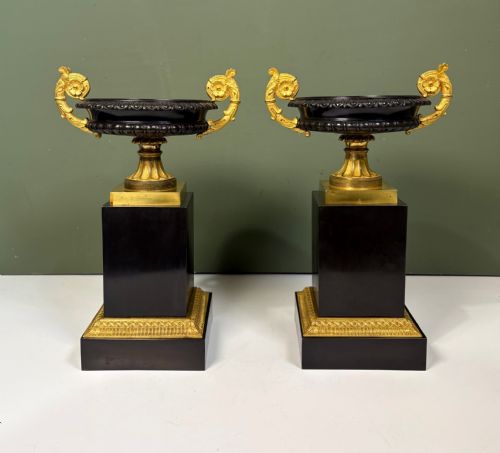


Pair of Tazzas
When you choose a pair of tazzas, you select elevated ornamental dishes designed to anchor a formal interior display.
Pair of Tazzas
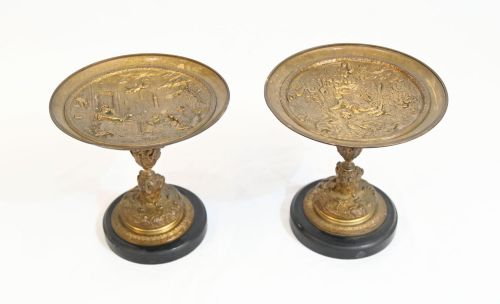
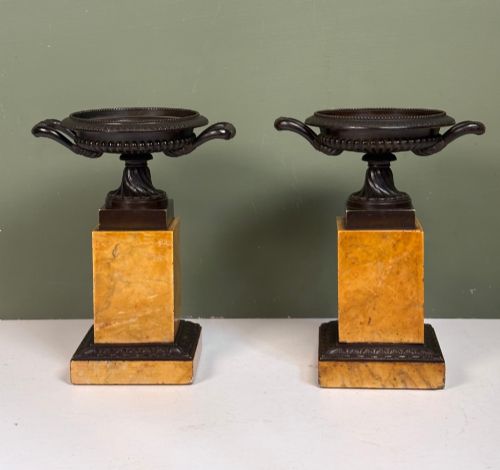
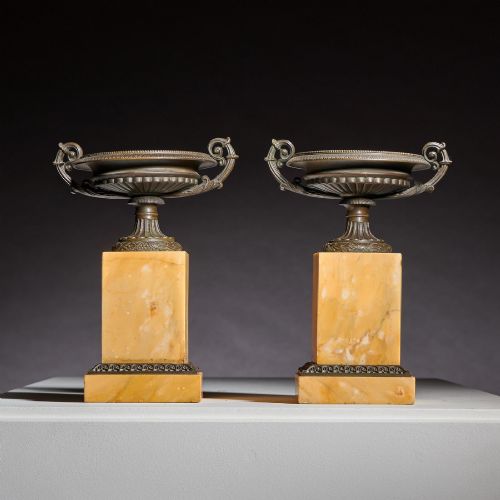
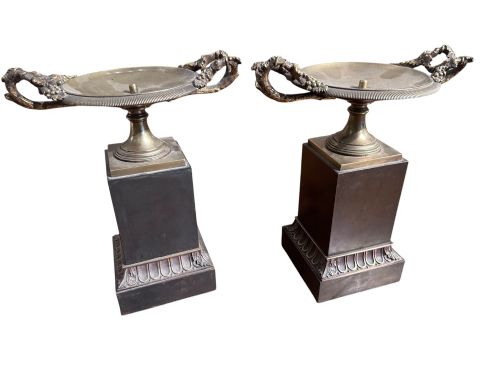
A pair of tazzas functions as a matched set of footed dishes, compotes or pedestal platters rooted in classical antiquity. These decorative objects emerge primarily in nineteenth-century workshops inspired by French Empire, Regency and Grand Tour aesthetics.
The form spans diverse cultural traditions, appearing in European bronze and marble, Chinese cloisonne enamel and carved hardwood, or British silver and cut glass. Collectors encounter everything from monumental library centrepieces to diminutive sweet dishes.
Makers often fashioned these pieces to serve as ornamental centrepieces on tables, consoles and mantelpieces rather than for practical dining use. The pairing creates symmetry, a defining requirement for formal nineteenth-century interior arrangements.
Materials and construction methods
Foundry workers cast patinated bronze, gilt bronze and brass to form the structural pedestals and mounts, frequently combining these metals with carved white, black, siena or verde antico marble. Ormolu highlights provide brilliant contrast against dark patinated surfaces.
Craftsmen utilised specialised techniques for contrasting media, such as cloisonne enamelling on metal bases, hand-cutting heavy crystal glass dishes, or mounting delicate mother-of-pearl shell bowls into metal frames.
Pair of Tazzas Retail Price Guide 2026
Typical asking prices for pair of tazzas among the pieces listed under this phrase on Sellingantiques today, from the lower quarter to the upper quarter. They describe what is for sale here now, not the wider market.
Listings demonstrate a strong prevalence of nineteenth-century French Empire and Italian Grand Tour designs executed in bronze, marble and ormolu.
Assessing craftsmanship and design
Quality reveals itself through the crispness of the bronze chasing, the density and figuring of the marble bases, and the weight of the metal components. Finer examples display meticulous hand-finishing on mountings and seamless joins between dissimilar materials.
The artistic ambition of the design dictates distinction, separating standard decorative wares from exceptional Grand Tour souvenirs sculpted after genuine classical antiquities.
Molineux and Webb·Aspreys of London·Royal Doulton
The Pair of Tazzas Glossary
- Tazza
- A shallow bowl or dish mounted on a stem and foot, derived from ancient drinking vessels. They serve primarily for display in domestic settings.
- Grand Tour
- A cultural journey undertaken by wealthy young Europeans in the eighteenth and nineteenth centuries. Souvenirs included miniature bronzes and marble architectural models.
- Ormolu
- Gilded bronze produced by applying a mercury-gilding process to cast bronze. This technique creates a rich golden finish on decorative mounts.
- Sienna marble
- A yellow-hued Italian marble featuring dramatic dark veining. It appears frequently in neoclassical and Regency decorative objects.
- Compote
- A stemmed dish used for serving fruit or sweets, synonymous with certain tazza forms. They feature prominently in nineteenth-century dining and drawing room arrangements.
Pair of Tazzas: Frequently Asked Questions
What is a tazza used for?
These elevated pedestal vessels functioned traditionally as ornamental centrepieces on dining tables, sideboards and mantelpieces.
Wealthy households utilised them to display fruit, sweetmeats or simply to add classical symmetry to formal room schemes.
How do I date a marble tazza?
Dating relies on examining the mineral characteristics of the marble, the casting quality of any attached metal mounts, and the overall stylistic vocabulary.
Nineteenth-century Grand Tour pieces often utilise specific Italian marbles like siena or verde antico paired with patinated or gilded bronze.
Are these pieces strictly decorative?
Many examples were created purely as decorative objects or souvenir items for travellers returning from Italy.
Silver and glass variants found practical use during Victorian dinners, while heavy bronze and marble versions remained stationary display pieces.
Why do they come in pairs?
Interior design conventions of the Georgian, Regency and Victorian eras demanded symmetry in room decoration.
Matched pairs allowed owners to balance mantelpieces, console tables and large architectural credenzas effectively.