




Chinese Export Nesting Tables
Chinese export nesting tables are graduated sets of occasional surfaces designed to slide neatly into one another, offering practical versatility with distinct cultural artistry.
Chinese Export Nesting Tables
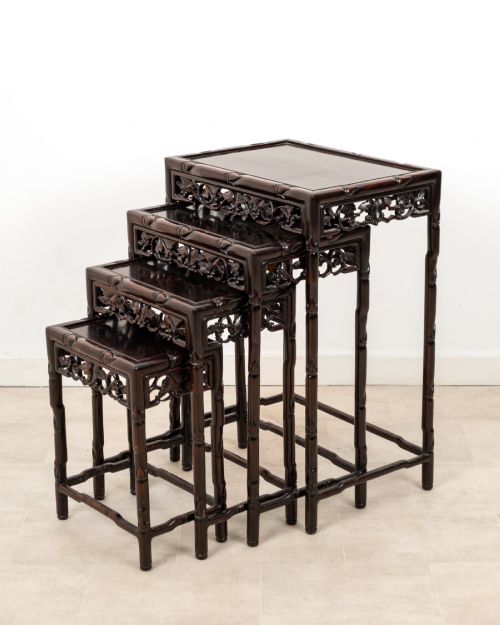
When you search for chinese export nesting tables, you encounter sets usually comprising four graduated pieces designed to stack together. The primary forms span the nineteenth century and the early twentieth century, including Edwardian examples.
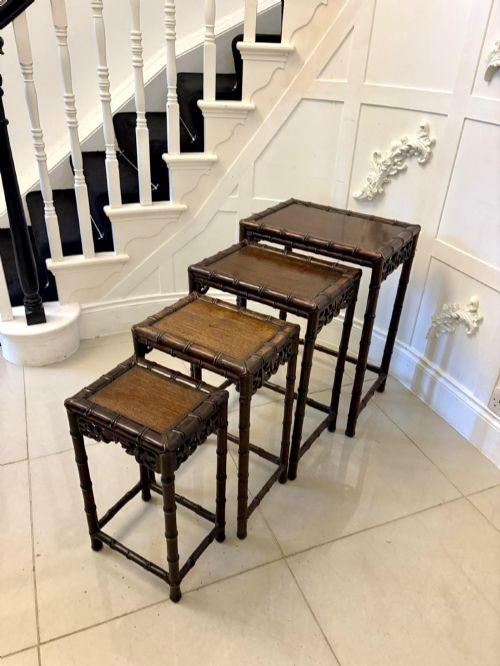
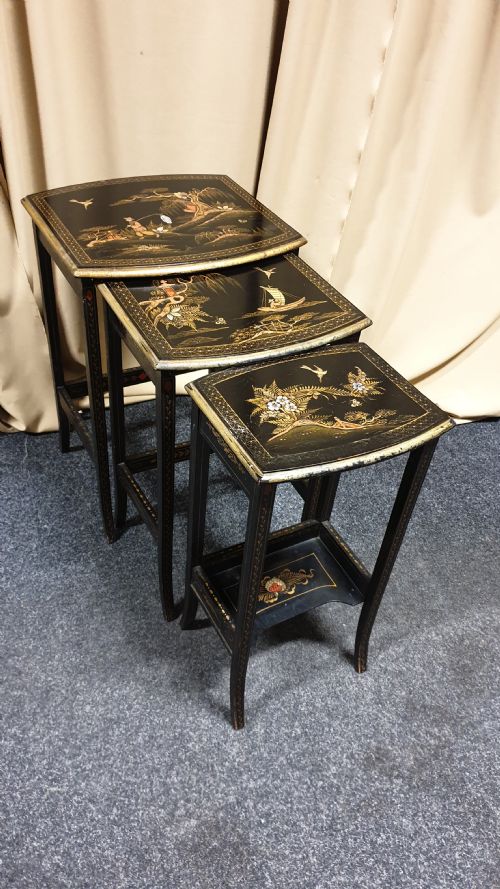
Most sets appear in dense timbers such as hardwood, rosewood, teak, and hongmu, alongside occasional lacquer finishes decorated with gold leaf. These tables served as versatile occasional furniture, easily moved around a room for tea or display before sliding back into a compact single column.
Construction and materials
Cabinetmakers utilised dense Asian hardwoods, specifically rosewood, teak, and hongmu, selecting them for their weight and structural stability. These timbers allowed for intricate carving along the friezes and legs without compromising the load-bearing capacity of the smaller tables.
Lacquer surfaces received layers of pigment and gold leaf in the Chinoiserie style, creating detailed pictorial scenes across the tabletops. Joinery relied on precise traditional framing to ensure each table slid smoothly into the one immediately larger than it.
Listings for chinese export nesting tables feature items dated across the nineteenth century, 1900, 1910, 1920, and the Edwardian era.
Evaluating craftsmanship
Quality rests in the crispness of the carved hardwood and the structural integrity of the graduated frames. Finer examples display deeply undercut carving on the friezes and bamboo-moulded framing that remains rigid across all four surfaces.
The choice of timber heavily dictates the grade, with dense hongmu and figured burrwood inserts representing superior execution compared to plain secondary woods. Lacquer variations depend on the preservation of the gold leaf detail and the depth of the dark ground finish.
The Chinese Export Nesting Tables Glossary
- Hongmu
- A traditional Chinese term for dense tropical hardwoods, often translated as red wood. It encompasses heavy, durable timbers prized for furniture making.
- Chinoiserie
- A European artistic style reflecting Chinese motifs and techniques. It appears on lacquer surfaces decorated with gold leaf and Oriental scenes.
- Graduated
- Describing a set of tables where each piece diminishes in height and width to fit inside the next. This sizing allows the entire nest to occupy the floor space of a single table.
- Quartetto
- An older descriptor for a set of four stackable occasional tables. The term originates from nineteenth-century English usage for nested furniture.
Chinese Export Nesting Tables: Frequently Asked Questions
What is a nest of tables?
A nest of tables consists of multiple freestanding surfaces, usually four, built in decreasing sizes to stack together. They provide extra table space when entertaining and store compactly when not in use.
Historically placed in reception rooms, these sets allowed hosts to serve refreshments across a room before returning the tables to a single stacked footprint.
How do I date these tables?
Dating relies on timber selection, carving style, and construction methods recorded across nineteenth-century and early twentieth-century examples. Heavier hongmu and detailed bamboo-carved hardwood typically point to the earlier Victorian periods.
Later Edwardian pieces often incorporate simpler lines or alternative lacquer finishes while maintaining the traditional four-table graduation.
Where were these tables made?
These pieces were produced in China for the export market, catering to Western tastes during the nineteenth and early twentieth centuries. Workshops combined traditional Chinese joinery techniques with forms suited to European drawing rooms.
Export production often blended local hardwood traditions with Chinoiserie decoration specifically requested by foreign merchants and buyers.
How should I care for lacquer surfaces?
Lacquer requires gentle dusting with a soft, dry cloth and protection from direct sunlight and extreme humidity. Avoid chemical polishes that can degrade the historic surface layers.
Keeping the environment stable preserves both the delicate gold leaf detailing and the underlying wood structure of the nesting set.