



Chinoiserie Nesting Tables
Chinoiserie nesting tables bring layered lacquer and gilt detail to a room, offering surface space that tucks away neatly when not in use.
Chinoiserie Nesting Tables
Chinoiserie nesting tables comprise sets of occasional tables, usually numbering three or four pieces, designed to fit cleanly inside one another. These sets appear primarily from the nineteenth century and the early twentieth century, including pieces referencing the Queen Anne style and French Chinoiserie aesthetics.
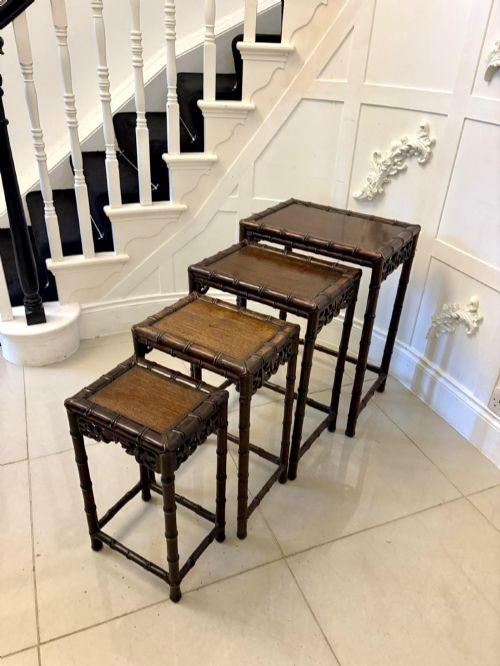
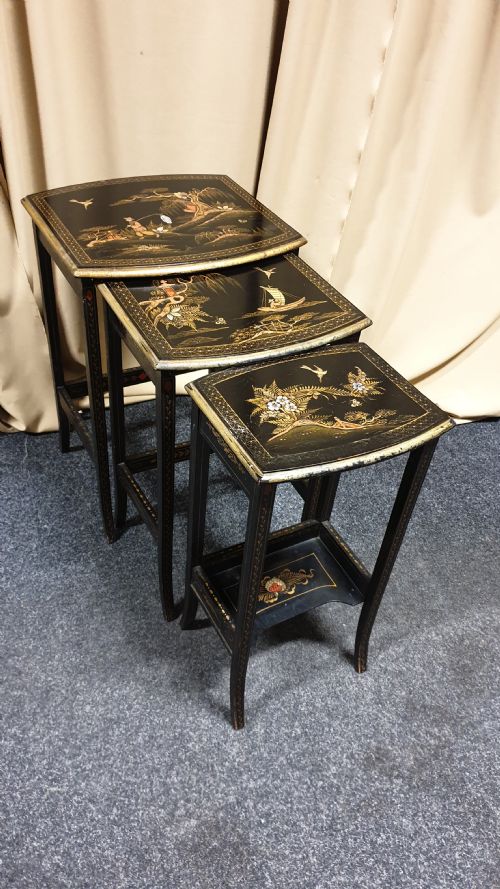
The forms span simple lacquered surfaces alongside carved faux bamboo frames and heavily decorated black lacquer finishes. Buyers examining this page encounter tables originating across the nineteenth century up to the nineteen-twenties, presenting varied table counts per set.
How they were made
Construction relies upon hardwood and general wood framing, sometimes shaped into carved faux bamboo motifs. Artisans applied black lacquer surfaces, building up the body before adding decorative elements.
Visual depth comes from gold leaf, gilding, gilt paint, and general paint work. These applied finishes create the characteristic pictorial scenes associated with the style.
Listings feature pieces spanning the nineteenth century, nineteen-hundred, nineteen-ten, and nineteen-twenty, utilising lacquer, wood, gold leaf, and gilding.
What varies in quality
Quality rests heavily on the execution of the lacquer and the crispness of the gilding or gold leaf application. Finer sets display meticulous hand-painted details across the black lacquer surfaces rather than basic surface decoration.
The underlying woodwork dictates structural integrity, distinguishing simple sets from elaborately carved pieces involving faux bamboo or Boulle-work detailing. The cohesion of the nesting mechanism and the balance of each individual table within the set also mark differences in production standards.
The Chinoiserie Nesting Tables Glossary
- Chinoiserie
- European interpretation and imitation of East Asian artistic traditions, particularly in decorative arts and lacquer work. This style dominates the ornamentation found on these nesting tables.
- Lacquer
- A durable resin finish applied in multiple layers to wood surfaces, often sanded smooth and polished. It provides the dark background typical of these tables.
- Boulle-work
- Elaborate marquetry inlay utilising materials such as tortoiseshell and brass, referenced in specific high-end nineteenth-century examples. The technique adds distinct textural contrast to the lacquer.
- Faux bamboo
- Wood turned and carved to imitate natural bamboo stalks. This decorative framing appears on selected nineteenth-century Oriental-influenced pieces.
- Gilding
- The application of gold leaf or gilt paint to surfaces to highlight details and motifs. It creates the luminous contrast against the dark background.
Chinoiserie Nesting Tables: Frequently Asked Questions
How do nesting tables work?
Nesting tables are a graduated set of small tables designed to slide sequentially beneath the largest piece. This configuration saves floor space while keeping multiple surfaces available.
Users pull individual tables out as needed for drinks or display, returning them to the stack when finished.
What is French Chinoiserie?
French Chinoiserie is a style that blends European furniture forms with whimsical interpretations of Chinese motifs. It flourished particularly during revival periods in the nineteenth century.
These pieces often feature floral painted elements alongside traditional lacquer techniques.
How are these tables dated?
Dating relies on construction methods, wood types, and stylistic indicators such as Queen Anne revival shapes or Victorian faux bamboo carving. Material analysis of the lacquer and underlying timber also guides attribution.
Pieces on this page span from the nineteenth century through the early twentieth century.
Where should I place them?
These tables suit sitting rooms or studies where surface space is needed intermittently. Keeping them stacked as a single unit showcases the graduated decoration.
Spreading the tables across a room provides matching surfaces for guests while maintaining a cohesive aesthetic.