
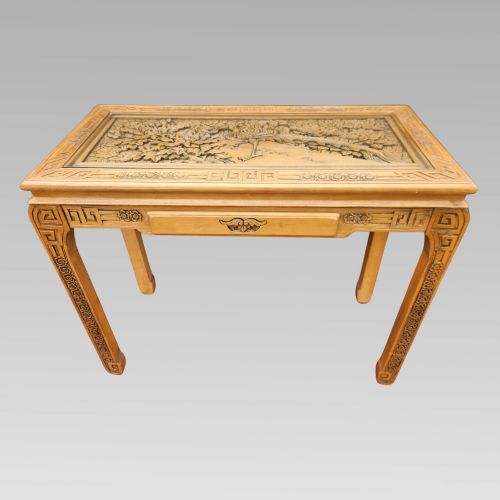


Chinese Entry Console
These Chinese entry console pieces bring substantial Qing Dynasty character and practical surface space to a hallway.

Chinese Entry Console
A chinese entry console brings traditional form and practical surface space to a hallway or reception area. Buyers searching for a chinese entry console encounter elm, hardwood, and lacquer tables originating from the nineteenth century up to nineteen thirty. The selection includes console tables, altar tables, side cabinets, and side tables in provincial, export, and regional styles.
Altar tables and rectangular console tables dominate the pieces on this page, often featuring carved details. Elm and hardwood examples appear frequently alongside red lacquer finishes and occasional brass fittings or glass elements. Pieces span the Qing dynasty, nineteenth century, and early twentieth century with traditional Chinese design characteristics.
Materials and Construction
Makers utilised solid timbers such as elm and dense hardwoods, constructing frames designed to support heavy use in domestic settings. Surfaces were finished with clear polishes to highlight the natural grain or coated in red lacquer.
Carved ornamentation appears across many items, particularly on apron rails and panel work. Joinery techniques allowed large tables and side cabinets to remain stable without relying on metal fasteners.
Listings span the nineteenth century and early twentieth century, featuring elm, hardwood, and red lacquer across altar tables and console forms.
Evaluating Quality and Execution
The sophistication of the carving distinguishes finer examples from simpler provincial pieces. Crisp execution of motifs along the apron and legs shows the skill of the original workshop.
Condition of the timber and original lacquer surfaces dictates the visual impact of each piece. Intact joinery and well-preserved surface patination separate superior items from those with heavy losses.
The Chinese Entry Console Glossary
- Altar table
- A traditional rectangular table featuring upturned flanges at the short ends, originally designed for ritual use but adopted for domestic display. These pieces provide narrow surface depths suitable for entryways.
- Qing Dynasty
- The final imperial dynasty of China, spanning from sixteen forty-four to nineteen twelve. Pieces from this period exhibit characteristic carving styles and traditional joinery.
- Lacquer
- A durable resin finish applied in multiple layers to wood surfaces, often seen in red tones on export and regional furniture. This technique protects the timber while providing a glossy decorative appearance.
- Elm
- A resilient native timber utilised extensively for Chinese furniture construction. It accepts carving well and displays a pronounced grain pattern under clear finishes.
Chinese Entry Console: Frequently Asked Questions
Where should I place a console table?
These tables fit naturally in narrow hallways, entrance passages, or behind seating arrangements.
Their shallow depth allows them to sit against walls without obstructing movement through domestic spaces.
How do I care for lacquer surfaces?
Dust surfaces regularly with a soft, dry cloth to prevent abrasive particle accumulation.
Keep pieces away from direct sunlight and moisture to protect the finish over time.
What is the difference between an altar table and a console?
Altar tables often feature distinct upturned flanges at the short ends of the top board.
Standard console tables typically have flat rectangular or demi-lune tops without these raised architectural ends.
How can I identify nineteenth-century pieces?
Nineteenth-century items show traditional hand-carved details and construction methods characteristic of the late Qing period.
Materials typically include solid elm, hardwood, or lacquered wood bearing natural signs of age.