
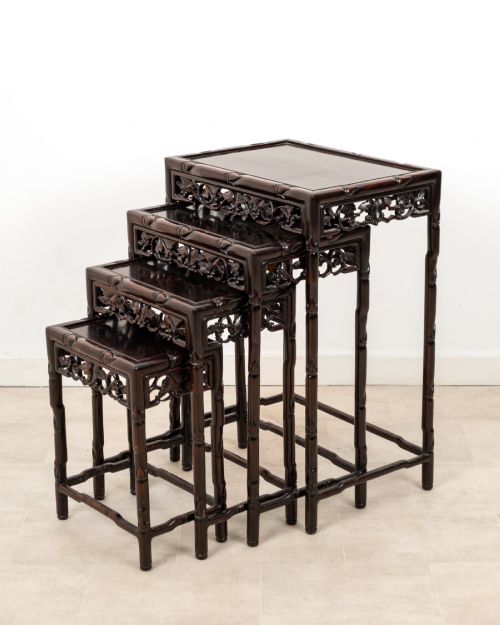
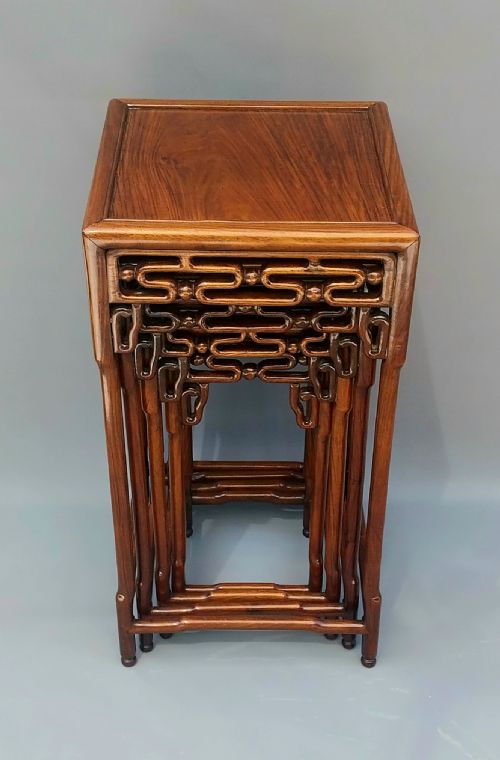


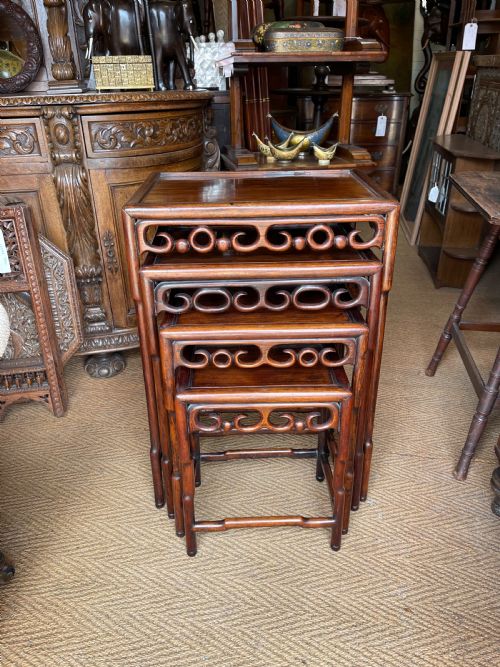


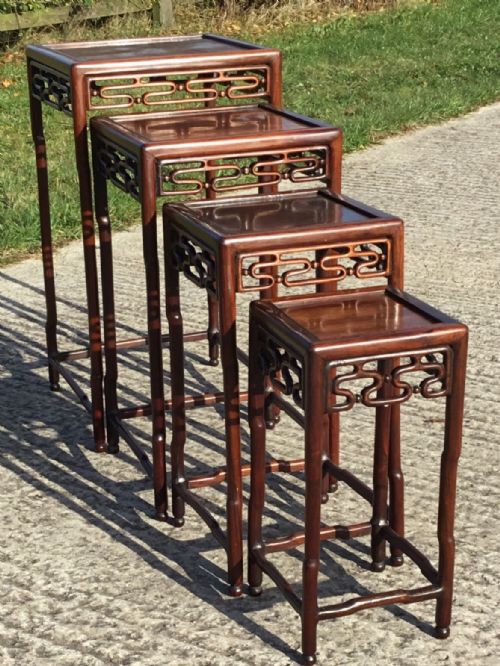
Chinese Carved Rosewood Nest
A Chinese carved rosewood nest delivers functional tiered tables that slide together neatly, offering traditional craftsmanship for modern display.
Chinese Carved Rosewood Nest
A chinese carved rosewood nest consists of graduated tables designed to slide neatly beneath one another to save floor space. Most pieces encountered on this page originate from the nineteenth century or the early decades of the twentieth century, including Edwardian and Qing Dynasty periods.
The standard configuration comprises a set of four tables, though occasional sets of three appear. These items function primarily as side or occasional tables within domestic interiors, presenting traditional Chinese carving across the top surfaces.
Materials and construction methods
Cabinetmakers utilised dense exotic timbers such as rosewood, hongmu, and burrwood to build these sets. The material provides the structural weight necessary for supporting graduated frames without requiring excessive thickness in the legs.
Woodworkers applied intricate carving directly to the hardwood surfaces, following Chinese Export and Qing Dynasty traditions. The construction relies on traditional joinery that allows each table in the set to fit precisely inside the next largest frame.
Listings span the nineteenth century through the 1930s, featuring forms like the quartetto alongside standard sets of three or four tables.
Distinctions in execution and timber
Quality rests upon the crispness of the carved details and the selection of the timber grain. Finer examples display deeply undercut motifs on the friezes and tops, whereas simpler versions show shallower work.
The choice of dense hongmu or figured burrwood panels elevates a set above standard hardwood iterations. Proportion and the smoothness of the sliding action between the graduated tables also indicate superior workshop practice.
The Chinese Carved Rosewood Nest Glossary
- Rosewood
- A heavy, dense tropical timber valued for its rich colour and durability. It forms the primary structural material for traditional carved nests.
- Hongmu
- A traditional Chinese term for dense hardwoods, literally translating to red wood. It encompasses several heavy timber species used in fine antique furniture.
- Graduated
- Describing a set of tables built in decreasing sizes so smaller units slide beneath larger ones. This feature defines the physical arrangement of a nest.
- Quartetto
- A set of four matching occasional tables designed to fit together. The term appears frequently in nineteenth-century British records for nests.
- Burrwood
- Wood taken from a tree growth featuring swirling grain patterns. Cabinetmakers used it for decorative panel inserts on table tops.
Chinese Carved Rosewood Nest: Frequently Asked Questions
How were these tables used?
Historically, owners deployed the individual tables around a room for serving tea or displaying objects. When guests departed, the smaller units slid back beneath the main table.
This space-saving design made them adaptable furniture pieces in both traditional Chinese interiors and later Western homes.
How do I date a rosewood nest?
Dating relies on stylistic markers, timber characteristics, and construction methods associated with periods like the Qing Dynasty or the Victorian era. Nineteenth-century examples often display heavier hardwood frames and distinct carving depths.
Later sets from the early twentieth century may show slight variations in proportion and joinery techniques while retaining traditional motifs.
How do I care for antique rosewood?
Maintain antique rosewood by keeping the furniture away from direct sunlight and sudden temperature shifts. This prevents the dense hardwood from drying out or splitting.
Apply a light application of appropriate furniture wax occasionally to nourish the timber and preserve the natural sheen of the polished surface.