




Hardwood Nest of Four
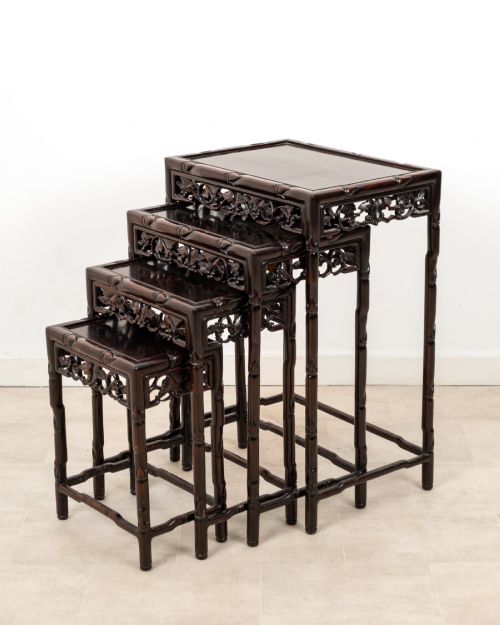
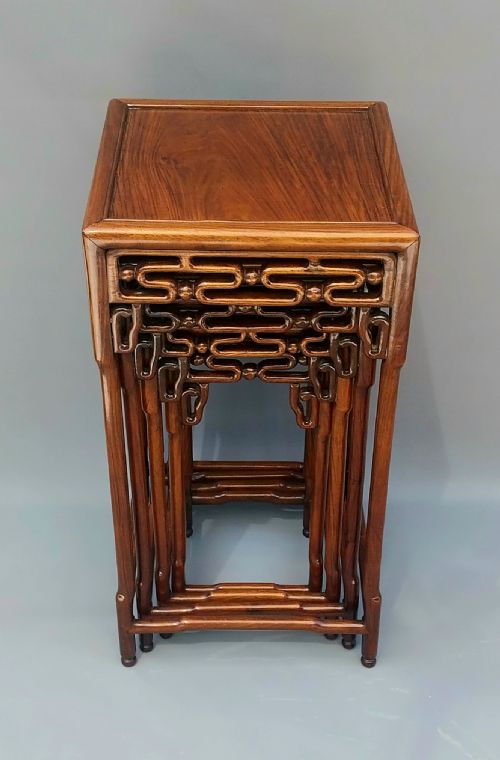
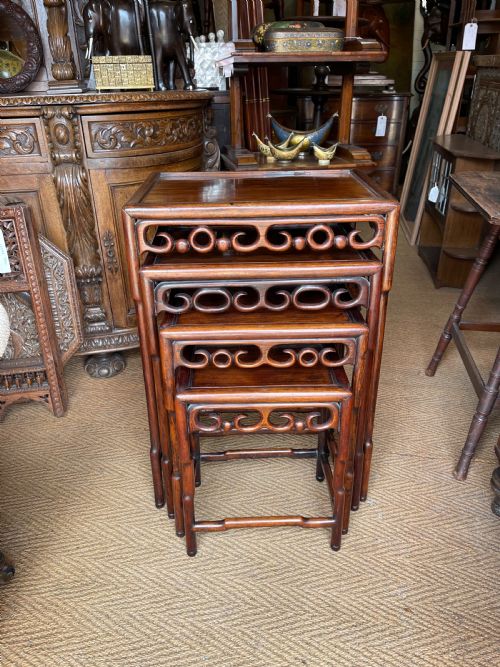
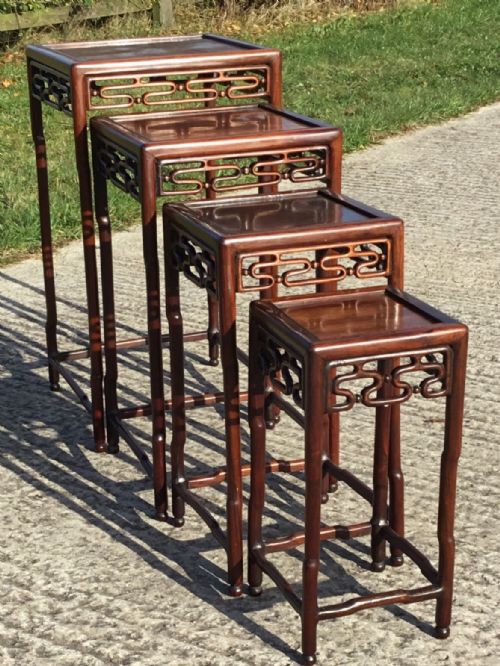
A hardwood nest of four gives you four graduated tables that slide neatly beneath one another, saving floor space while offering multiple surfaces.
Hardwood Nest of Four
When you search for a hardwood nest of four, you find sets of four graduated tables designed to slot together when not in use. These pieces primarily date from the nineteenth century into the early twentieth century, spanning Victorian, Edwardian, and later periods.
Most examples originate from China or reflect Chinese export and Chinoiserie styles, featuring forms such as side tables and occasional tables. The individual tables descend in size so that the smaller ones slide completely under the largest top table.
You encounter variations spanning traditional Qing Dynasty aesthetics alongside later export pieces produced for Western markets. The construction relies on Asian timbers, most notably dense hongmu and rosewood, alongside general hardwood definitions.
What varies in quality
The standard of carving dictates much of the distinction between pieces, ranging from crisp relief work on the top and frieze to plain surfaces. Deeply undercut carving and well-defined motifs require greater skill than shallow, machine-finished detailing.
Timber selection and structural stability also separate examples at different levels. Sets that retain all four original tables with tight joints and unwarped tops demonstrate better initial craftsmanship and careful survival.
Listings feature pieces spanning the nineteenth century, Victorian era, Edwardian period, and early twentieth century up to the nineteen-thirties.
The Hardwood Nest of Four Glossary
- Graduated
- Describing a set of tables where each piece decreases in dimensions so they fit inside one another. This design maximises floor space.
- Hongmu
- A traditional Chinese term for dense hardwoods, often translated as red wood. It encompasses several heavy timber species used in fine furniture.
- Frieze
- The decorative horizontal band situated directly beneath the top surface of a table. Carving often appears on this part.
- Quartetto
- A nineteenth-century term used to describe a set of four small tables designed to nest together. They function as portable tea or occasional tables.
- Chinoiserie
- European artistic styles reflecting Chinese motifs and techniques. These pieces were made in response to Western demand for Asian design.
Hardwood Nest of Four: Frequently Asked Questions
What is a hardwood nest of four?
A hardwood nest of four comprises four tables of descending size built to slide beneath one another. They provide multiple surfaces for drinks or display while occupying the footprint of a single small table.
Most surviving examples date from the nineteenth and early twentieth centuries, often originating from China or following Chinese export traditions in rosewood or hongmu.
How were nesting tables used?
These tables served as versatile occasional furniture in nineteenth-century and Edwardian parlours and drawing rooms. Servants or hosts could pull out the smaller tables individually to serve tea or hold books.
When the gathering ended, the tables stacked back together into a compact single unit against the wall or beside a chair.
How do I date a nest of tables?
Dating relies on timber characteristics, construction methods, and stylistic cues such as Qing Dynasty influence or Edwardian manufacture. Nineteenth-century sets frequently exhibit dense rosewood or hongmu with hand-carved relief details.
Later twentieth-century versions often show simpler construction or different export grading marks. Comparing the wear patterns on the runners helps confirm age.
Are all four tables always present?
Complete sets include all four graduated tables, though individual pieces occasionally went missing over decades of use. Finding a set where every table survives in proportion is typical for well-kept antiques.
Replacement tables within a set often show slight discrepancies in timber grain or carved depth upon close inspection.
How do I care for antique hardwood?
Maintain these tables by keeping them away from direct heat sources and strong sunlight, which dries out dense timbers like rosewood and hongmu. Dust them regularly with a soft, dry cloth.
Avoid silicone-based polishes that build up a film over the carved relief decoration. A traditional wax can be applied sparingly to nourish the wood.