




Chinese Carved Dragon Table
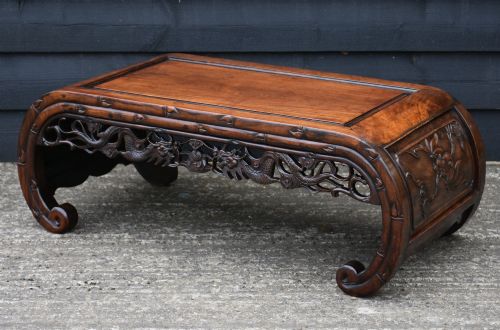
A Chinese carved dragon table brings dynamic relief carving and dense timber into a room, offering both surface utility and dramatic form.
Chinese Carved Dragon Table
When you search for a Chinese carved dragon table, you encounter diverse timber furniture created across the nineteenth and early twentieth centuries, spanning periods from the Victorian and Edwardian eras back to the Qing Dynasty. These pieces range from substantial centre tables and low coffee tables to nests of four tables and small occasional stands, frequently designed for export markets.
Originating largely from export workshops and traditional makers, these tables combine practical surfaces with intricate symbolism. Their forms adapt to Western domestic spaces while retaining distinctly Asian structural motifs.
How They Were Made
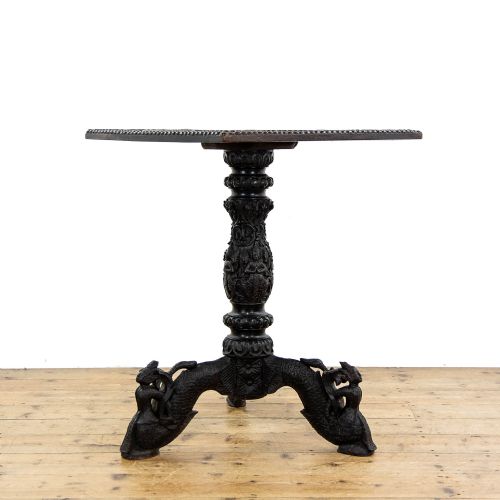
Makers utilised dense timbers such as hardwood, rosewood, teak, and camphorwood to provide a stable foundation capable of supporting heavy, deep-relief carving. These woods were joined using traditional woodworking techniques that allowed the intricate aprons, legs, and dragon details to be integrated securely into the frame.
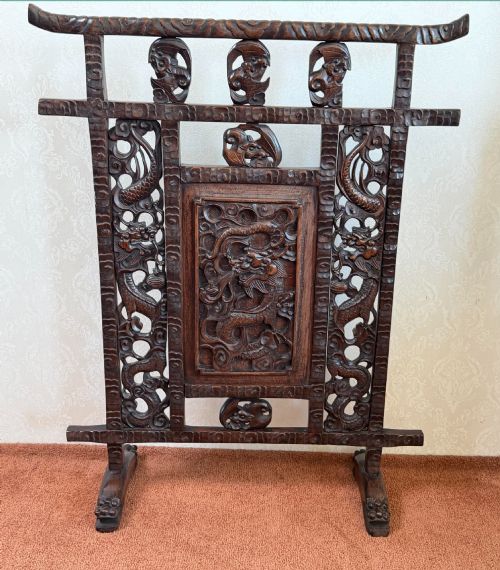
Surface ornamentation relied on hand-carving chisels to sculpt sinuous dragon forms, scales, and cloud bands directly into the timber. Certain examples incorporated contrasting materials, mounting rouge marble inserts into the tops or adding brass elements to complete the composition.
Even the tea ceremony gongs demand respect, brandishing carved stands and brass bells ready to summon order.
What Varies in Quality
The depth and crispness of the hand-carving dictate the visual impact of each piece, distinguishing shallow, mechanical execution from deeply undercut, spirited dragon motifs. Superior examples display meticulous attention to anatomical detail in the claws and scales, whereas simpler pieces show softer, more generalised relief.
Timber selection and structural integrity also separate the range, with dense rosewood and heavy hardwoods commanding greater presence than lighter woods. The integration of inset marble tops and the stability of joints further define the standard of execution.
The Chinese Carved Dragon Table Glossary
- Hardwood
- A dense, durable timber derived from angiosperm trees, utilised extensively in these tables for its ability to hold intricate carved detail without splintering.
- Chinoiserie
- A European artistic style and interpretation reflecting Chinese decorative traditions, often appearing alongside traditional carving methods in export pieces.
- Nest of Tables
- A set of graduated tables designed to fit neatly beneath one another when not in use, frequently recorded in sets of three or four.
- Occasional Table
- A small, versatile stand used for lamps, plants, or display, appearing across Victorian and Edwardian domestic interiors.
- Qing Dynasty
- The final imperial dynasty of China, spanning from the seventeenth to the early twentieth century, whose stylistic vocabulary influences many listed pieces.
Chinese Carved Dragon Table: Frequently Asked Questions
How do I style a Chinese carved dragon table?
You can integrate these tables into contemporary or traditional interiors by using them as accent pieces, lamp stands, or low coffee surfaces where their carved detail stands out.
Their dark timber tones and sculptural relief pair well with simple upholstery and neutral backgrounds, allowing the craftsmanship to remain the focal point.
What woods were used for these tables?
The listings show that makers primarily used dense hardwoods, specifically rosewood, teak, and camphorwood, to construct the frames and surfaces.
These heavy timbers provided the necessary structural strength for deep-relief carving while offering rich natural grain and colour.
Are these tables antique?
The pieces listed span the nineteenth century, the Victorian and Edwardian periods, and the early twentieth century up to the 1930s, establishing them as genuine antiques.
Their age is reflected in the patination of the timber, the hand-carved execution, and the historical periods documented in the inventory.
What is a nest of tables?
A nest of tables consists of a set of graduated pieces designed to stack together compactly, appearing frequently in sets of three or four.
In these listings, they combine practical surface utility with coordinated carved dragon details across all sizes in the set.