




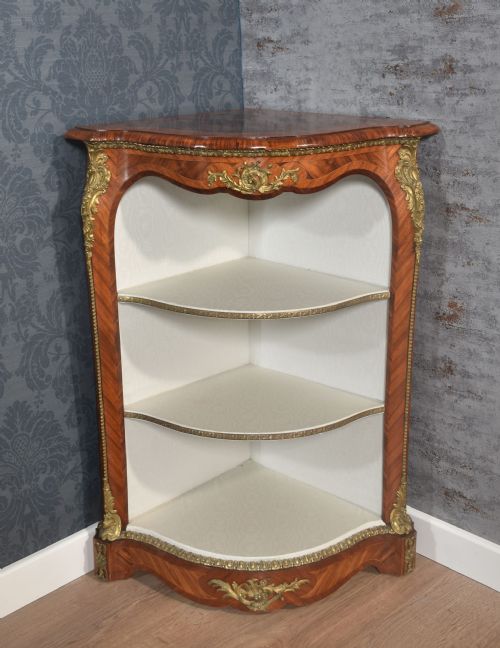


Carved Wooden Corner Shelves
Carved wooden corner shelves turn empty room angles into useful display space using rich timber and traditional joinery.
Carved Wooden Corner Shelves
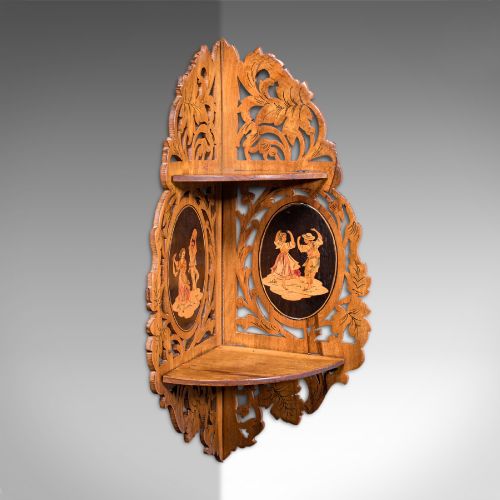
Carved wooden corner shelves utilise neglected room angles to display objects while adding architectural interest to domestic interiors. When searching for carved wooden corner shelves, buyers encounter multi-tiered stands, wall-mounted ledges, and floor-standing whatnots designed to fit snug against perpendicular walls.
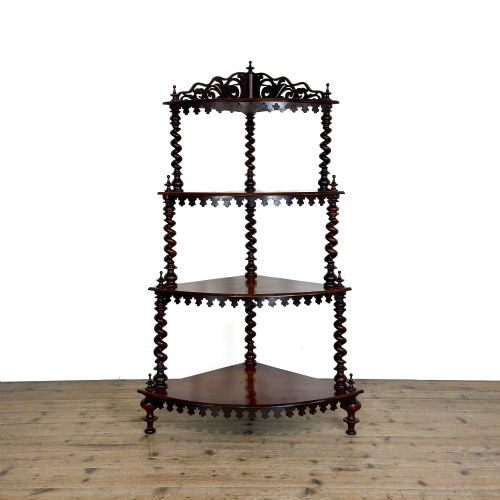
The pieces appearing on this page span the eighteenth, nineteenth, and early twentieth centuries, reflecting diverse aesthetic movements from Georgian proportion to Victorian revivalism. Walnut, mahogany, and burr walnut dominate the selection, frequently enhanced by marquetry, inlay, or turned supports such as barley twist columns.
Forms range from simple open shelving units to glazed corner cupboards and mirrored whatnots with intricate carved details. Origin and influence stretch across British workshops, continental centres like Sorrento, and colonial production using exotic timbers like padouk.
How they were made
Cabinetmakers constructed these shelves using dense hardwoods including mahogany, walnut, and pine, selected for their stability and capacity to hold carved detail. Timber boards were joined with traditional methods, often incorporating bracket supports and wall fixings to bear weight securely in room corners.
Surface decoration involved skilled hand carving, contrasting wood veneers, and marquetry inlay using olive wood and kingwood. Ormolu mounts and brass fixtures added structural reinforcement and decorative contrast, while turned elements like barley twist uprights required precise lathe work.
Carved Wooden Corner Shelves Retail Price Guide 2026
Typical asking prices for carved wooden corner shelves among the pieces listed under this phrase on Sellingantiques today, from the lower quarter to the upper quarter. They describe what is for sale here now, not the wider market.
Recorded forms range from freestanding multi-tiered whatnots and occasional tables to wall-hung corner cabinets and mirrored display units.
What varies in quality
Quality depends upon the selection of timber grain, particularly in burr walnut and figured mahogany surfaces where pattern placement dictates visual depth. The precision of hand carving and the crispness of turned columns separate standard domestic pieces from exhibition standards.
Construction methods reveal the maker's hand through tight jointing, intelligent grain alignment to prevent warping, and the integration of secondary timbers. Finer examples feature sophisticated marquetry, substantial brass or ormolu hardware, and mirrored back panels fitted with bevelled glass.
Liberty & Co.
The Carved Wooden Corner Shelves Glossary
- Whatnot
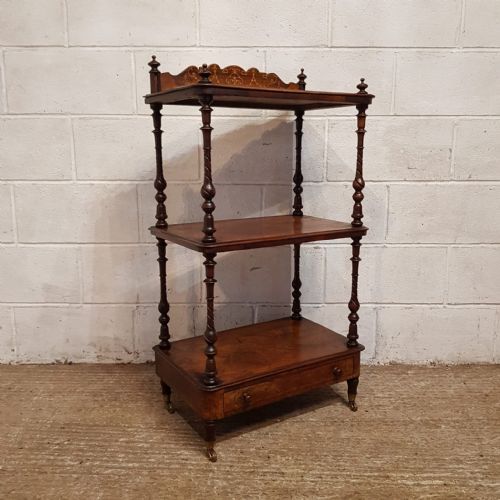
- A multi-tiered piece of freestanding furniture designed for displaying ornaments, books, or small objects. These pieces often feature three or four shelves supported by turned columns.
- Marquetry
- The art of applying decorative pieces of veneer to a structure to form geometric or pictorial designs. Craftsmen use contrasting timbers such as olive wood and walnut to create depth.
- Barley Twist
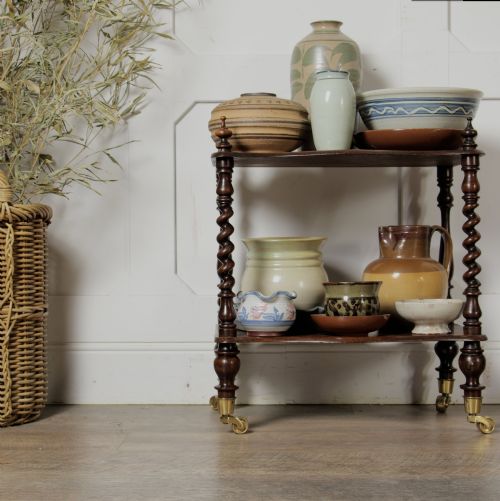
- A turned column detail resembling the spiral shape of barley sugar. This decorative technique appears frequently on upright supports of nineteenth-century stands.
- Ormolu
- Gilded bronze mounts applied to furniture for decorative effect during the eighteenth and nineteenth centuries. These metal elements provide contrast against dark hardwoods like mahogany.
- Burr Walnut
- Timber taken from a tree growth or burl, yielding complex, swirling grain patterns. Cabinetmakers prize this material for high-status veneering on cabinet doors and shelf surfaces.
Carved Wooden Corner Shelves: Frequently Asked Questions
How were corner shelves used historically?
These pieces served practical and decorative functions in period homes, holding porcelain, books, and decorative ornaments in rooms where floor space was limited. Their corner placement maximised utility in smaller parlours and drawing rooms.
Larger variations functioned as whatnots or cabinets, keeping valued possessions visible yet out of the main pathway of daily household movement.
How do I date a wooden corner shelf?
Dating relies on timber choice, construction techniques, and stylistic clues matching prevailing design periods like Victorian revivalism or Georgian proportion. Secondary woods and fastener types inside the structure offer further chronological evidence.
Carving styles and decorative veneers such as burr walnut or marquetry align directly with the manufacturing decade recorded in each listing.
Are these shelves sturdy enough for heavy items?
Most pieces safely support books, ceramics, and ornaments appropriate to their original domestic function. Wall-mounted variants depend heavily upon proper installation and secure fixings into solid masonry or studs.
Freestanding corner whatnots distribute weight across multiple tiered platforms supported by turned columns and corner uprights.
What is the difference between a whatnot and a corner shelf?
A whatnot is typically a freestanding tiered stand with multiple open platforms for display, whereas corner shelves may also include enclosed cabinets or wall-mounted ledges. Both share the specific geometry required to fit room corners.
Whatnots often incorporate mirrors, carved crestings, and substantial turned supports that distinguish them from simpler bracketed wall shelves.