
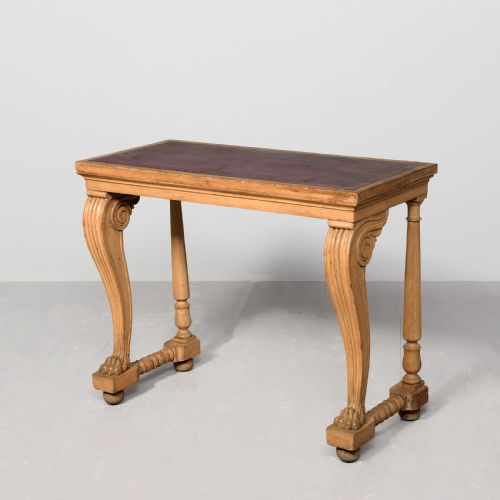
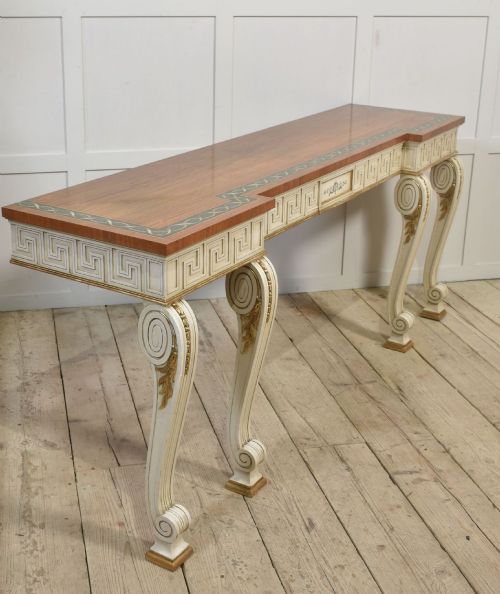
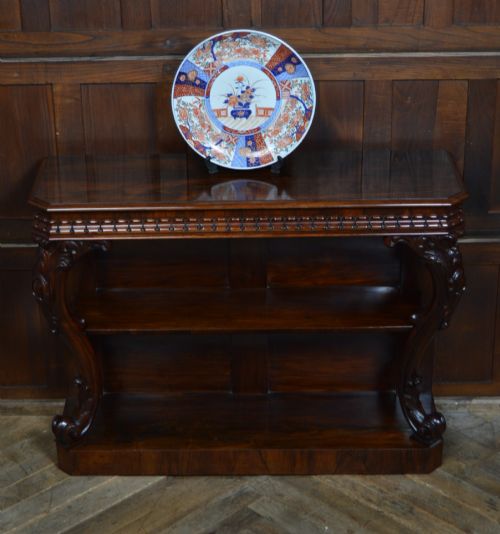
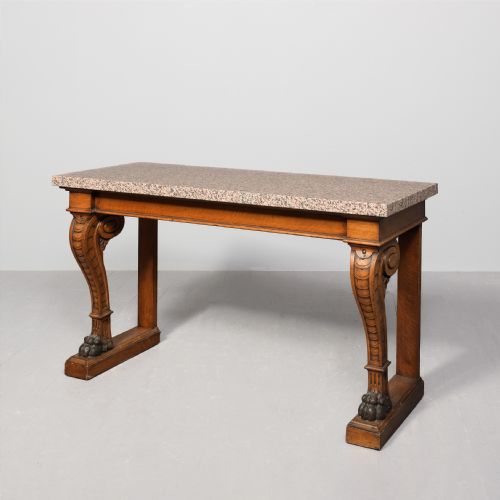

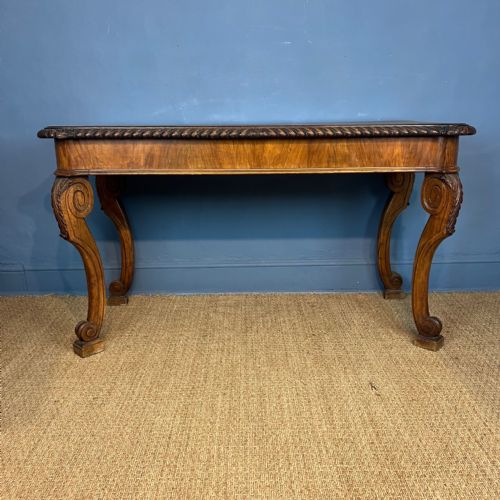


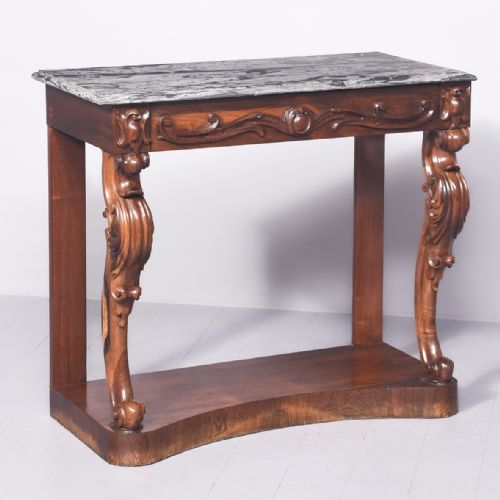
Carved Scroll Leg Console
A carved scroll leg console brings architectural presence to a hallway or drawing room, prized for its dynamic supports and substantial timber.
Carved Scroll Leg Console
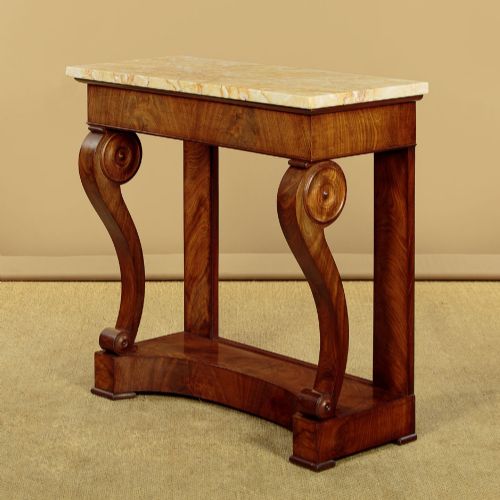
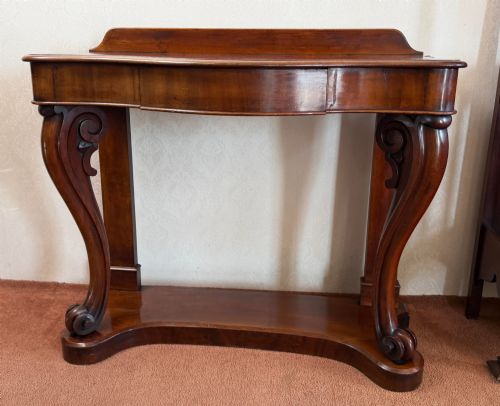
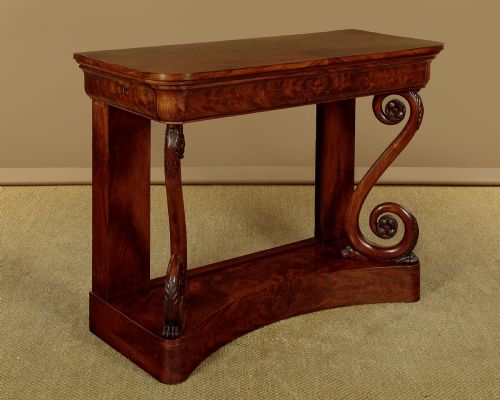
A carved scroll leg console functions primarily as a wall-abutting surface, historically designed to display ornaments or hold lamps in formal rooms. The selection on this page spans the Georgian, Regency, and Victorian periods, alongside later nineteenth-century interpretations.
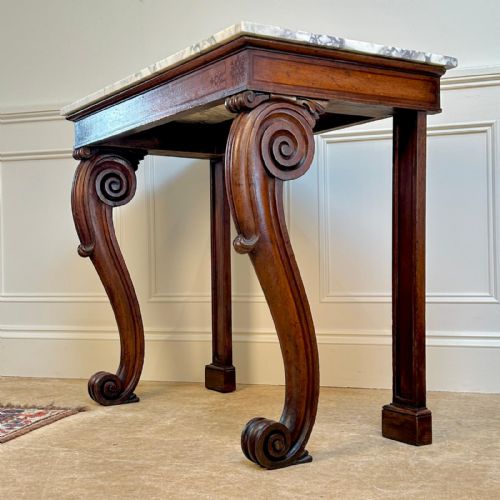
Most examples found here utilise mahogany, rosewood, or oak, often finished with heavy marble, granite, or wooden tops. Alongside standard console tables, buyers will encounter related forms including pier tables, side tables, and altar tables sharing the characteristic scroll leg configuration.
Materials and construction methods
Cabinetmakers constructed these pieces using dense hardwoods such as mahogany, rosewood, and oak, frequently employing decorative veneers like burr walnut to add visual depth to the frieze and supports. Solid timber framing provided the necessary structural rigidity to bear heavy marble and granite tops.
The defining scroll legs were shaped by hand, utilising traditional carving techniques to achieve fluid, sweeping volutes that transition smoothly into plinths or feet. Joinery involved precise mortise and tenon joints, ensuring the table could support substantial weight against a wall without racking.
The listings on this site combine British mahogany and rosewood furniture with occasional Anglo-Indian and Qing Dynasty hardwood forms.
Distinctions in craftsmanship and design
Quality reveals itself in the depth and crispness of the timber carving on the scroll legs, where sharper undercutting and fluent lines denote superior workshop output. Weaker examples exhibit shallower, machine-smoothed details that lack the three-dimensional vigour of better pieces.
The choice and thickness of the top surface further distinguish the tier of a console, with solid slab marbles or finely figured timber veneers elevating the piece above simpler utilitarian builds. Attribution to recorded makers also shifts a table into a different tier of historical interest.
James Mein of Kelso·Robert Strahan·Alexander McKenzie of Glasgow·Gillows·Whytock and Reid
The Carved Scroll Leg Console Glossary
- Console table
- A table designed to stand against a wall, traditionally fixed with brackets or supported by front legs. These tables often feature elaborate decoration to the front apron and legs.
- Pier table
- A low table specifically designed to fit against the wall space between two windows, frequently paired with a matching wall mirror above. They share many structural traits with standard console tables.
- Scroll leg
- A furniture support carved into a spiral or volute shape resembling a rolled parchment. This form provides a visually heavy anchor for neoclassical and Victorian case furniture.
- Altar table
- A rectangular form originating in Asian furniture traditions, featuring raised ends or scroll terminations. These tables serve a display function comparable to Western console tables.
- Serpentine shape
- A front edge or surface configuration curving inward centrally and outward at the ends, or vice versa. This contour adds movement and complexity to the silhouette of a side table.
Carved Scroll Leg Console: Frequently Asked Questions
How do I care for a marble top?
Marble surfaces require regular dusting with a soft cloth and immediate blotting of acidic spills like wine or citrus juice to prevent etching.
Avoid abrasive cleaners or harsh scouring pads, using mild soapy water instead to preserve the polished stone finish.
Are these tables freestanding?
Traditional console tables were designed to abut a wall, sometimes relying on structural brackets for complete stability.
While some nineteenth-century examples are finished as centre tables, buyers should check the back of a piece to confirm if it is fully polished all round.
How can I tell the period?
Dating relies on identifying timber choices, such as Regency rosewood versus Victorian mahogany, and matching carving styles to known decorative movements.
Neoclassical and Victorian flourishes offer clear visual cues when compared against earlier Georgian proportions.