
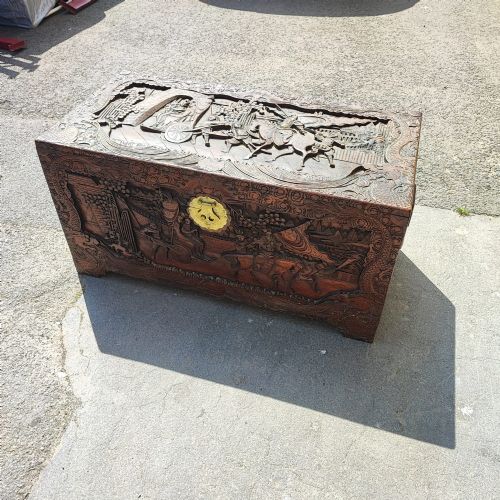


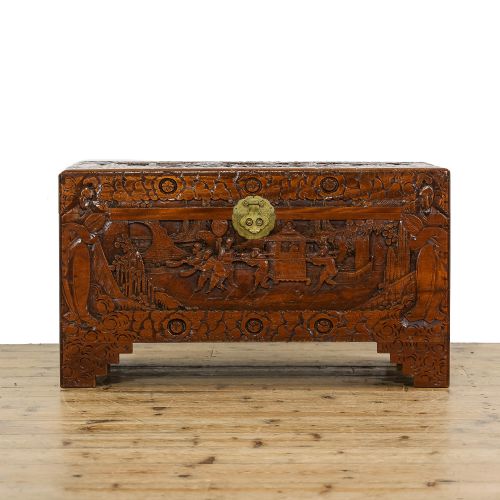


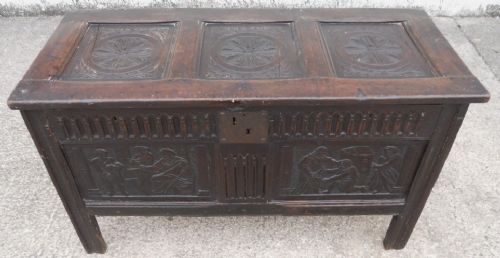
Carved Relief Trunk
A carved relief trunk offers deep utility and rich ornamentation, bringing solid timber and historic carving directly into a room.
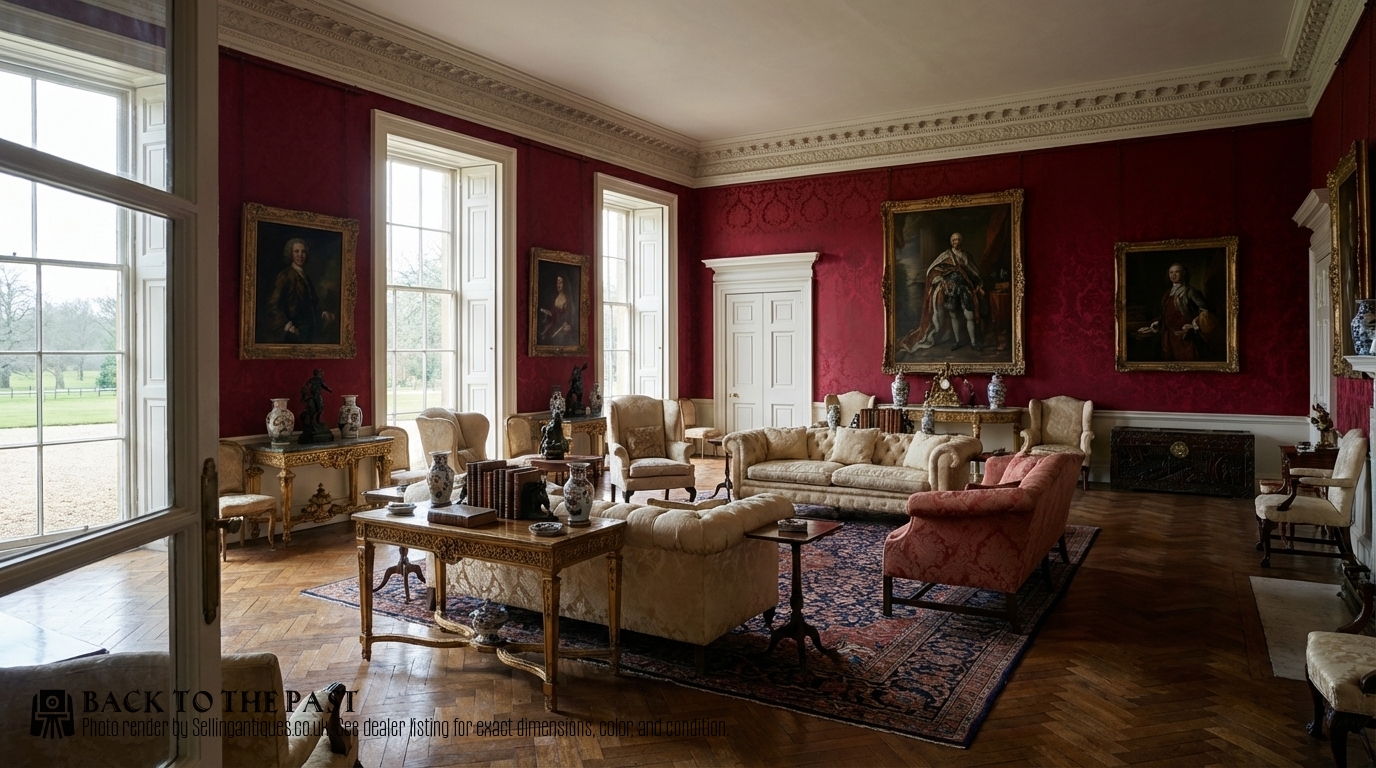
Carved Relief Trunk
A carved relief trunk is a substantial storage piece defined by sculptural surface work, most frequently encountered in camphor wood and hardwood variants dating from the nineteenth and early twentieth centuries. These storage chests, luggage chests, and blanket boxes combine deep internal capacity with elaborate figurative or floral panels raised from the timber surface.
The selection ranges from traditional Chinese export camphor wood boxes to Anglo-Indian teak storage chests and European oak examples featuring biblical scenes. While the core form remains a heavy lidded box designed for linen or travel, regional styles introduce distinct ornamental vocabularies spanning Gothic revival motifs and oriental carving.
How they were made
Construction relies heavily on dense timbers such as camphor wood, teak, and oak, often joined to withstand heavy use and marine travel. Woodworkers utilised solid timber panels carved directly in relief, sinking the background to leave motifs standing proud.
Surface finishes vary from natural waxed hardwoods to applied lacquer and paint, occasionally complemented by brass hardware. The structural framework typically employs robust corner joints and heavy lids designed to protect contents from moisture and insects.
What varies in quality
Quality rests upon the depth and precision of the carved relief work, where crisp undercutting and well-defined figurative details separate master carvers from routine production. The choice of timber also dictates overall merit, with figured camphor wood and dense old-growth teak commanding greater attention than plain utility lumber.
Proportion and structural integrity define the higher tiers of these chests, ensuring that heavy lids align cleanly with the base and that internal compartments remain intact. The sophistication of regional stylistic execution, whether Anglo-Indian or Chinese export, further elevates the piece.
The Carved Relief Trunk Glossary
- Camphor Wood
- An aromatic timber prized for its insect-repellent properties and distinct grain. It forms the primary material for many oriental storage chests.
- Relief
- A sculptural technique where figures or patterns project from a flat background. In these trunks, panels are carved directly into the solid wood.
- Chinese Export
- Goods manufactured in China specifically for Western markets during the nineteenth and early twentieth centuries. These pieces often blend traditional forms with requested colonial aesthetics.
- Anglo-Indian
- A descriptive term for furniture produced in India under British influence, frequently combining British structural forms with native carving traditions.
- Gothic Revival
- An architectural and decorative style drawing inspiration from medieval forms. Pieces display pointed arches, tracery, and heavy ecclesiastical motifs.
Carved Relief Trunk: Frequently Asked Questions
What were carved relief trunks used for?
These trunks served primarily as secure containers for clothing, blankets, and valuable personal possessions during travel or domestic storage. Their dense timber construction helped protect contents from dampness and pests.
In many households, they doubled as blanket boxes at the foot of a bed or functioned as heavy luggage chests for long sea voyages.
How do I care for a camphor wood trunk?
Keep the wood nourished with appropriate natural waxes and avoid placing the chest in direct sunlight or near sudden heat sources. Camphor wood naturally releases aromatic oils that benefit from gentle cleaning.
Maintain stable humidity levels in the room to prevent the solid timber panels from splitting or warping over time.
How can I tell Chinese export trunks apart from Indian ones?
Chinese export trunks frequently utilise camphor wood and feature maritime scenes, dragons, or dense foliage carved in shallow relief. They were tailored for the Western trade.
Indian storage chests, such as Anglo-Indian teak examples, often display deeper, more geometric or architectural carving traditions reflecting local craftsmanship.
How do I date an antique carved trunk?
Dating relies on examining the timber species, hinge types, construction methods, and the specific style of the carved relief panels. Nineteenth-century pieces often show hand-tool marks and traditional joinery.
Comparing the decorative motifs against documented periods, such as Gothic revival or specific export eras, helps narrow down the decade of production.