

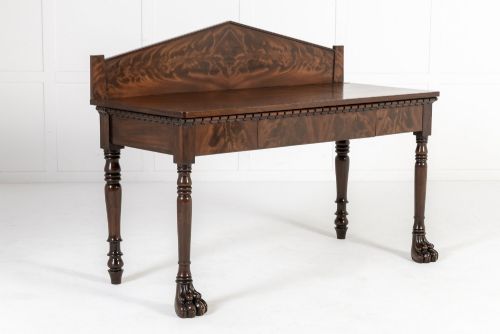


Carved Paw Foot Sideboard
A carved paw foot sideboard brings strong Regency and Victorian presence into a room, offering both bold scale and practical storage.

Carved Paw Foot Sideboard
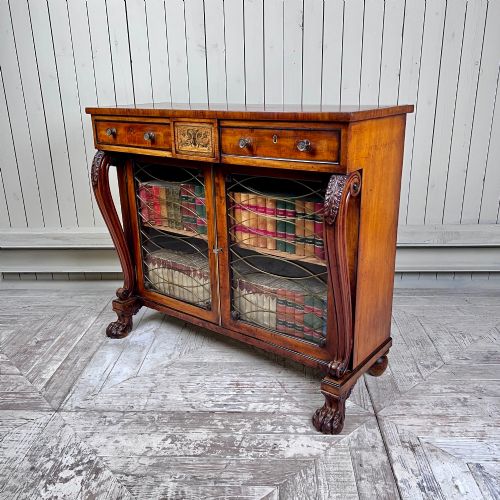
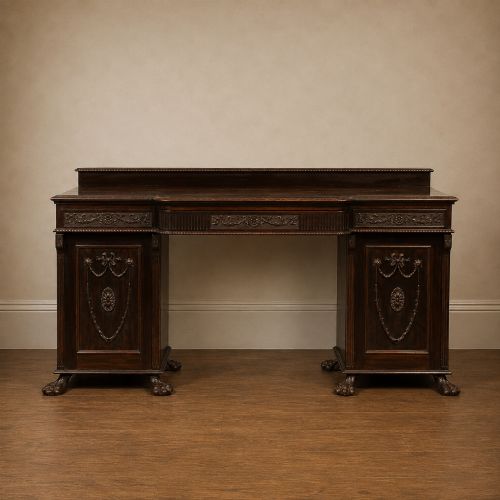
A carved paw foot sideboard encompasses grand serving tables, chiffoniers, and breakfront cabinets dating from the Regency, William IV, Victorian, and Edwardian periods. These large dining room pieces serve as focal points in a traditional interior, combining timber surfaces with sculptural furniture feet.
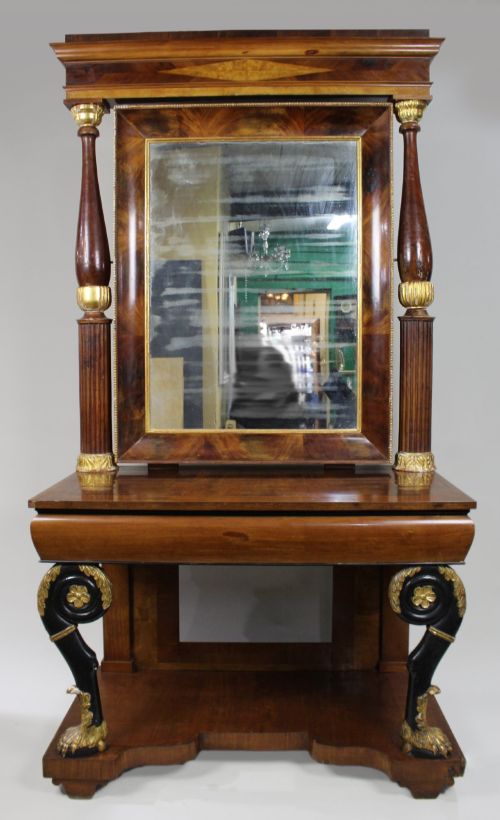
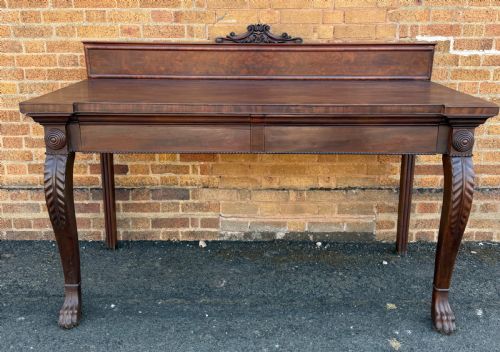
The versions most commonly met on this page belong to the Regency and 19th-century eras, often formed from rich timbers like flame mahogany or rosewood. They range from console tables and metamorphic buffets to imposing serving tables with distinct architectural styling.
How they were made
Cabinet makers utilised solid mahogany and applied flame mahogany veneer over structural carcases, frequently enriching the surfaces with contrasting ebony details and parcel gilt accents. Brass inlay and hardware provide metallic contrast against the dark wood tones.
Carving defines the lower extremities, where skilled hands shaped timber into animalistic support feet. Marble tops and glass panels also appear on specific console and bookcase variants within the selection.
Mahogany is the dominant timber across these listings, accompanied by rosewood, ebony, and brass.
What varies in quality
Quality reveals itself in the depth and sharpness of the timber carving, particularly around the paw feet and structural supports. Bold design and imposing scale separate standard utility furniture from pieces of ambitious architectural conception.
The choice of primary timber and secondary veneers dictates the visual richness of the surface. Figured flame mahogany and precise brass or ebony inlay distinguish the finer workshops from simpler regional production.
Gillow·George Smith
The Carved Paw Foot Sideboard Glossary
- Paw foot
- A carved furniture foot shaped to resemble the paw of a beast, often lion or bear. This detail anchors heavy timber case pieces visually to the floor.
- Chiffonier
- A compact sideboard or low cabinet featuring doors below and often a shelf superstructure above. It evolved during the nineteenth century for dining and drawing rooms.
- Serving table
- A large table designed for dining rooms to hold dishes before service. These items frequently lack the cupboards found in standard sideboards.
- Parcel gilt
- A decorative technique where specific carved or moulded details are partially covered in gold leaf. This creates contrast against a dark wood background.
- Breakfront
- A piece of furniture whose central section projects forward from the flanking wings. This architectural arrangement creates varied depth and shadow across the front.
Carved Paw Foot Sideboard: Frequently Asked Questions
What is a carved paw foot sideboard?
A carved paw foot sideboard is a large nineteenth-century dining room storage or serving piece featuring animalistic feet. These items range from pedestal sideboards to serving tables.
They display the heavy proportions and architectural styling typical of Regency and Victorian design.
How do I date a sideboard?
Dating relies on timber choice, construction methods, and stylistic cues like brass inlay or specific revival motifs. Regency pieces lean toward classical restraint and rich mahogany veneers.
Later Victorian and Edwardian examples often incorporate heavier carving or mixed revival styles.
Where were these pieces used?
These sideboards and serving tables stood primarily in formal dining rooms and grand hallways. They functioned as surfaces for food service or display.
Chiffoniers also saw service in drawing rooms for storing books and tableware.
Are these sideboards made of solid wood?
Most examples combine solid timber framing with fine wood veneers, such as flame mahogany, applied to primary surfaces. Secondary timbers provide internal structural support.
Brass, ebony, and parcel gilt elements add contrasting detail to the main wood structure.