



William IV Serving Table
These William IV serving table pieces bring solid presence and rich mahogany grain to your dining room.

What a William IV Serving Table Is
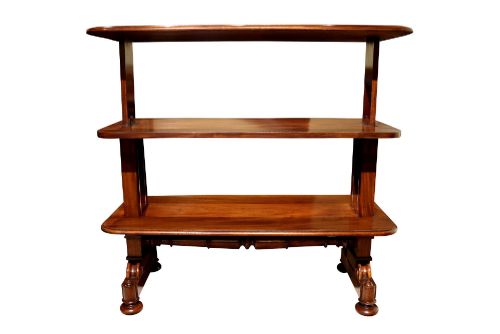
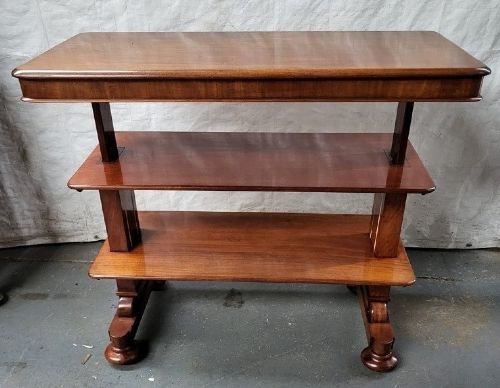
A william iv serving table stands as a substantial piece of dining room furniture from the nineteenth century, designed to hold heavy dishes during large meals. Most examples encountered here date from the nineteenth century and the Victorian era, spanning forms that connect directly to console and hall tables.
The records show these pieces appearing in distinct regional variations, including Scottish and Irish formats alongside standard English models. Makers drew inspiration from the Regency and Irish Regency styles, producing forms that double as sideboards, buffets, and dumb waiters.
Narrow proportions appear frequently among these listings, making them adaptable for modern hallways and dining spaces without losing their architectural weight. You will find them grouped alongside console tables and sideboards, reflecting how fluid nineteenth century room usage truly was.
Materials and Construction
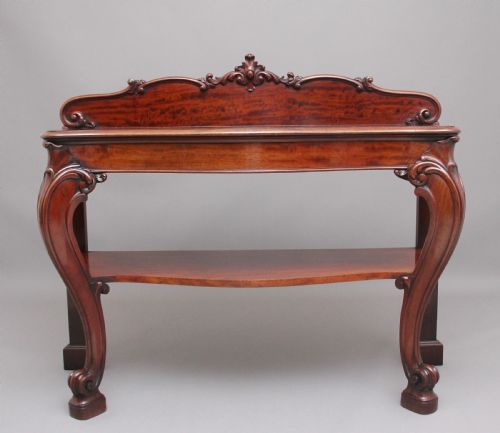
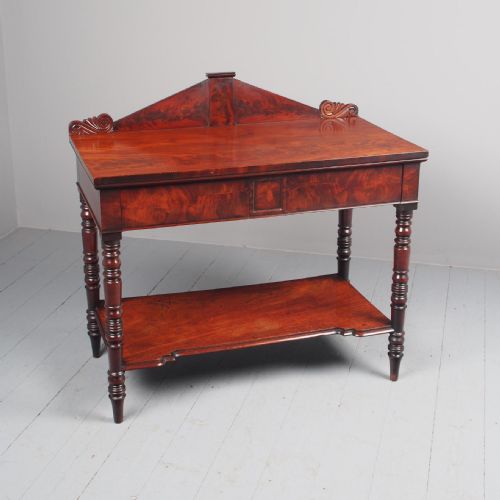
Cabinet makers built these serving tables predominantly using solid mahogany and flame mahogany veneer, chosen for deep figuring and rich surface warmth. Brass hardware and fittings occasionally appear on related pieces such as dumb waiters, adding metallic contrast to the timber.
Carved details define the structural framework, showing disciplined hand work on legs, friezes, and backsplashes. Scottish and Irish workshops applied distinct regional interpretations to these standard construction methods, resulting in robust proportions and bold linear profiles.
Retail Price Guide 2026
Typical UK retail prices for william iv serving table, calculated from the Sellingantiques database of over a million retail prices indexed since 2003. This retail price guide relies exclusively on Sellingantiques data; no external sources or auction records are used, so the figures do not describe the wider market.
The archive reveals regional variations originating from both Scottish and Irish cabinet makers working in the William IV style.
Distinctions in Quality
The grade of timber sets the standard across these pieces, with highly figured flame mahogany veneer commanding greater visual presence than plain stock. Superior examples display careful book-matching on drawer fronts and tabletops, where the grain patterns mirror each other precisely.
Carving execution separates standard production from exceptional work, particularly on scrolled consoles and heavy pedestals. Workshops operating in Dublin, London, and Scotland achieved varying degrees of crispness in their ornamental foliage and structural mouldings.
Gillows of Lancaster and London·James Mein of Kelso·William and Gibton of Dublin·John Henry and Charles Lias
The William IV Serving Table Glossary
- Flame mahogany
- A veneer cut from the fork of the mahogany tree where branches meet the trunk, creating a fiery, undulating grain pattern. This highly decorative surface was favoured by nineteenth-century cabinet makers for prominent table tops.
- Console table
- A table designed to stand against a wall, frequently supported by ornamental brackets or scroll legs rather than four independent vertical posts. Many serving tables share this architectural format.
- Dumb waiter
- A tiered serving piece fitted with revolving or fixed circular trays used for holding food and tableware without servant assistance. These items appear within the same nineteenth-century dining room tradition.
- Regency style
- An English design aesthetic spanning the early nineteenth century, characterised by classical restraint, heavy timber framing, and Greek or Roman motifs. The subsequent William IV period evolved directly from these neoclassical roots.
- Veneer
- A thin layer of superior timber applied over a secondary wood base to provide a decorative exterior surface. Flame mahogany veneer represents the primary decorative skin seen on these tables.
Frequently Asked Questions
How do I use a serving table today?
These tables function well as sideboards in dining rooms or as statement console tables in wide hallways. Their narrow proportions allow them to sit flush against walls without obstructing walkways.
Surface space accommodates lamps, decorative objects, or serving dishes during gatherings. They offer practical utility while retaining historic character.
How do I distinguish a Scottish serving table?
Scottish examples often display particularly heavy timber scantlings and robust architectural detailing. Regional workshops favoured bold mahogany grain and unfussy structural mass.
Comparing the base moulding and leg assembly reveals these distinct regional preferences. Scottish pieces carry a heavier, grounded presence compared to lighter London models.
What is the difference between a console and a serving table?
Console tables traditionally require wall attachment for complete stability, whereas serving tables are fully freestanding pieces. In nineteenth-century furniture records, makers often used these terms interchangeably.
Both forms share the characteristic flat top and frontal display orientation. Their actual function in a dining room remains identical regardless of the original catalogue label.
How do I care for nineteenth-century mahogany?
Maintain the timber by applying natural beeswax polish sparingly and buffing with a soft cloth. Avoid placing tables near direct heat sources or strong sunlight to prevent veneer splitting.
Use coasters and felt pads beneath objects placed on the surface to protect the polish. Regular dusting preserves the warm tone of the flame mahogany grain.