


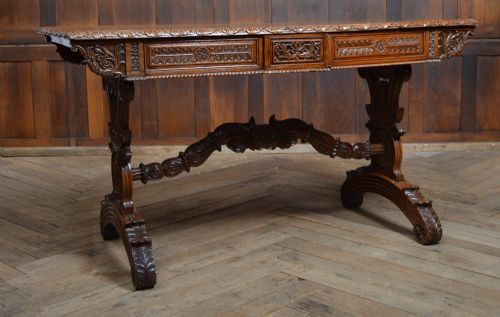
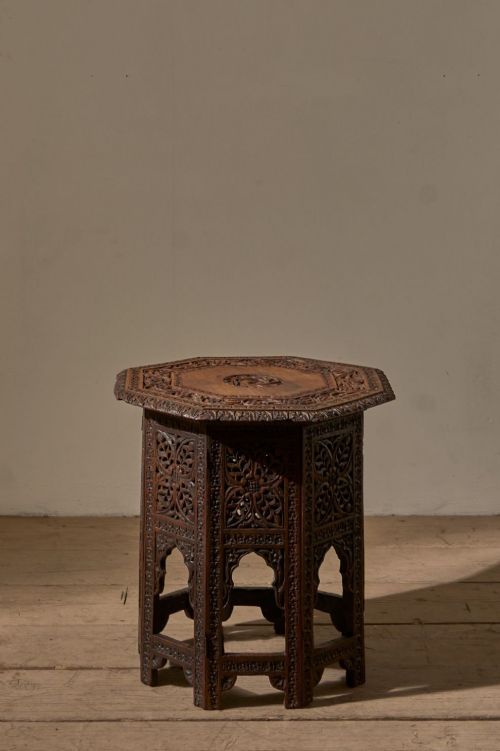
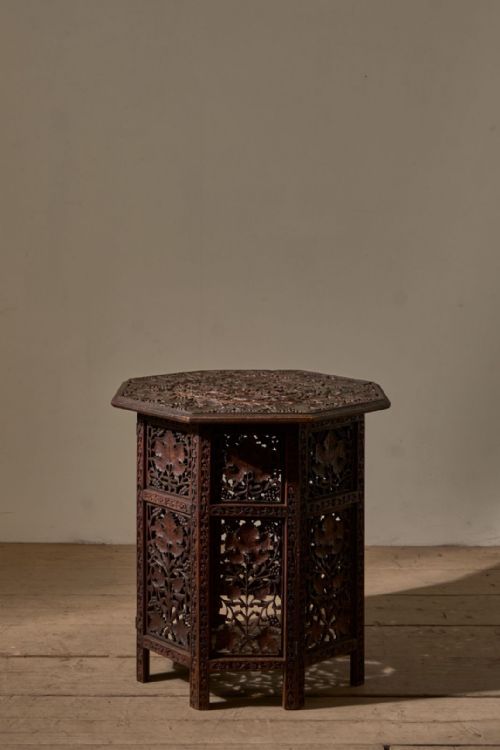


Carved Padauk Table
A carved padauk table brings dense tropical timber and deep hand-chiseled relief straight into a room, offering both sturdy utility and striking regional design.
Carved Padauk Table
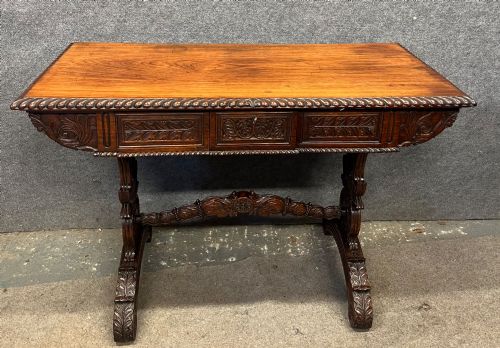
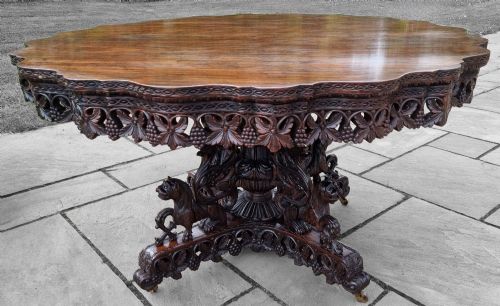
A carved padauk table represents the intersection of British colonial enterprise and local craftsmanship, seen across the nineteenth century in forms such as centre tables, side tables, and desks. These pieces originate from Anglo-Indian, Anglo-Burmese, and Chinese Export workshops, reflecting distinct regional tastes within the British Empire.
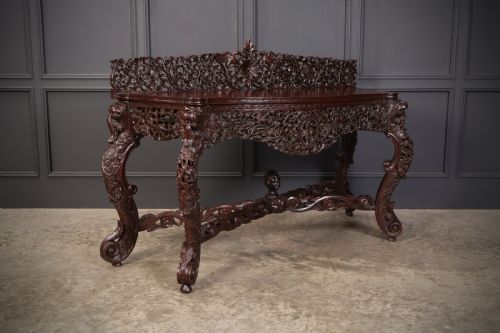
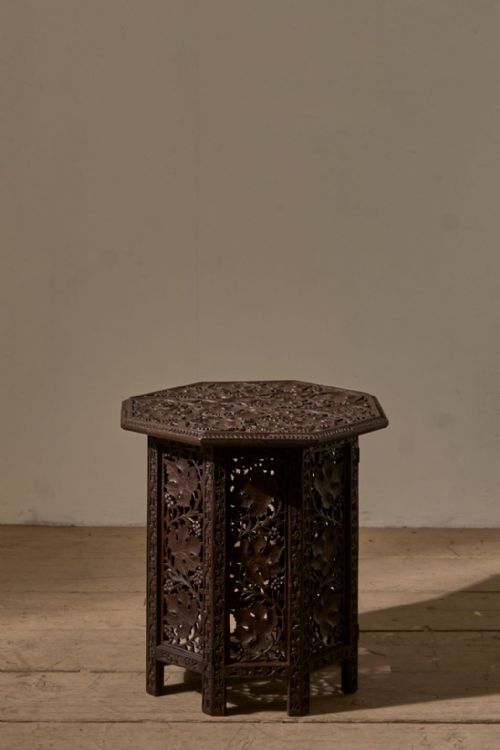
The most common formats on this page are side tables and centre tables, frequently featuring circular tops, pedestal bases, or folding mechanisms designed for colonial transport. Alongside tables, related forms like console tables, occasional tables, library tables, and sideboards appear in padauk wood.
Makers utilised heavy tropical hardwoods to execute intricate relief carvings depicting foliage, dragons, and geometric motifs. These works span the Victorian era, with specific dates clustering around the decades from eighteen-forty to eighteen-ninety.
How they were made
Construction relies heavily on dense padauk wood, supplemented occasionally by teak, brass hardware, marble inserts, and bone inlay. Padauk provides a stable, heavy substrate that resists splitting while taking a crisp edge from carving tools.
Artisans applied deep relief carving directly into the solid timber, often covering every visible surface with dense scrollwork, leaves, or mythological figures. Bases were constructed as fixed pedestals or clever collapsible frames to facilitate long-distance maritime shipping.
Carved Padauk Table Retail Price Guide 2026
Typical asking prices for carved padauk table among the pieces listed under this phrase on Sellingantiques today, from the lower quarter to the upper quarter. They describe what is for sale here now, not the wider market.
Listings feature items dated across the nineteenth century, with specific occurrences recorded in eighteen-forty, eighteen-fifty, eighteen-sixty, eighteen-seventy, eighteen-eighty, and eighteen-ninety.
What varies in quality
Depth and sharpness of the chisel work separate ordinary items from superior examples, with finer pieces displaying crisp undercut foliage and well-defined animal or floral motifs rather than shallow stamping. The architectural balance of the base, whether a carved pedestal or a complex leg assembly, dictates the visual success of the piece.
Selection of the padauk timber itself matters, as richly figured reddish-brown heartwood with a uniform grain creates a more harmonious surface than dull or patched boards. The integration of secondary materials like marble tops or bone inlay adds complexity to the construction.
The Carved Padauk Table Glossary
- Padauk
- A dense tropical hardwood known for its deep reddish-brown colour and exceptional durability in furniture making. It darkens gracefully upon exposure to light.
- Anglo-Indian
- A style of furniture produced in India during the British colonial period, combining European forms with traditional local carving techniques. These items often feature dense botanical motifs.
- Centre table
- A freestanding table finished on all sides, historically placed in the middle of a room to display decorative objects or serve as a focal point. They frequently feature elaborate pedestal bases.
- Console table
- A table designed to stand against a wall, sometimes supported by wall brackets or heavy carved legs. In colonial contexts, these pieces showcase extensive surface carving.
- Partners desk
- A large double-sided desk built with drawers and cupboards facing both directions, allowing two people to work opposite one another. Surviving examples in padauk are substantial pieces of library furniture.
Carved Padauk Table: Frequently Asked Questions
How do I identify Anglo-Indian furniture?
Anglo-Indian furniture is identified by European furniture forms executed with traditional non-Western carving techniques. Look for dense, continuous relief work depicting local flora, fauna, or mythical figures like dragons.
The timber is almost exclusively tropical hardwood such as padauk or teak, often exhibiting a deep reddish-brown hue. Construction methods generally adhere to British cabinet-making standards of the nineteenth century.
Were these tables made for export?
Many of these tables were produced specifically for the export market and British officers serving abroad. Workshops in India and Burma adapted local craftsmanship to suit European domestic fashions.
Some pieces, such as collapsible occasional tables, were engineered for ease of transport during colonial travel. Others remained stationary as grand centre tables for colonial bungalows or British estates.
How do I care for padauk wood?
Padauk wood requires minimal maintenance due to its natural oils and exceptional density. Keep the surface clean with a soft, dry cloth and avoid harsh chemical cleaners.
Protect the timber from direct sunlight and extreme humidity fluctuations to prevent drying or fading. Occasional application of a suitable wax helps maintain the natural lustre of the reddish-brown grain.