



Carved Gilt Ottoman
These carved gilt ottoman options bring formal seating and footrests to a room, valued for their ornate woodwork and gilded finishes.
Carved Gilt Ottoman
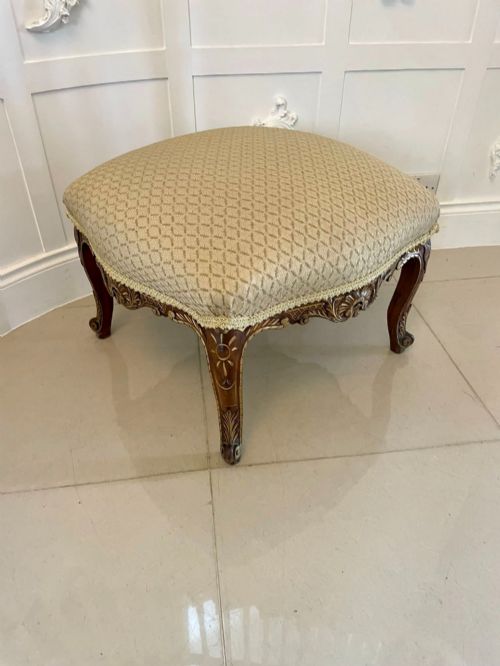
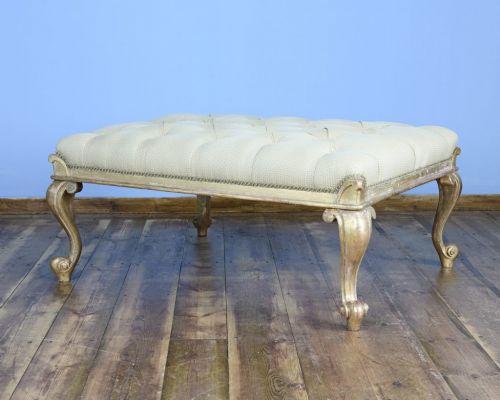
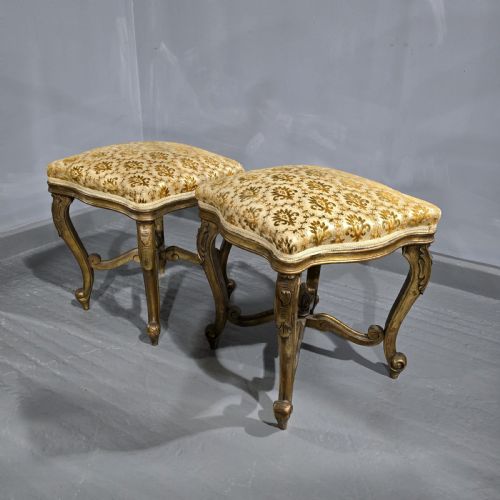
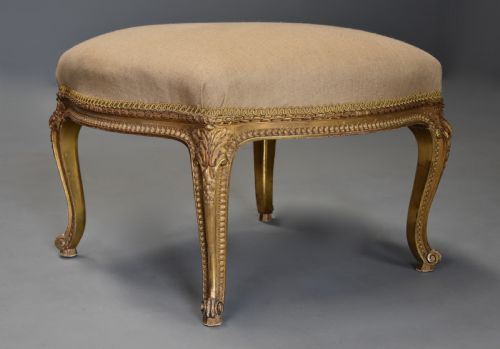
A carved gilt ottoman serves as a versatile seat or footrest within traditional interiors, taking forms such as stools, window seats, and benches. Buyers seeking a carved gilt ottoman often encounter pieces spanning the nineteenth century, including Georgian examples and later revivals.
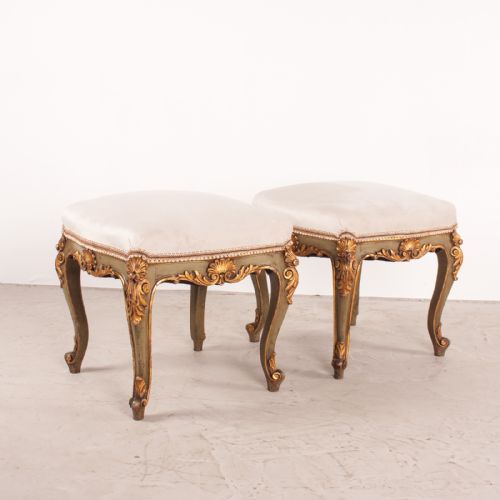
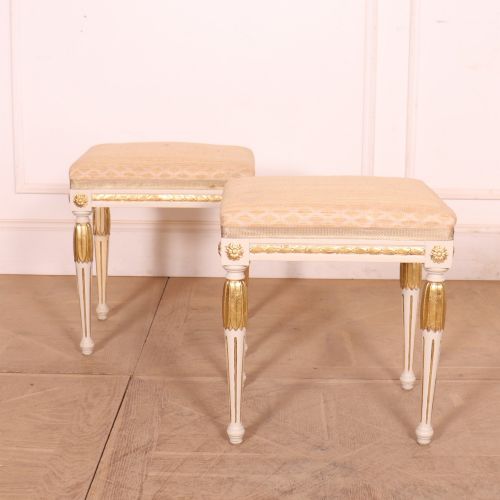
The selection ranges from compact footstools to grand scale centre pieces, often designed with upholstered tops in fabric or textile. French styles dominate the offerings, alongside Swedish painted designs and Italian neo-classical forms.
Makers and workshops across Europe produced these seating items using carved wood frames finished with gold leaf, paint, or gesso. These pieces function equally well as standalone decorative items or as functional footrests before larger armchairs and sofas.
How they were made
Craftsmen utilised solid timbers including walnut and general wood substrates to build the structural frames of each stool and bench. These wooden foundations received intricate hand-carved details, reflecting the prevailing design vocabulary of the period.
Surfaces were prepared for gilding using gesso layers before the application of gold leaf or paint to achieve the characteristic metallic sheen. Upholstery completed the construction, securing fabrics and textiles over the padded upper sections.
Listings feature eighteenth-century Georgian origins alongside nineteenth-century French Neoclassical, Gustavian, and Victorian revivals.
What varies in quality
The refinement of the hand carving on the wooden frame separates standard production from exceptional examples, with deeper undercut details and crisper motifs showing superior workshop execution. The application of gold leaf or parcel gilt finishes demonstrates the skill of the gilder, where smooth burnishing contrasts with matte decorative areas.
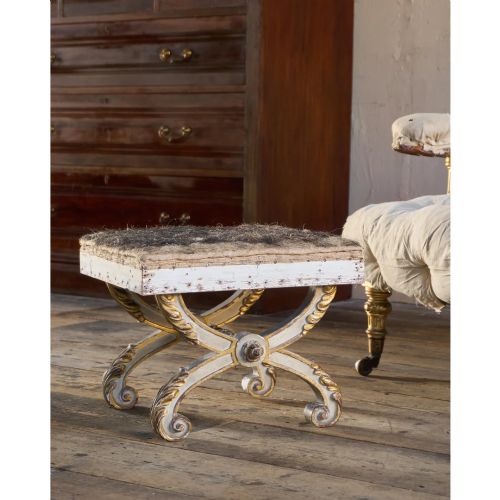
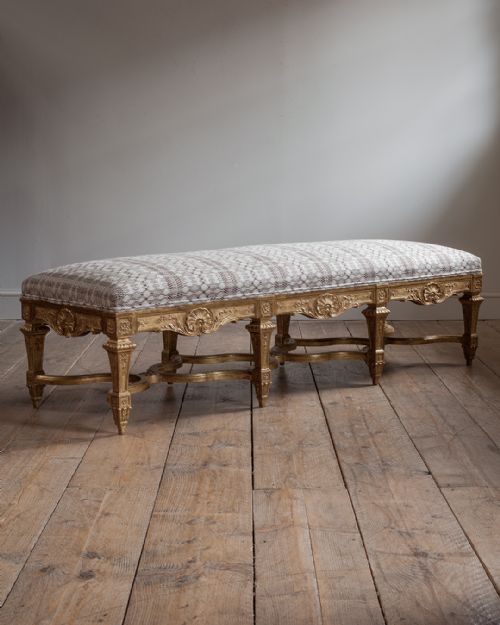
Structural integrity depends on the joinery within the frame, particularly on curule X-frames and window seats that endure regular weight bearing. Furthermore, the quality of the timber beneath the gilding, such as solid walnut, dictates the baseline durability of the piece.
Miles and Edwards·Loidrault Freres Paris·A.M.E. Fournier
The Carved Gilt Ottoman Glossary
- Giltwood
- Wood that has been coated with gold leaf or gold dust for decorative effect. This finish defines the primary visual characteristic of these gilded seats.
- Curule stool
- An ancient Roman magistrate chair shape featuring intersecting X-shaped legs. This form appears frequently in nineteenth-century neoclassical and revival pieces.
- Parcel gilt
- A decorative technique where only specific portions of an object receive gilding while the rest remains painted or shows natural wood. This method highlights particular carved details on the frame.
- Gesso
- A plaster mixture applied to wood surfaces as a smooth base for gilding or painting. It allows intricate relief work to be carved before applying gold leaf.
- Louis XV style
- A French design period characterised by asymmetrical curves, scrollwork, and natural motifs like leaves and flowers. Many nineteenth-century stools adopt this ornate aesthetic.
Carved Gilt Ottoman: Frequently Asked Questions
Where should I place a carved gilt ottoman?
These pieces fit well at the foot of a bed, beneath a window, or beside a primary seating group as an accessible footrest.
Their decorative gilt frames allow them to function as sculptural elements when not in active use as extra seats.
How do I clean a gilded wood frame?
Dust the carved surfaces gently with a soft, dry cloth to prevent accumulation in the recesses of the relief work.
Avoid liquid cleaners and polishes, which can strip or damage historical gold leaf and gesso layers over time.
What is the difference between a stool and a window seat?
Stools generally provide compact, four-legged or X-frame support designed for versatility in the centre of a room or before a chair.
Window seats typically feature an elongated bench form, occasionally incorporating armrests tailored for placement beneath architectural windows.
How can I identify a nineteenth-century French piece?
Look for characteristic revival styles such as Louis XV or Louis XIV, coupled with traditional joinery methods and patinated giltwood finishes.
Some pieces may carry maker stamps or workshop attribution marks on the wooden frame underneath.