
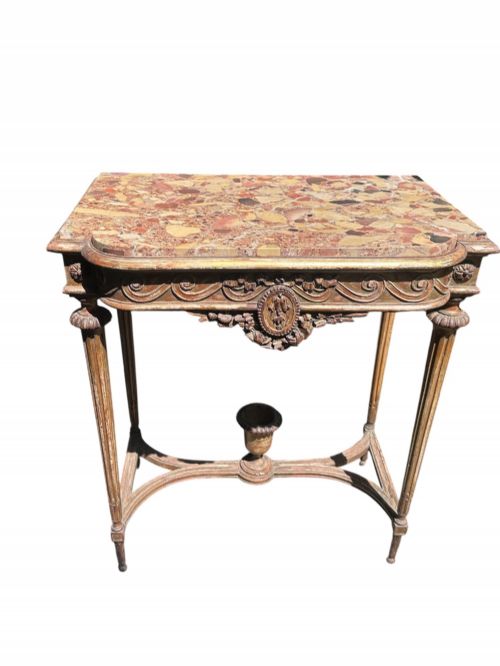


Carved Gilt Occasional Table
A carved gilt occasional table brings nineteenth-century French and English decorative elegance into a room.
Carved Gilt Occasional Table
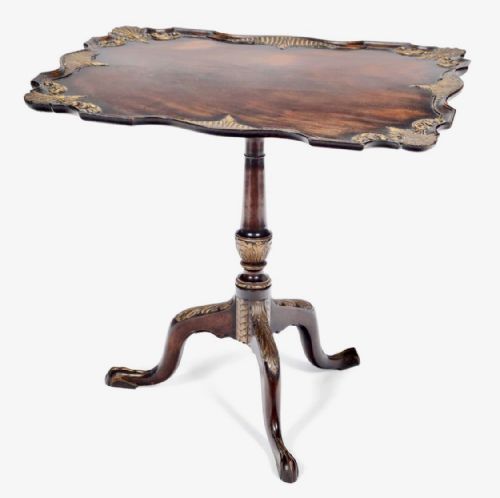
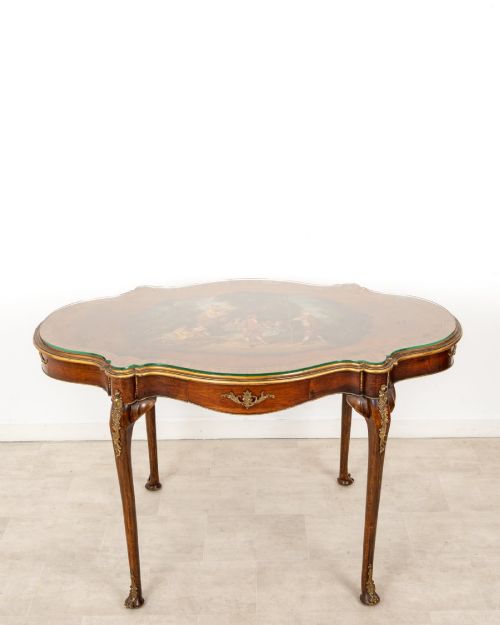
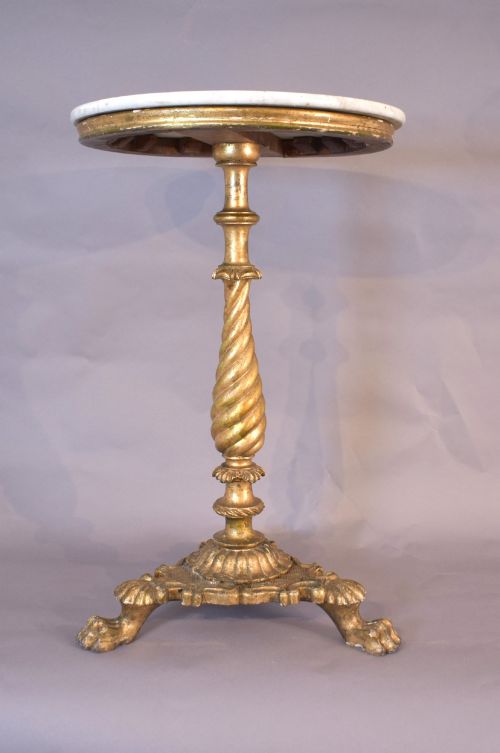
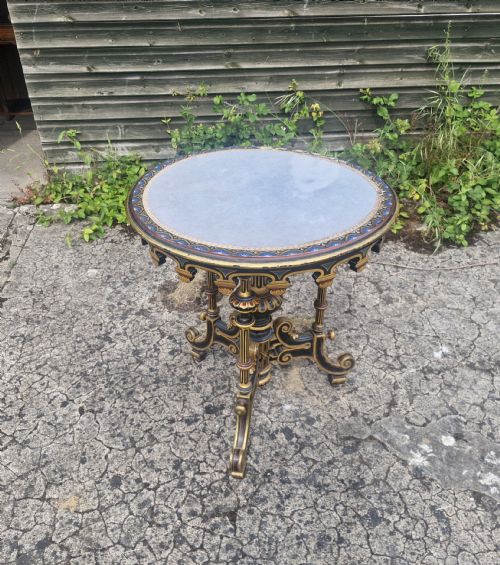
A carved gilt occasional table serves as a decorative surface for lamps, urns, or display in a reception room. When you search for a carved gilt occasional table, you encounter pieces primarily from the nineteenth century, alongside Edwardian and later interpretations.
The form appears as side tables, centre tables, coffee tables, urn stands, and tripod tables. French styles, particularly Louis XV and Louis XVI revivals, dominate the selection alongside Victorian and Italian painted variations.
Makers and workshops across Europe produced these tables using giltwood, painted wood, and mahogany, often pairing them with inset marble tops or ormolu mounts. The smaller tripod and lamp stands sit alongside larger centre tables intended for the middle of a room.
How they were made
Cabinetmakers shaped the frames from hardwoods such as mahogany and walnut, or softer woods prepared for gilding. Carvers applied gesso to the wooden foundation before laying gold or parcel gilt leaf across the ornate scrolls and fluted legs.
Surface decoration frequently involved paint, Vernis Martin lacquer, or ebonisation to contrast with the metallic gilding. Heavy marble slabs, sometimes inset into the wooden frame, provided durable tops for lamp and centre tables.
Mounts in ormolu or gilt bronze were cast and chased separately before attachment to corners, aprons, and legs, adding architectural definition to French revival designs.
Listings feature periods spanning from the Victorian era and the 1880s through to the 1930s, alongside nineteenth-century pieces.
What varies in quality
The depth and crispness of the hand-carving separate ordinary production from superior examples. Sharp leaf motifs, clean fluting, and undercut scrolls indicate a skilled carver rather than a hurried workshop output.
The application of the gilt layer dictates longevity and visual warmth, with genuine gold leaf ageing differently from modern metallic paints. Furthermore, the selection of heavy, finely veined marble tops elevates the substance of a table above those with plain timber or painted substitutes.
Henry Dasson·Whytock and Reid
The Carved Gilt Occasional Table Glossary
- Giltwood
- Wood coated with gold leaf or metallic powder applied over a prepared gesso ground. This finish provides the characteristic metallic gleam seen on revival furniture frames.
- Tripod table
- A small freestanding table supported by three pillar legs radiating from a central column or stem. Many examples feature tilt-top mechanisms for storage.
- Vernis Martin
- A type of simulated Japanese lacquer developed in eighteenth-century France and emulated later. It uses layers of translucent varnish over painted decoration.
- Gueridon
- A small French table, often round and supported by a single central pedestal or columns. These pieces function as accent tables or plant stands.
Carved Gilt Occasional Table: Frequently Asked Questions
Where should I place an occasional table?
These tables suit corners, beside seating, or in the centre of a room depending on their specific form. Tripod and urn stands occupy minimal floor space while holding lamps or decorative objects.
Larger centre tables require open floor space to allow movement around all sides. Their decorated aprons and carved legs demand visibility rather than being pushed flush against a wall.
How do I care for a giltwood surface?
Giltwood requires gentle dusting with a soft, dry brush to prevent the delicate gold leaf from lifting or scratching. Avoid moisture, chemical polishes, and abrasive cloths entirely.
Position the table away from direct sunlight and heat sources to prevent the underlying gesso and wood from drying and cracking.
What is the difference between a side table and a centre table?
Side tables typically feature a finished front and back, designed to stand against a wall or in an alcove. They often support lamps or smaller decorative items.
Centre tables are finished on all four sides because they stood in the middle of a room. They frequently feature detailed carving and ornamentation visible from any angle.
How do I identify a French revival table?
French revival pieces incorporate design elements from the reigns of Louis XV and Louis XVI, such as cabriole legs, asymmetrical rococo scrolls, or neoclassical fluting. Makers during the nineteenth century revived these aesthetics for fashionable interiors.
Materials such as ormolu mounts, Vernis Martin finishes, and inset marble tops further signal French influence.