
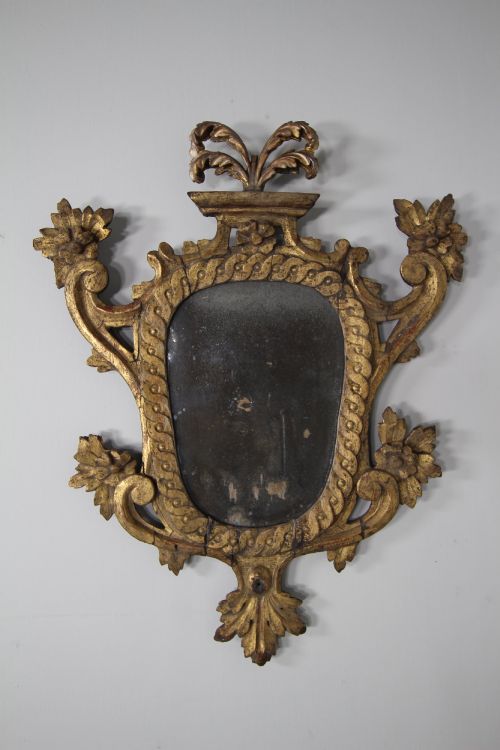
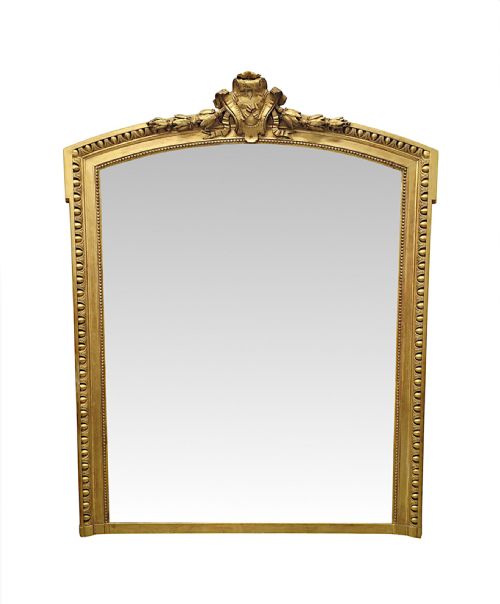


Carved Cartouche Mirror
A carved cartouche mirror brings sculptural asymmetry and grand French or Italian flair to a room, driven by ornate scrolling frames.
Carved Cartouche Mirror
A carved cartouche mirror centres around a prominent, shield-like or scroll-bordered ornamental plaque, often forming the crest or focal point of the frame. These wall-hanging looking glasses draw heavily from Italian Rococo, French Rococo, and Baroque Revival vocabularies, presenting dynamic, flowing outlines rather than strict symmetry.
You will most frequently encounter 19th-century interpretations on this page, alongside earlier 18th-century Italian examples and occasional Edwardian or 1920 pieces. Formats range from large overmantel and hall mirrors to compact vanity and wall-hanging variations executed in distinct revival styles.
Many pieces display specific regional influences, spanning French chateau aesthetics and Italian Rococo craftsmanship. Alongside standard wall mirrors, the form occasionally appears integrated into larger cabinet work, such as mirrored armoire wardrobes featuring carved cartouche crests.
How they were made
Makers shaped these frames primarily from carved wood, gesso, and giltwood, applying layers of gold leaf over prepared surfaces to achieve a luminous metallic finish. Craftsmen utilised walnut for alternative timber iterations, particularly when executing designs shaped in the form of a heraldic shield.
The glazing relies upon traditional mirror glass, frequently presenting historical characteristics such as foxed plates with natural ageing spots. Artisans combined deep relief carving with delicate gesso mouldings to build up the complex, asymmetrical scrolls typical of rococo ornamentation.
Listings span the 18th century through the Edwardian period, uniting giltwood, gesso, walnut, and mirror glass in varied revival styles.
What varies in quality
The sophistication of the carving dictates much of the distinction, separating fluid, deeply undercut foliage and scrolls from stiffer, shallower mouldings. Superior examples demonstrate crisp definition in the gesso and balanced proportions within the central cartouche crest.
The preservation of original gilding and the character of the mirror plate significantly influence the piece. Untouched gold leaf surfaces and period plates with authentic foxing hold greater visual depth than later re-gilding or modern replacement glass.
The Carved Cartouche Mirror Glossary
- Cartouche
- An ornamental tablet or panel resembling a rolled-up piece of paper or a shield, often bearing carved decoration. In these mirrors, it forms the distinctive central crest.
- Giltwood
- Timber coated with gold leaf or gold paint applied over a prepared gesso base. This technique creates a rich, reflective surface characteristic of formal period frames.
- Gesso
- A plaster-like mixture applied to wood frames to provide a smooth base for carving and gilding. It allows craftsmen to model intricate fine details before applying leaf.
- Foxed plate
- Mirror glass displaying dark spots and blemishes caused by the degradation of the backing over time. Collectors prize genuine foxing as an indicator of age.
- Overmantel
- A large mirror designed to hang directly above a fireplace mantelpiece. These pieces often feature extended horizontal proportions or prominent crests.
Carved Cartouche Mirror: Frequently Asked Questions
Where should I hang a cartouche mirror?
These pieces excel above a mantelpiece, in a hallway, or as a focal point above a dressing table. Their ornate crests demand adequate wall space to display the scrolling woodwork fully.
Because many examples originate from French or Italian revival traditions, they pair naturally with classical architectural details and period interior schemes.
How do I identify an 18th-century mirror?
Eighteenth-century pieces typically exhibit hand-carved wooden frames with deep, organic gesso relief rather than mass-produced composition ornament. The gold leaf often shows thinning that reveals the red bole preparatory layer underneath.
Examination of the reverse and the fixings further helps determine the age of the construction timber and mounting system.
Are these mirrors fragile?
The protruding gesso and carved wooden scrolls require careful handling during installation and cleaning. Wall fixings must be robust enough to support the weight of the timber and glass assembly.
Dusting with a soft, dry brush helps protect the delicate gilt surfaces from unnecessary wear.