

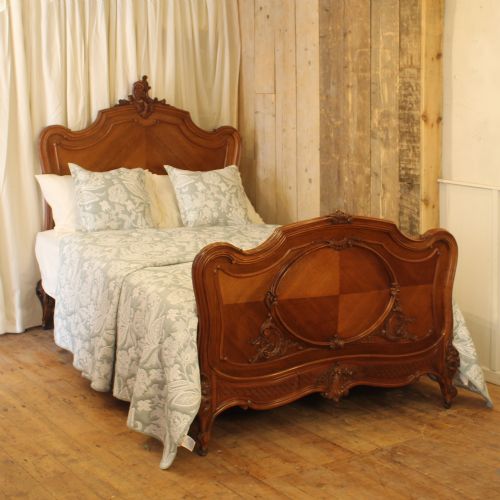


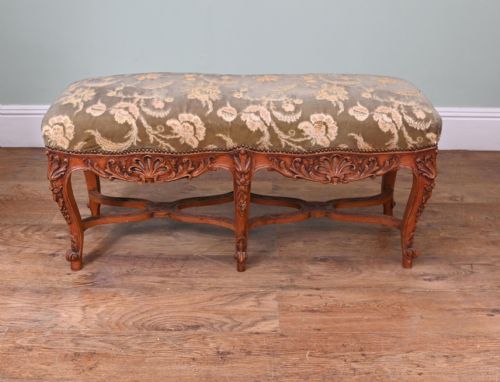


Carved Cabriole Leg Bed
These carved cabriole leg bed pieces offer period character and sturdy timber construction, making them a practical choice for a traditional bedroom.
Carved Cabriole Leg Bed
A carved cabriole leg bed search brings up a mix of large sleeping furniture and associated long seating forms like window seats and benches. The listings span the nineteenth and twentieth centuries, showing how makers adapted curved leg designs across decades.
Most examples you encounter date from the Victorian era up to the nineteen-thirties, drawing on styles such as Queen Anne Revival, Louis XV, and French Provincial. These pieces reflect historical revivals rather than original eighteenth-century production.
Alongside full double and king size beds, the selection includes benches, stools, and ottomans that share the defining carved cabriole leg aesthetic. Walnut and mahogany appear frequently as the primary woods used for these forms.
Materials and Construction
Makers shaped structural elements from dense timbers like walnut, mahogany, oak, and rosewood, often applying walnut veneer to flat surfaces for a figured grain. The curved legs required skilled woodworking to achieve the characteristic double-curved contour without compromising load-bearing strength.
Upholstery forms an integral part of many pieces, utilising velvet, tapestry, and printed fabrics such as Liberty or William Morris designs. Brass details and painted finishes also appear on select items to accent the woodwork.
Carved Cabriole Leg Bed Retail Price Guide 2026
Typical asking prices for carved cabriole leg bed among the pieces listed under this phrase on Sellingantiques today, from the lower quarter to the upper quarter. They describe what is for sale here now, not the wider market.
Listings for carved cabriole leg bed pieces feature items dated from eighteen-sixty through nineteen-thirty, utilising walnut, mahogany, oak, and rosewood.
Assessing Quality and Execution
The standard of carving defines the distinction between finer examples and simpler production, particularly in how cleanly the motifs are rendered on the knee of the leg. Crisp execution of details like ball and claw feet indicates greater skill from the maker.
Timber selection and the preservation of original veneers also determine overall merit. Pieces that retain their structural integrity in the joints and feature period-appropriate upholstery fabrics hold greater interest for collectors.
The Carved Cabriole Leg Bed Glossary
- Window seat
- A long upholstered stool or bench designed to sit beneath a window. These pieces often share the decorative leg treatment of contemporary beds.
- Walnut veneer
- A thin layer of walnut wood applied to a secondary timber base to provide a decorative surface. This technique allows for striking grain patterns across wider panels.
- Ottoman
- A low upholstered seat or bench without arms or a back. They appear in nineteenth-century forms alongside longer window stools.
Carved Cabriole Leg Bed: Frequently Asked Questions
What is a cabriole leg?
A cabriole leg is a curved furniture support that bends outward at the top and inward near the foot, mimicking animal legs. It is a defining feature of Queen Anne and Louis XV revival styles.
This design distributes weight effectively while adding a decorative line to beds and seating. Craftsmen carved these shapes directly from solid hardwoods like walnut and mahogany.
How old are these pieces?
The items listed date primarily from the nineteenth and early twentieth centuries, spanning periods from eighteen-sixty to nineteen-thirty. They represent revival styles rather than original antique pieces from the early seventeen hundreds.
Victorian and Edwardian workshops produced these designs to replicate earlier historical aesthetics. Materials and construction methods reflect the industrial capabilities of those later decades.
What woods were used?
Cabinetmakers utilised dense hardwoods such as walnut, mahogany, oak, and rosewood for structural stability and fine carving. Walnut veneer was also applied to surfaces to create decorative grain patterns.
These timbers provided the strength required for curved legs and heavy bed frames. Secondary woods were frequently used for internal framing hidden from view.
Are these pieces original or revival?
The vast majority are revival pieces produced during the Victorian and Edwardian eras, referencing earlier French and English styles. They interpret historical forms for homes of the nineteenth and twentieth centuries.
Stylistic cues like Queen Anne Revival and Louis XV indicate these later production dates. Examining the timber and construction methods helps clarify the exact manufacturing period.