
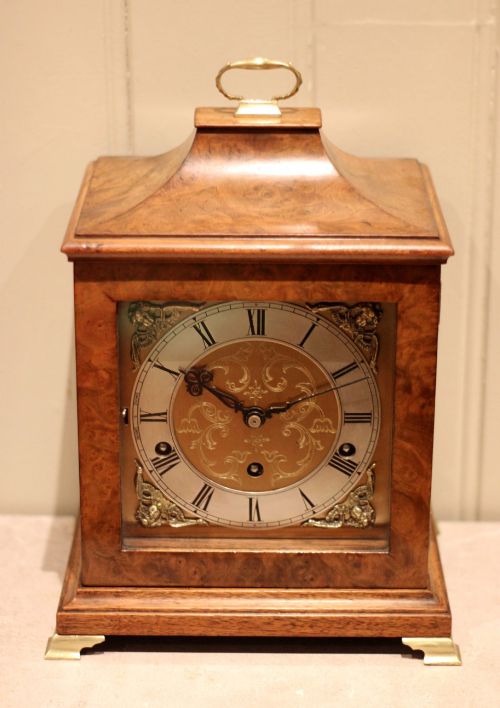
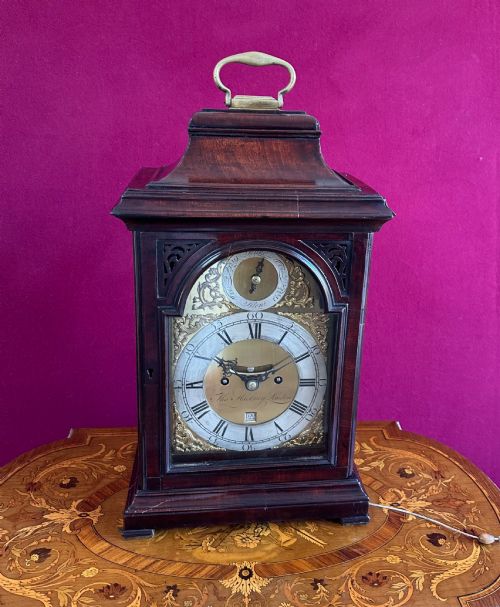


Caddy Top Bracket Clock
A caddy top bracket clock is a handsome table timekeeper with a shaped top that sits proudly in any room.
Caddy Top Bracket Clock
A caddy top bracket clock is a table timekeeper characterised by its distinctive stepped or domed upper section, a form seen across the seventeenth, eighteenth, and nineteenth centuries. These pieces function as mantel clocks and table clocks, often housing verge or pendulum movements inside substantial wooden cases.
The versions most commonly met on this page span the Georgian era through to later revivals, reflecting styles such as George II, William and Mary, and Chinoiserie. Makers from London and major firms created these timepieces to command attention on a bracket or surface, combining timekeeping utility with striking woodwork.
Examples range from early ebony and gilded brass creations to later burr walnut and mahogany interpretations. Collectors encounter both authentic period pieces and twentieth-century revivals that faithfully echo earlier proportions.
Materials and construction
Makers fashioned the cases of a caddy top bracket clock from dense timbers such as mahogany, walnut, burr walnut veneer, and ebony, often selecting wood for rich grain patterns. Gilded brass and standard brass appear extensively for dial mounts, handle hardware, and movement components.
Movements required precise metalworking, utilising brass and steel parts arranged for verge escapements, quarter striking, and chime systems. Glass doors and side panels protected the delicate dials while allowing visibility of the internal mechanics.
Some clocks feature small brass carrying handles on top, ready for a servant to move time around the estate.
What separates the best examples
The distinction between ordinary and exceptional examples lies in the crispness of the case carving, the depth of the wood figuring, and the complexity of the internal movement. Burr walnut veneer and ebony demand meticulous cabinetmaking to achieve seamless alignment across the caddy top shape.
Movement sophistication also divides the range, where quarter striking mechanisms, chime functions, and signed dials by established makers elevate a clock's standing. Original gilded brass mounts and well-preserved glass panels further distinguish a superior piece from a standard execution.
Mappin & Webb·Henry Jones·Lenzkirch·John Taylor·Watson
The Caddy Top Bracket Clock Glossary
- Caddy top
- A shaped, domed, or stepped upper section resembling a tea caddy, commonly found on the roofs of earlier bracket clocks. This architectural silhouette defines the distinct profile of the case.
- Verge movement
- An early type of escapement mechanism utilising a foliot or pendulum to regulate time. It represents traditional clockmaking methods seen in seventeenth and eighteenth-century examples.
- Quarter striking
- A mechanism that sounds the time at each quarter hour using bells or gongs. This complexity adds auditory richness to the clock's function.
- Chinoiserie
- A decorative style inspired by Chinese art, featuring hand-painted or lacquered motifs on the clock case. It appears in revival pieces seeking an exotic aesthetic.
- Bracket clock
- A portable timekeeper originally designed to rest upon a matching wall bracket or table surface. The term persists regardless of whether the supporting bracket survives.
Caddy Top Bracket Clock: Frequently Asked Questions
What is a caddy top bracket clock?
A caddy top bracket clock is a traditional table timekeeper featuring a stepped or domed wooden superstructure above the main dial case. These clocks were designed to sit on desks, tables, or dedicated wall brackets.
They combine intricate cabinetwork with mechanical movements, displaying styles ranging from seventeenth-century ebony to Georgian mahogany.
How do I wind my clock?
Winding involves inserting a key into the winding holes on the dial face and turning gently until resistance is felt. Care must be taken not to overwind the springs.
Consulting the specific movement type, whether verge or later anchor escapement, ensures the proper tension is applied.
Where should I place a bracket clock?
These clocks require a stable, level surface away from direct sunlight, draughts, and extreme temperature fluctuations. Placing them on a sturdy mantel, sideboard, or dedicated wall bracket ensures accurate timekeeping.
Level placement is particularly vital for older verge movements to maintain a consistent beat.
How do I identify the period?
Dating relies on examining the timber, the style of the brass dial, and the construction of the internal movement. Georgian pieces often feature rich mahogany and silvered brass dials, while later revivals copy these traits with twentieth-century precision.
Maker signatures inscribed on the dial or movement backplate also provide clear chronological markers.