


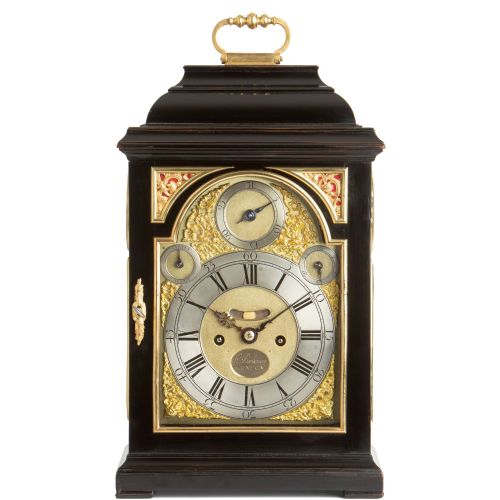

8 Day Bracket Clock
An 8 day bracket clock brings the disciplined craftsmanship of Georgian, Regency and later workshops directly onto a table or mantelpiece.
8 Day Bracket Clock
An 8 day bracket clock is a portable timepiece designed to sit on a bracket, shelf or table, housing a complex movement that requires winding roughly once a week. The pieces appearing here span from early eighteenth century ebonised and mahogany examples to later Victorian, Edwardian and early twentieth century interpretations.
Most items you will encounter on this page are housed in mahogany, rosewood or ebonised wood cases, often detailed with brass, enamel dials and glass panels. They range from miniature architectural forms to bell top and lancet styles, reflecting the changing interior fashions of their respective eras.
Materials and construction
Cabinetmakers constructed the housing from dense hardwoods like mahogany, oak and rosewood, frequently employing ebonised finishes or delicate marquetry and brass inlay. Brass formed the structural plates and gear trains of the movements, alongside glazed bezels and silvered or enamelled dials.
Movements relied on mechanical drive systems such as fusee mechanisms to maintain even power delivery as the mainspring unwound, paired with verge or anchor escapements to regulate the beat. Master clockmakers integrated striking trains, chiming sequences and repeating mechanisms into compact metal frames.
Listings feature movements ranging from early eighteenth century fusee designs to late nineteenth century musical and chiming trains housed in oak, mahogany and rosewood.
Factors of quality
Quality rests primarily in the crispness of the movement's execution and the integrity of the maker's signature. Signed dials and backplates by established London or regional makers indicate superior workshop standards.
The architectural refinement of the wooden case, the originality of the brass fittings and the survival of the matching wall bracket or original dial components distinguish exceptional examples from standard domestic timepieces.
Mappin & Webb·Thomas Moss·Richard Rooker·Hampson & Son·Somersall London·Agar Of Malton·Winterhalder & Hofmeier·Robert Higgs·John McGregor·L.Donne·Richard Peckover·Abel Panchaud·Webster·Camerer Kuss & Co
The 8 Day Bracket Clock Glossary
- Fusee
- A conical pulley connected to the mainspring by a chain or gut line that equalises the driving force as the spring loses tension. This device ensures consistent timekeeping throughout the weekly run.
- Verge escapement
- An early type of clock escapement using a crown wheel and pallets mounted on a swinging rod. It requires careful adjustment and produces a distinctive rapid beat.
- Bell top
- A style of wooden clock case featuring a stepped, domed superstructure resembling the shape of a handbell. It is characteristic of fine eighteenth-century English design.
- Quarter striking
- A clock mechanism that chimes the quarters of the hour on bells or gongs in addition to striking the full hour. More advanced versions sound multiple tunes.
- Silvered dial
- A brass clock face treated with a silver solution and engraved with numerals and maker details, offering a clear, luminous contrast against dark mahogany woodwork.
8 Day Bracket Clock: Frequently Asked Questions
What is an 8 day bracket clock?
An 8 day bracket clock is a portable mechanical timepiece built to run for approximately eight days on a single wind. They were originally made to sit on a dedicated wall bracket to project sound evenly through a room.
Over centuries, these clocks evolved from high status functional objects into decorative mantelpieces, combining precision brass movements with fine cabinetwork in mahogany, rosewood and oak.
How do I wind an 8 day clock?
Winding involves inserting a matching key into the winding holes on the dial and turning it gently until resistance indicates the mainspring is fully tensioned. Most fusee and spring driven movements require a weekly routine.
Take care not to overwind the mechanism, and consult the specific requirements of fusee chains or twin train striking trains before handling the internal key points.
Where should I place a bracket clock?
These clocks require a stable, level surface away from direct sunlight, draughts and damp environments to protect the wood and delicate internal metals. A heavy sideboard, mantelpiece or a secure wall bracket provides an ideal base.
Because the mechanical beat relies on a level foundation, adjusting the feet ensures the pendulum or balance system maintains an even rhythm.
How do I tell an eighteenth century clock from a later piece?
Eighteenth century examples often feature substantial mahogany cases with bell tops, brass carrying handles and fusee movements bearing the maker's signature on the brass backplate. Dial materials like silvered brass or pinned enamel are typical of this period.
Later Victorian and Edwardian interpretations frequently adopt darker ebonised woods, elaborate marquetry, or heavier chiming arrangements designed for domestic mantel use rather than strict wall hanging.