
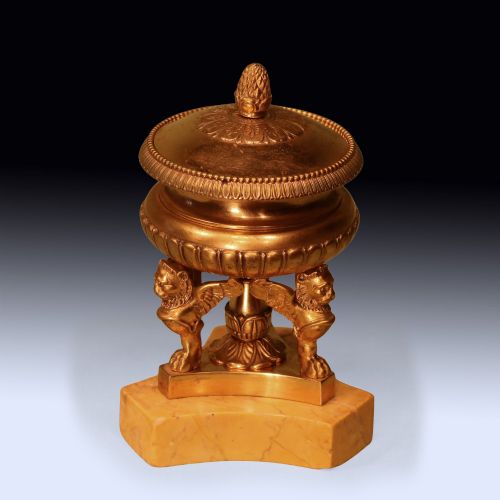


Brass Urn Set
These brass urn set pieces bring heavy metal and stone to a mantel, matching clock garnitures and fire tools from past centuries.
Brass Urn Set
A brass urn set typically comprises matching decorative vessels or functional implements such as fire tools and clock garnitures. These groupings appear across nineteenth-century Victorian and earlier Georgian periods, often originating from French workshops.
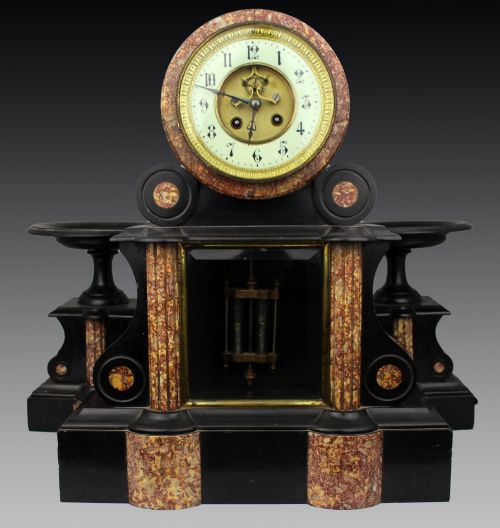
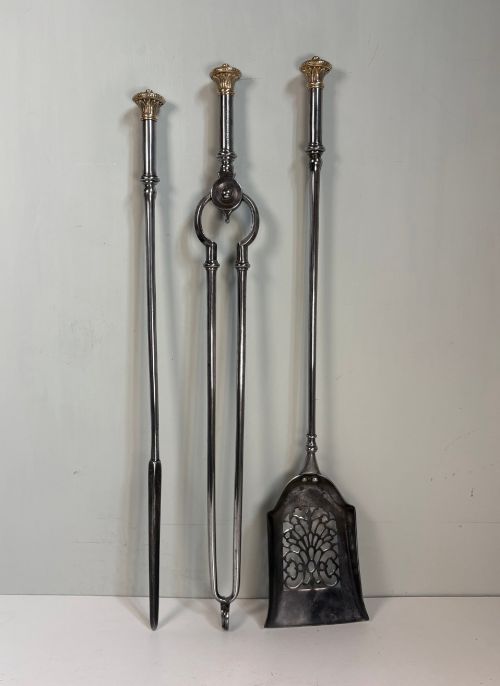
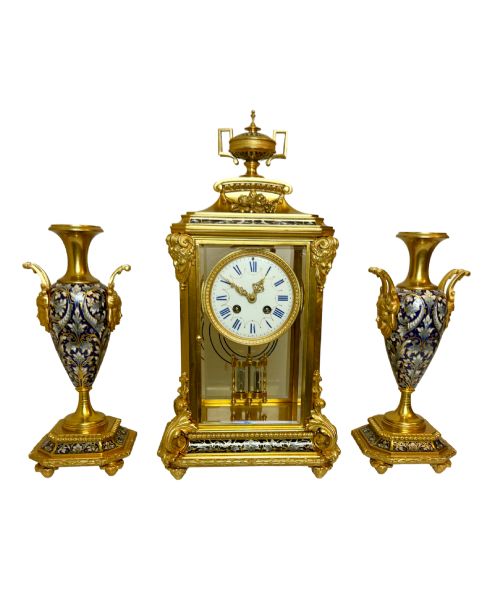
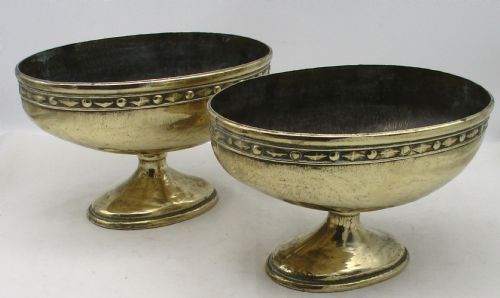
The most common forms on this page include clock garnitures accompanied by side vases, alongside matching pairs of brass church vases or pedestal bowls. Fire tools in brass and steel also form part of these matched groupings.
Originating largely from the nineteenth century, these sets combine brass, ormolu, and gilt bronze with contrasting marble or black slate bases. Their presence reflects domestic display habits of the Victorian era and French Second Empire.
Distinctions in quality
The refinement of the casting and champleve enamel work separates standard production from finer pieces. Crisp detail in the brass foliage and figures indicates superior workshop execution.
The choice of base material influences the distinction between pieces, with dense Sienna or black marble marking heavier, more stable constructions. The integration of porcelain panels or gilt bronze mounts also raises the standard.
Completeness defines the integrity of a set, where matching components retain their original harmony without mismatched replacements. The precision of the mechanical movements in associated clocks further distinguishes the better examples.
Some church vases double as pedestal bowls, ready to hold holy water or spare buttons with equal solemnity.
Japy Frères·A.D Mougin·Vincenti of Paris
The Brass Urn Set Glossary
- Clock garniture
- A set comprising a central mantel clock accompanied by matching side pieces such as vases or urns. These groups were designed to sit together on a fireplace mantel or sideboard.
- Ormolu
- Finely ground high-carat gold applied to a bronze or brass base using a mercury amalgamation process. This technique gives the metal a rich, warm yellow lustre.
- Champleve enamel
- A technique where troughs or cells are hollowed out of the metal surface and filled with vitreous enamel powder before firing. The resulting design sits flush with the metal partitions.
- Sienna marble
- A yellow-brown decorative marble quarried in Italy, featuring dark veining and rich tonal variation. It frequently provides a contrasting base for nineteenth-century French bronzes.
- Fire tools
- Implements used for managing a coal or wood fire, including shovels, pokers, and tongs. They are often sold as matched sets with a supporting stand.
Brass Urn Set: Frequently Asked Questions
What is a clock garniture?
A clock garniture is a matched set consisting of a central mantel clock flanked by two matching side pieces, such as urns or vases. These sets were manufactured to create a symmetrical decorative arrangement on a mantelpiece.
Most surviving examples date from the nineteenth century and incorporate materials like marble, gilt bronze, and enamel to unify the group.
How do I clean brass and marble?
Brass components benefit from gentle dusting with a soft cloth to prevent the accumulation of grime. Avoid harsh chemical polishes that can strip original gilding or patina from antique metal surfaces.
Marble bases require simple wiping with a damp cloth and immediate drying. Acidic cleaners must be avoided entirely as they etch and ruin the polished stone.
Are fire tools meant for use?
Antique fire tools in brass and steel were originally made for domestic hearth maintenance. Many surviving sets retain structural strength suitable for light fireside duties.
Heavier decorative sets, however, are often better suited for display alongside a fireplace rather than heavy daily use.
How are periods identified?
Periods are identified through a combination of stylistic cues, manufacturing techniques, and material choices. Pieces displaying heavy ormolu, champleve enamel, and Sienna marble typically point to nineteenth-century French production.
Simpler pierced brass designs or steel fire tools often indicate earlier Georgian or mid-Victorian workshop origins.