
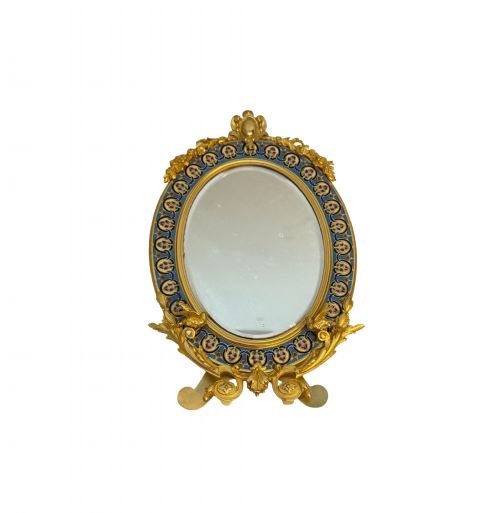


Brass Tabletop Mirror
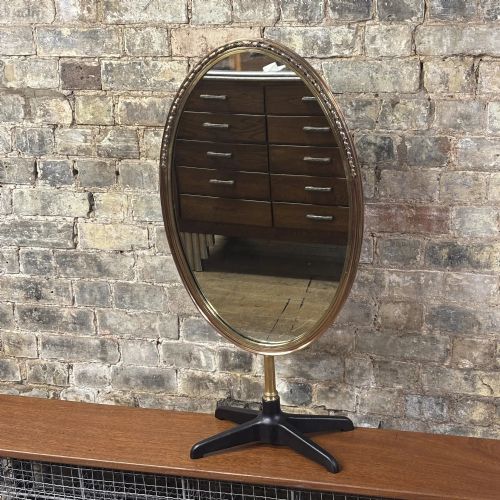
A brass tabletop mirror sits on a dressing surface to catch the light and tilt your reflection.
Brass Tabletop Mirror
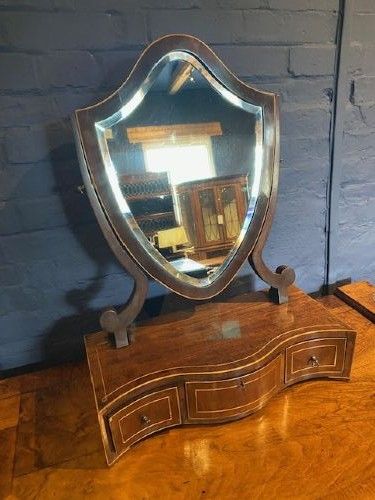
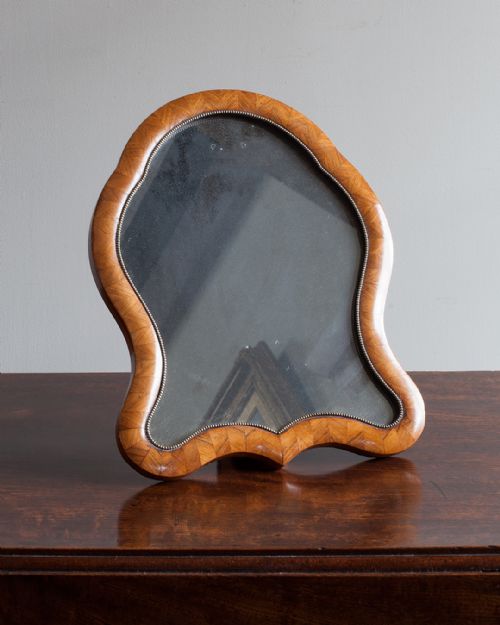
A brass tabletop mirror serves as a functional dressing piece, taking forms such as swing mirrors, vanity mirrors, and toilet mirrors. These objects range from compact nineteenth-century examples to larger Edwardian and Art Deco iterations.
The most common versions on this page span the Victorian period and the early twentieth century, often incorporating stands of mahogany, oak, or burr walnut alongside the metal frame.
Originating from British workshops, French makers, and continental European centres, these mirrors combine utilitarian glass with decorative metalwork designed for daily use.
Materials and construction
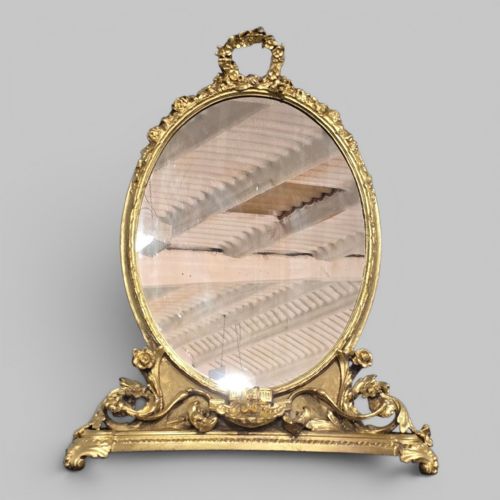
Foundry workers cast brass, bronze, gilt bronze, or ormolu into ornate frames, sometimes embellishing the surfaces with champleve enamel, Limoges enamel, or green onyx inserts.
Joiners and cabinetmakers constructed matching stands and pedestals from dense timbers such as mahogany, kingwood, burr walnut, and polished oak to support the pivoting mirror assemblies.
Glassmakers produced bevelled mirror glass and optical mirror plates, securing them into adjustable swing frames that tilt on metal pivots and brass mountings.
Listings feature brass tabletop mirrors paired with mahogany, oak, burr walnut, green onyx, and gilt bronze across the nineteenth and twentieth centuries.
Judging quality in brass tabletop mirrors
Quality rests in the crispness of the cast brass or gilt bronze work, where sharply defined French Rococo scrolls or Empire period mounts distinguish superior pieces from softer, coarser castings.
The choice of secondary materials elevates an object, such as the grain pattern in figured mahogany and burr walnut stands, or the presence of hand-applied enamel and genuine bevelled glass.
Mechanical integrity in the swing pivots and hinges ensures the mirror holds its angle steadily without slipping, reflecting thoughtful engineering alongside decorative ambition.
Thomas Rubergall·F. Bienvue
The Brass Tabletop Mirror Glossary
- Swing mirror
- A mirror plate mounted on vertical side posts that allows the glass to tilt back and forth. This form dominates nineteenth-century dressing table furniture.
- Ormolu
- Gilded bronze produced by applying a mercury and gold amalgam to a bronze base, creating a rich golden finish found on French pieces.
- Bevelled glass
- Mirror glass with an edge cut at an oblique angle to catch the light. It signals finer manufacturing standards in nineteenth and twentieth-century plates.
- Champleve
- An enamelling technique where troughs are hollowed out of a metal surface and filled with vitreous enamel before firing.
- Toilet mirror
- A smaller portable mirror designed to sit on top of a chest of drawers or dressing table for grooming.
Brass Tabletop Mirror: Frequently Asked Questions
Where do you put a brass tabletop mirror?
These mirrors sit comfortably on top of dressing tables, chests of drawers, or sideboards where they add reflective depth to a room.
Position them near a natural light source to brighten darker corners while remaining accessible for daily grooming routines.
How do swing mirrors stay upright?
A swing mirror relies on tension screws, threaded pivot pins, or side arms fitted into the upright support posts.
Adjusting these side fastenings tightens the grip on the frame so the mirror stays fixed at your chosen angle.
What is the difference between ormolu and brass?
Ormolu consists of a bronze base gilded with a mercury and gold mixture, yielding a warm, deep metallic lustre that differs from standard brass.
Brass is an alloy of copper and zinc that maintains a brighter, yellower tone unless artificially aged or lacquered.
How do you clean antique brass and glass?
Dust the brass frame gently with a dry microfiber cloth to protect any original patination, lacquer, or delicate gilding.
Apply standard glass cleaner to a cloth rather than the mirror itself to avoid liquid seeping behind the plate.