


Brass Rimmed Side Table
A brass rimmed side table brings instant warmth and utility to a room through fine timber and subtle metalwork.
What these tables are
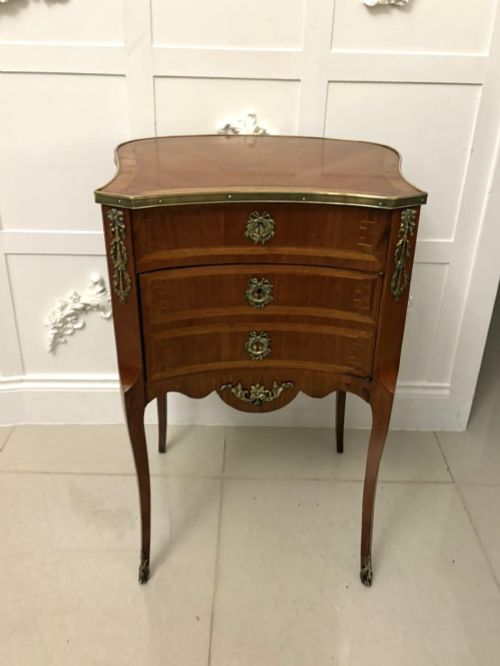
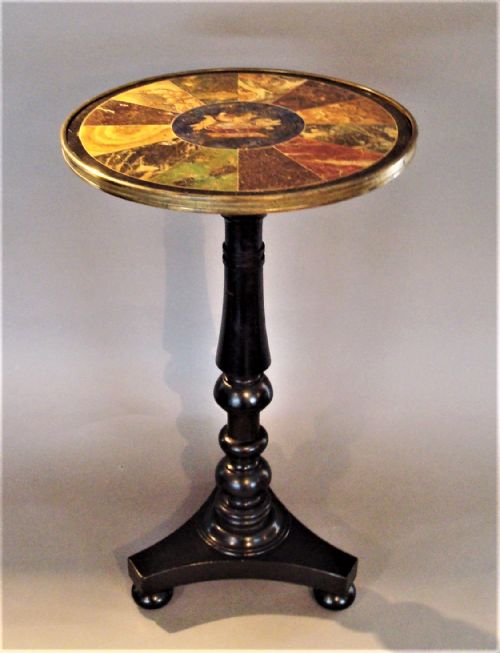
A brass rimmed side table represents a diverse group of occasional furniture spanning the Georgian, Victorian, and twentieth-century periods. These pieces include two-tier occasional tables, étagères, gueridons, and refined side cabinets.
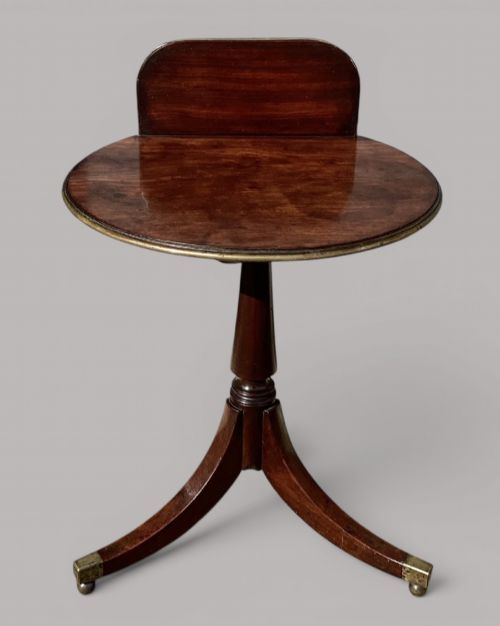
The selection ranges from early nineteenth-century French pieces in coromandel and walnut to substantial British tripod tables in mahogany. Makers such as W. Turner Lord and Co contributed to this tradition with labelled Victorian examples.
Buyers encounter French Louis XV styles alongside English vernacular forms, each utilising distinctive surface decoration and framing brass work. The common thread uniting these forms is the characteristic metal gallery or rim defining the top surface.
Materials and construction
Cabinet makers constructed these pieces using solid and veneered timbers including mahogany, walnut, coromandel, and kingwood. Marquetry inlay and ebonised wood often form intricate decorative patterns across the top surfaces and tiers.
Metalwork plays a structural and decorative role, featuring cast brass rims, galleries, and ormolu mounts. Joinery techniques vary from simple turned tripod supports to complex multi-tiered cabinet frames.
Retail Price Guide 2026
Typical UK retail prices for brass rimmed side table, calculated from the Sellingantiques database of over a million retail prices indexed since 2003. This retail price guide relies exclusively on Sellingantiques data; no external sources or auction records are used, so the figures do not describe the wider market.
Listings feature items spanning the Georgian, Victorian, and Edwardian eras, utilising mahogany, walnut, and coromandel.
Quality and craftsmanship
Superior examples distinguish themselves through the precision of their marquetry inlay and the selection of figured timber veneers like coromandel. The integration of the brass rim reflects the overall standard of the joinery.
Maker attribution elevates a piece, particularly when bearing the stamp or mark of established firms like W. Turner Lord and Co. The crispness of ormolu mounts and the weight of the brass gallery separate standard production from exceptional work.
W. Turner Lord and Co
The Brass Rimmed Side Table Glossary
- Gueridon
- A small French table, often round, supported by a central pillar or columns. These originated in the seventeenth century and frequently feature decorative brass rims.
- Étagère
- A piece of furniture consisting of open shelves or tiers for displaying small objects. They are commonly constructed in fine French walnut or marquetry.
- Marquetry
- The art of applying pieces of veneer to a structure to form decorative patterns. Craftsmen use various coloured woods to create floral or geometric designs.
- Ormolu
- Gilded bronze used for furniture mounts and decorative hardware. It provides a bright golden accent against darker woods like mahogany and ebonised timber.
- Whatnot
- A multi-tiered shelving unit used for storage or display. Victorian examples often incorporate turned supports and gallery rails.
Frequently Asked Questions
What is a brass rimmed side table used for?
These tables function as versatile surfaces for lamps, books, and decorative objects in a living space or bedroom.
Their compact dimensions allow them to fit easily beside seating or in corners where larger furniture cannot go.
How do I identify the period of a table?
Dating relies on examining the timber species, construction methods, and stylistic cues like French Louis XV curves or Georgian tripod bases.
Makers' marks or stamps provide direct evidence of origin and approximate date of manufacture.
Are these tables purely decorative?
While highly decorative, multi-tiered examples and side cabinets offer practical storage and display space.
The raised brass rim specifically prevents items from sliding off the top surface.
What woods were commonly used?
Cabinet makers utilised mahogany, walnut, kingwood, and coromandel as primary timber foundations.
Many pieces also feature marquetry inlay and ebonised wood accents to enhance the visual depth.