





Brass Inlaid Campaign Chest
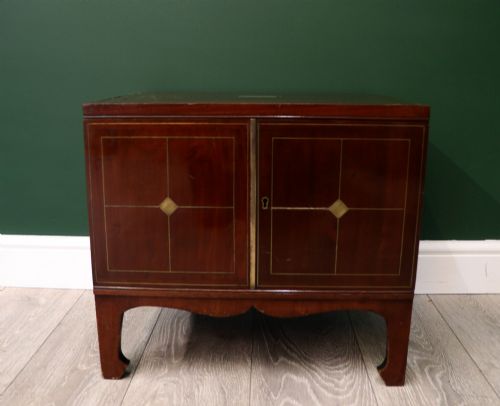
A brass inlaid campaign chest is a portable, finely fitted hardwood box built for travel that brings clever compartments and rich metalwork into any room.
Brass Inlaid Campaign Chest
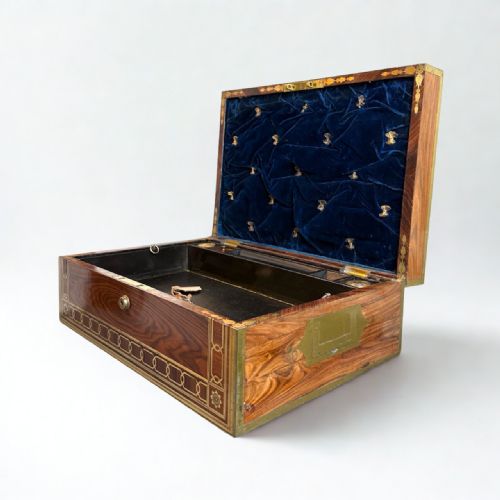
When you search for a brass inlaid campaign chest, you are looking at practical travelling furniture designed for officers and travellers across the eighteenth, nineteenth, and twentieth centuries. These pieces encompass robust two-section military chests of drawers, compartmentalised writing slopes, and dressing boxes formed to withstand long journeys.
The versions you are most likely to meet on this page span Georgian, Regency, and Victorian periods, alongside Chinese export examples in camphorwood and rosewood. They arrive in various forms including chests of drawers, cabinets, and presentation boxes, all united by flush brass hardware intended to prevent snagging during transit.
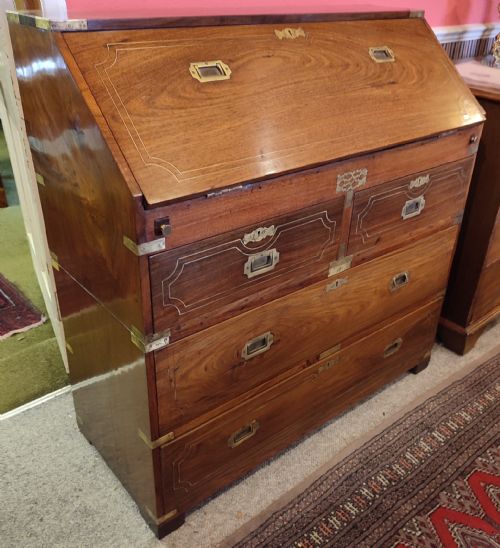
Many items display the characteristic divided structure of campaign furniture, allowing heavy trunks to separate into manageable sections for shipping. Whether configured as a bureau or a simple box, each object retains the modular integrity required by its original military or colonial context.
How they were made
Cabinetmakers built these pieces using dense, durable timbers such as mahogany, teak, rosewood, camphorwood, and padouk, which resisted warping in humid climates. Flame mahogany and satinwood veneers occasionally added decorative contrast to the primary surfaces.
Brass inlay and flush-fitting brass mounts were meticulously embedded into the wood to reinforce corners and provide secure handles without protruding. These metal elements were countersunk into the timber grain for a smooth exterior finish during transport.
Formations across the site include two-section military chests of drawers, writing slopes, jewellery boxes, and dressing cases.
What varies in quality
The distinction between ordinary and exceptional pieces rests upon the precision of the joinery and the complexity of the internal fittings. Superior examples feature secret drawers, smoothly operating writing surfaces, and well-executed brass inlay that remains flush with the surrounding wood.
The choice of timber heavily influences the character of the object, with figured grains like flame mahogany and select rosewood commanding greater attention. The integrity of the original lining, locks, and compartmentalised trays further separates standard utility trunks from finely appointed presentation boxes.
The Brass Inlaid Campaign Chest Glossary
- Campaign chest
- A sturdy chest of drawers built in two or more stackable sections for easy transport by military officers on duty. These units utilise recessed brass corners and flush handles to protect the wooden edges.
- Writing slope
- A portable box with a hinged sloping lid that opens to reveal a slanted writing surface, inkwell compartments, and secret storage slots. They were essential desk accessories for travellers.
- Camphorwood
- An aromatic timber frequently utilised in Chinese export chests and campaign trunks. Its natural scent helped deter insects and protect stored textiles from damage.
- Flush mount
- A metal handle, bracket, or escutcheon sunk directly into the wood so it does not project beyond the surface. This technique protected the hardware and prevented snagging during transit.
- Dressing box
- A fitted container holding glass bottles, small jars, and mirrors for personal grooming while away from home. These boxes often feature concealed compartments beneath the primary tray.
Brass Inlaid Campaign Chest: Frequently Asked Questions
What is a campaign chest?
A campaign chest is a piece of modular furniture designed to separate into distinct sections for military transport.
Built from robust hardwoods and reinforced with brass corners, it allowed officers to travel with their belongings securely stored.
How were writing slopes used?
Writing slopes served as portable desks containing paper, ink, and pens for correspondence on the move.
The hinged lid opened to create a slanted writing surface, while internal partitions kept small accessories secure.
Why use camphorwood?
Camphorwood was selected for colonial and export trunks because its natural fragrance acted as a deterrent against moths and insects.
This durable timber also handled changing climates well during long sea voyages.
How do I identify periods?
Period identification relies on observing the timber choices, cabinetmaking techniques, and brass hardware styles.
Georgian and Regency pieces often display clean architectural proportions, while Victorian examples introduce varied internal mechanisms.