
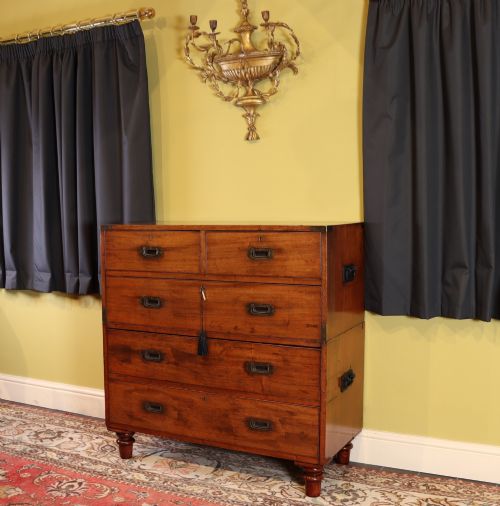


Split Section Military Drawers
Split section military drawers are ingenious two-part travelling chests built for officers on the move, offering modular storage and rugged transport.
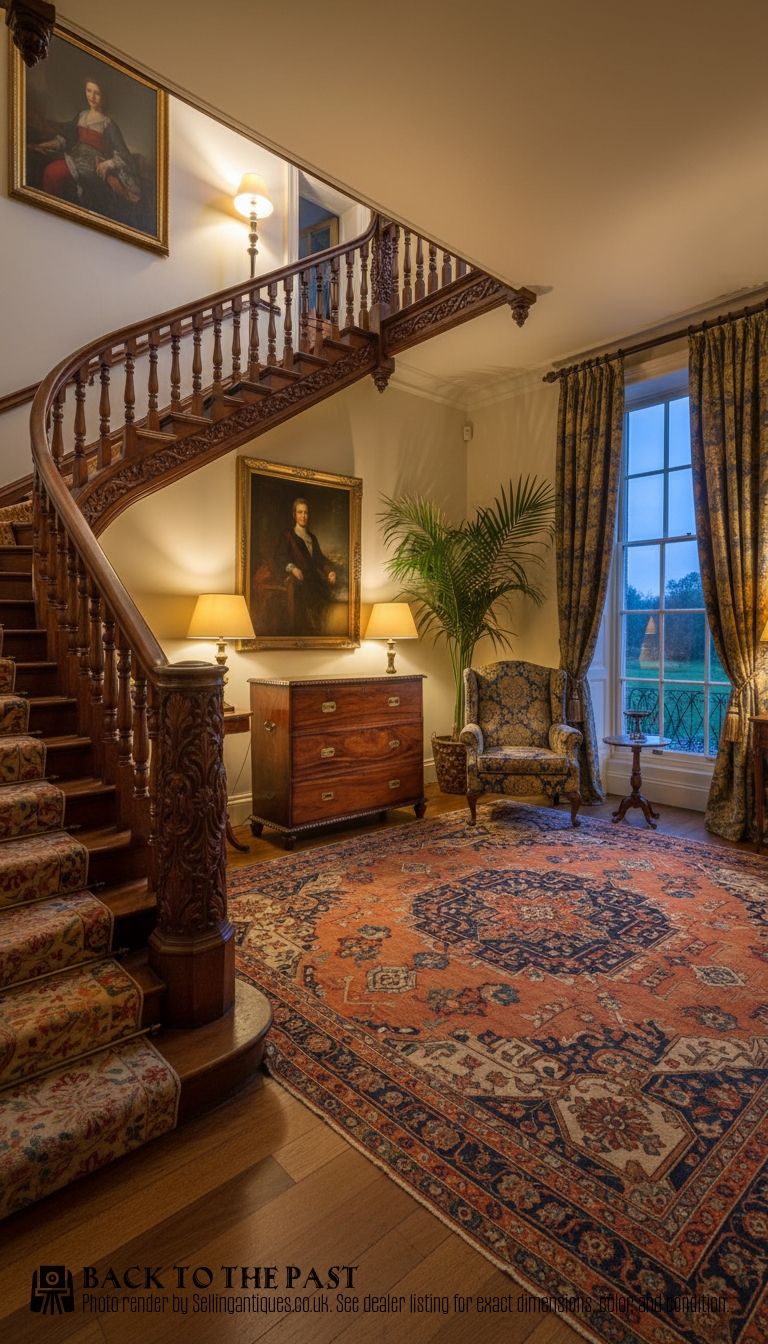
Split Section Military Drawers
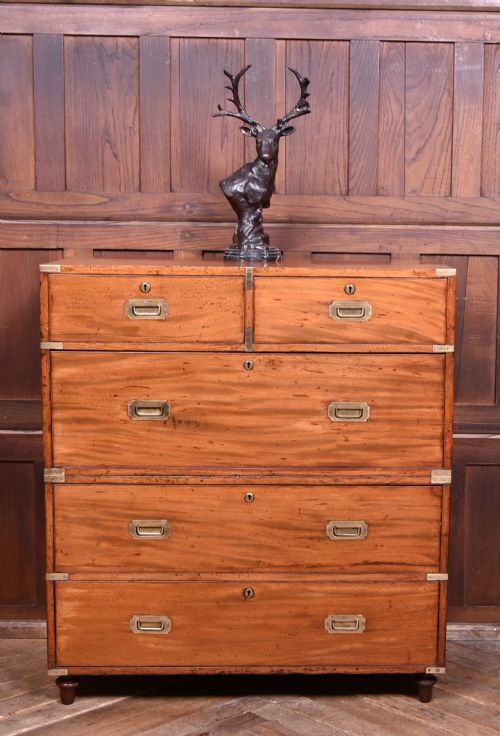
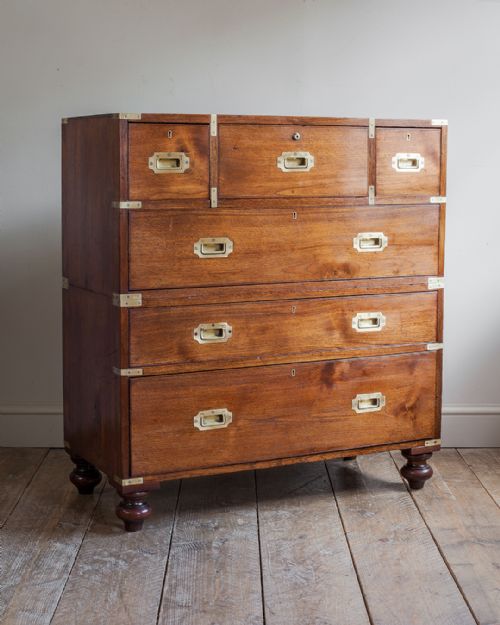
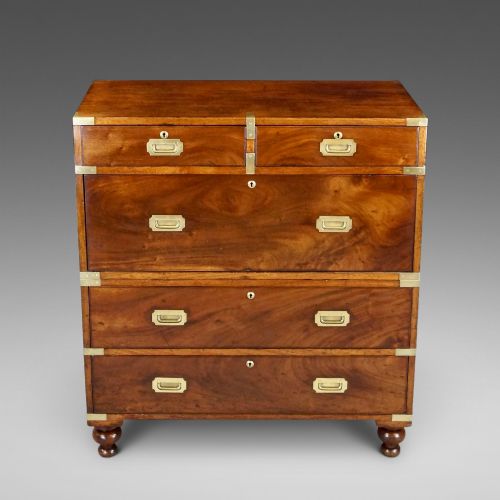
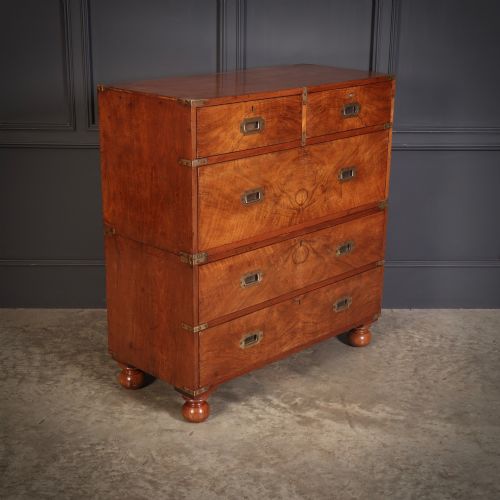
When you search for split section military drawers, you encounter sturdy chests designed to separate into two distinct carcases for ease of loading on campaigns. These pieces are most frequently encountered from the Victorian period, spanning the mid to late nineteenth century, alongside occasional early twentieth-century examples.
The dominant forms on this page include mahogany, teak, and camphor wood chests of drawers constructed in two stacking sections. Many incorporate brass binding to protect the corners and flush brass carrying handles set into the sides for lifting.
Makers designed these items for officers requiring portable furniture that could withstand rough journeys across the empire. The configuration typically involves a smaller upper chest resting securely upon a deeper lower chest, locked together with metal pins or side straps.
How they were made
Makers utilised dense timbers such as mahogany, teak, camphor wood, padouk, and walnut to resist warping in humid climates. These hardwoods were often selected for their durability and handsome grain, then finished with brass corners, straps, and flush-fitting handles.
The construction relies on a two-part carcass system designed to separate cleanly at the waist for transport. Dovetail joints secure the drawer frames, while internal dust boards between sections prevent dirt from entering the storage spaces during transit.
Camphor wood versions continue to release a faint, aromatic scent decades after leaving the nineteenth-century colonial trade routes.
What varies in quality
Quality in split section military drawers rests upon the precision of the brass hardware integration and the selection of timber figure. Higher-grade examples display crisp corner binding, well-fitted flush handles, and carefully matched wood grains across the two separate sections.
Internal secondary timbers and the complexity of the interior fittings also separate standard items from superior pieces. The presence of a fitted secretaire drawer with pigeonholes and small writing surfaces elevates the sophistication of the chest.
S. W. Silver & Co.·Army & Navy
The Split Section Military Drawers Glossary
- Campaign chest
- A modular chest of drawers built in sections with recessed brass handles and corner brackets for military transport. These items were essential luggage for officers on active service.
- Secretaire
- A desk drawer that pulls out and drops down to reveal a writing surface and small pigeonholes. This multi-purpose feature allowed officers to handle correspondence in the field.
- Brass binding
- Metal strips and corner pieces screwed to the edges of campaign furniture to absorb impact during travel. This reinforcement protected the timber frame from splitting.
- Two-part chest
- A piece of furniture constructed as an upper and lower box that stack together and lock in place. This division reduced the weight and bulk for pack animals or carts.
- Flush handle
- A metal handle hinged to fold completely flat into a recessed pocket in the drawer front. This design prevented items from snagging during packing and transit.
Split Section Military Drawers: Frequently Asked Questions
Why are military chests built in two sections?
The two-part construction allowed officers to divide the weight into manageable loads for transport on pack animals or wagons during campaigns.
Once safely at the destination, the upper section stacked easily onto the lower base to create a standard tall chest of drawers.
What woods were used for campaign chests?
Cabinetmakers employed durable hardwoods like mahogany, teak, camphor wood, padouk, and walnut to withstand harsh colonial climates.
Camphor wood was particularly favoured for its insect-repellent properties, making it ideal for storing uniforms in tropical regions.
Are campaign chests practical for modern homes?
These chests offer deep, sturdy drawer storage and a compact footprint that suits bedrooms, living rooms, and hallways.
The sectional design also makes them straightforward to move between rooms or houses compared to standard solid wardrobes.