
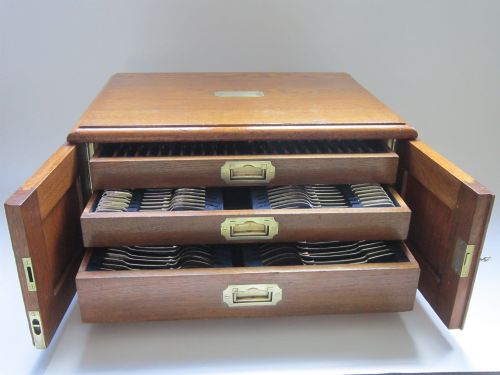

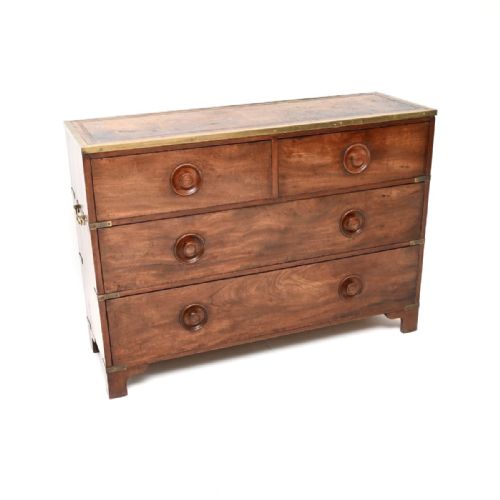
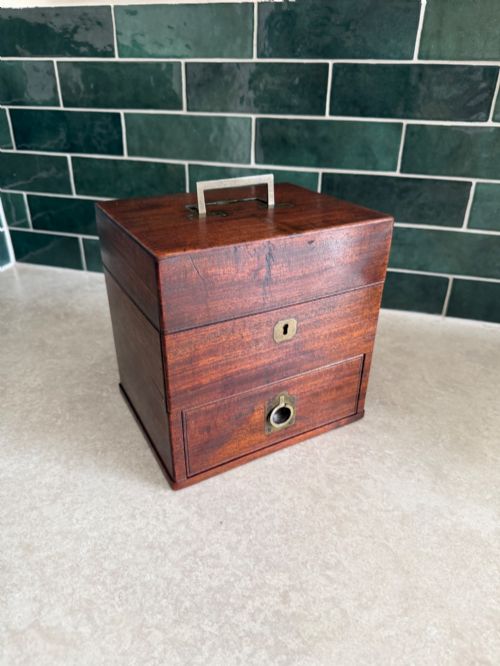
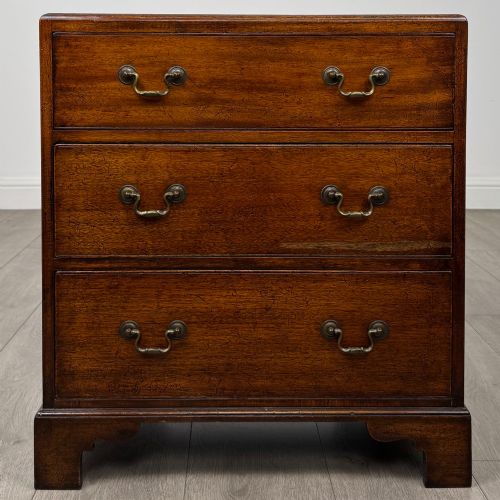
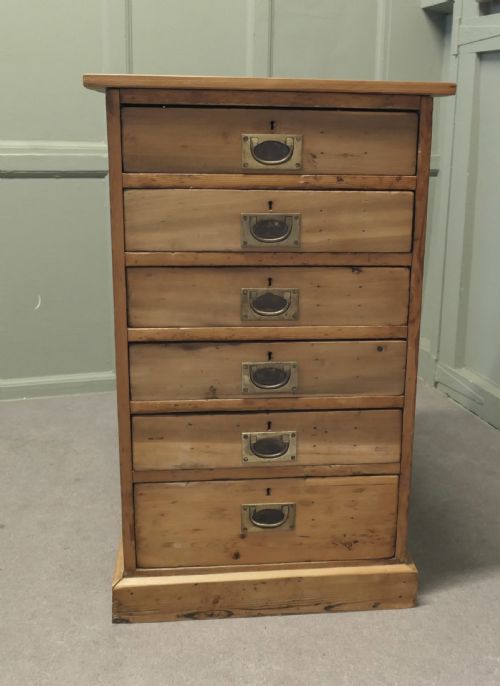

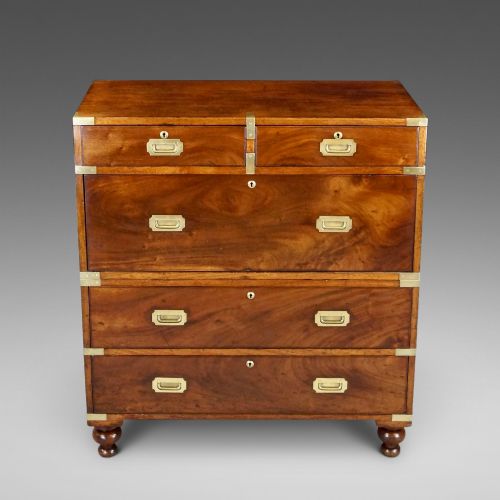
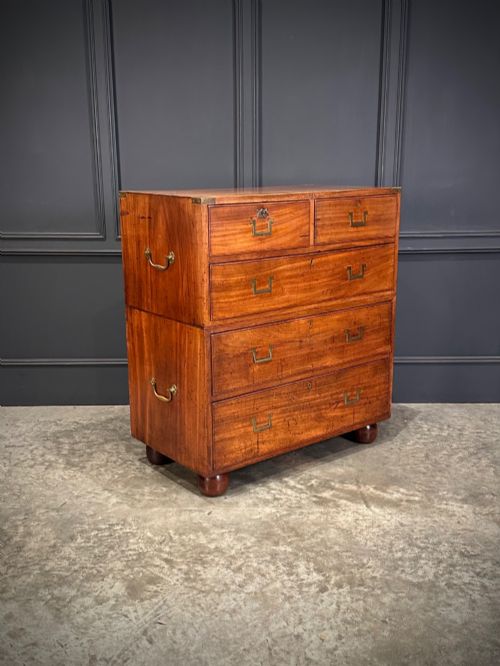
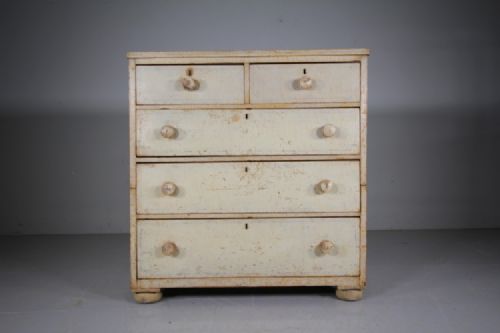
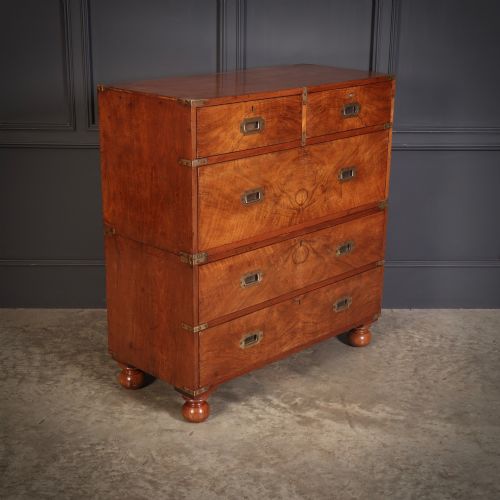
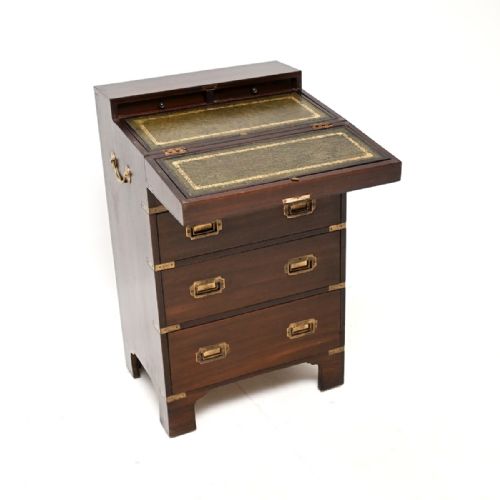

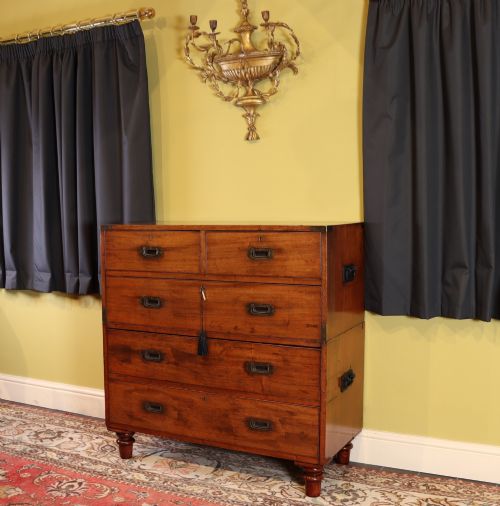
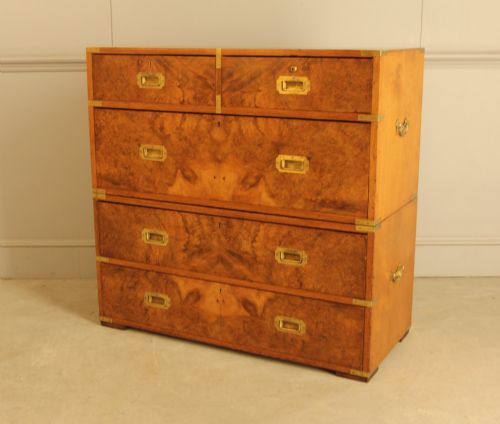
Campaign Chest Drawers
Campaign chest drawers are portable military furnishings built for officers on the move, prized for clean lines and brass hardware.

Identifying campaign chest drawers
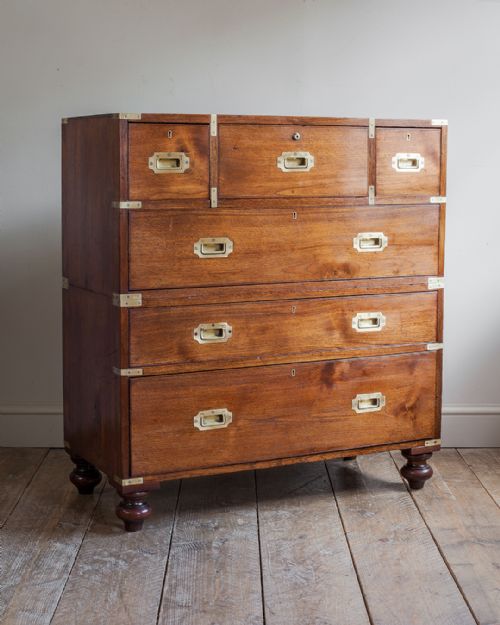
Campaign chest drawers are functional storage pieces designed to travel with military officers across the British Empire during the nineteenth century. These items typically divide into two or more stacking sections to ease transport on ships and wagons.
Most examples appearing here belong to the Victorian era or mid nineteenth century, adopting straightforward rectangular forms. Cabinets and low chests also feature alongside standard chest of drawers configurations.
Woods selected for these pieces include mahogany and teak, often bound in brass corners and recessed handles. This construction protected the edges from knocks during arduous journeys.
Judgements of quality
Superior examples display precise dovetail joinery, well fitted brass hardware, and high grade timber figures such as flame mahogany or solid teak. The tightness of the stacking sections indicates superior cabinet work.
Pieces fitted with writing surfaces, secretaire drawers, or compartments elevate the utility of the design. Simpler secondary woods or loose fittings separate standard functional pieces from finer officer grade furniture.
Listings feature mahogany, teak, walnut, rosewood, oak, pine, and yew alongside brass hardware.
Ross & Co. Dublin·Army & Navy CSL·W Day The Strand
The Campaign Chest Drawers Glossary
- Brass bound
- Edges and corners reinforced with brass strapping to withstand travel. This protective metalwork defines the industrial aesthetic of military furniture.
- Two part
- Built as stacked upper and lower modules that separate for transit. Iron carrying brackets often appear on the sides of these modular sections.
- Recessed handle
- A pull handle set flush into the drawer face so it does not protrude. This prevents snagging and allows multiple chests to sit flat against one another.
- Secretaire
- A drawer featuring a drop front that conceals small pigeonholes and a writing surface. Officers used these compartments for correspondence while on campaign.
- Dovetail
- An interlocking joint used to connect drawer sides securely. Fine, tight pins demonstrate skilled craftsmanship.
Frequently Asked Questions
Why do campaign chests split in two?
These chests were engineered in separate stacked sections so that military officers could transport their belongings easily on ships and packhorses during campaigns.
Each module fitted securely onto the one below using wooden alignment pins or brass brackets, creating a stable tower when assembled.
What woods were used for campaign chests?
Cabinet makers built these pieces using durable timbers like mahogany, teak, and walnut that could endure extreme weather conditions and rough travel.
Brass corners and flush handles reinforced the timber structure against heavy impacts.
How do I spot a genuine nineteenth century piece?
Authentic period examples exhibit hand cut dovetails, solid secondary woods inside the drawers, and heavy brass hardware screwed directly into dense timber.
Construction details like stacked sections and recessed brass pulls point directly to mid nineteenth century military requirements.
Can I use a campaign chest as a coffee table?
Shorter low campaign chests function well as living room tables while offering practical storage inside the drawers.
Their robust brass bound construction easily supports everyday domestic use.