

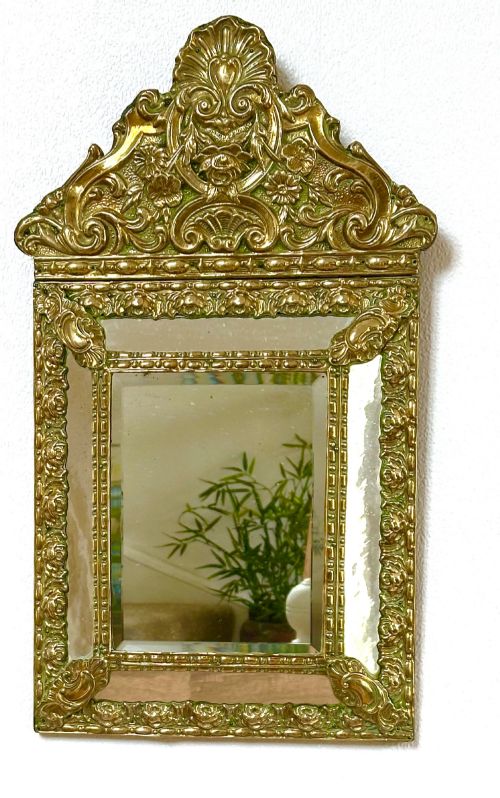


Brass Cushion Mirror
A brass cushion mirror brings deep-sectioned metalwork and a curved profile to a wall, offering rich reflection and period presence.
Brass Cushion Mirror
The profile derives from seventeenth-century prototypes, reinterpreted during the eighteen-eighties and surrounding decades with pressed or repousse brass mounted over timber or ebonised wood cores. Wall hanging formats dominate the selection, ranging from compact domestic items to large decorative showpieces incorporating tortoiseshell or marble elements. Each piece combines structural timber framing with metal sheathing to achieve the characteristic convex sweep.
Materials and construction
Makers constructed these frames by shaping sheet brass over carved wooden cores, utilising repousse and pressed techniques to hammer or stamp floral, figural, and geometric motifs into the metal. Ebonised wood or tortoiseshell frequently forms the contrasting backing or inner borders, visible alongside the polished brass surfaces. Mercury silvered glass plates appear in earlier examples, secured within the deep rebates of the cushion profile.
The assembly relies on corner joints and secured metal mounts that hold the convex frame sections rigid around the central mirror plate. Artisans applied patination to the brass and highlighted details with gilding, creating tonal depth across the raised surfaces of the cushion moulding.
Brass Cushion Mirror Retail Price Guide 2026
Typical asking prices for brass cushion mirror among the pieces listed under this phrase on Sellingantiques today, from the lower quarter to the upper quarter. They describe what is for sale here now, not the wider market.
Distinctions in quality
Quality rests upon the crispness of the repousse relief and the depth of the brass working, where hand-chased ornamentation outclasses mass-pressed sheeting. The choice of secondary materials - such as genuine tortoiseshell, heavy ebonised timber, or substantial marble consoles - separates standard production items from high-end salon pieces. Furthermore, the integrity of the original mercury glass plate contributes significantly to the overall character and standing of the mirror.
Proportion and scale dictate the visual impact of the cushion profile, with larger frames requiring precise joinery to maintain the structural curve without distortion. The retention of original patination, metal mounts, and backboards without excessive replacement parts marks the difference between a preserved survivor and a heavily altered object.
The Brass Cushion Mirror Glossary
- Cushion mirror
- A wall glass set within a swelling, convex frame profile that slopes outward from the wall towards the centre. This distinctive shape mimics seventeenth-century aesthetics.
- Repousse
- A metalworking technique where the artisan hammers the design from the reverse side to raise relief ornamentation on the front. This process creates tactile depth on the brass frame.
- Ebonised wood
- Timber treated with a dark stain or finish to imitate ebony, commonly used for contrasting borders on nineteenth-century frames. It provides a dark ground against polished brass mounts.
- Mercury plate
- A mirror glass produced by applying a tin and mercury amalgam to the rear of the glass, characteristic of older manufacturing methods. It frequently exhibits distinctive foxing spots.
- Foxed
- A term describing the natural ageing of mirror glass where the reflective backing degrades into speckled or cloudy patches. This occurs through oxidation over many decades.
Brass Cushion Mirror: Frequently Asked Questions
How do I hang a heavy brass cushion mirror?
These frames carry substantial weight due to their timber cores and metal sheathing, requiring secure wall fixings anchored directly into masonry or studs. Professional mirror hangers utilise heavy-duty brackets suited to the specific dimensions of the frame.
Avoid relying solely on decorative picture wire attached to older backboards, as original fixings may have weakened over time. Ensure the weight distributes evenly across the primary structural members of the wooden backing.
Are these mirrors French or Dutch in origin?
The selection includes both French and Flemish or Dutch designs, often reflecting nineteenth-century revivals of seventeenth-century aesthetics. French examples frequently feature ornate repousse brass work and tortoiseshell details.
Dutch and Flemish variations tend to display robust baroque styling with deep cushion profiles and expansive metal surfaces. Makers across both regions reinterpreted these historical motifs during the Victorian era.
What causes foxing on the glass?
Foxing develops when moisture breaches the backing over decades, causing the reflective metal amalgam to oxidise and separate from the glass. This chemical reaction creates dark, speckled patches across the surface.
Many collectors value original foxed plates because they confirm the age of the glass and add authentic character. Replacement plates appear in pieces where the original glass was damaged or lost.
How should I clean the brass frame?
Maintain the brass frame by dusting gently with a soft, dry cloth to prevent the accumulation of dirt within the repousse recesses. Avoid harsh chemical cleaners or abrasive polishes that strip away the historic patination.
Preserving the aged surface tonality maintains the visual integrity of nineteenth-century metalwork. Professional conservation methods apply only when active corrosion threatens the stability of the brass.