




Brass Book Trough
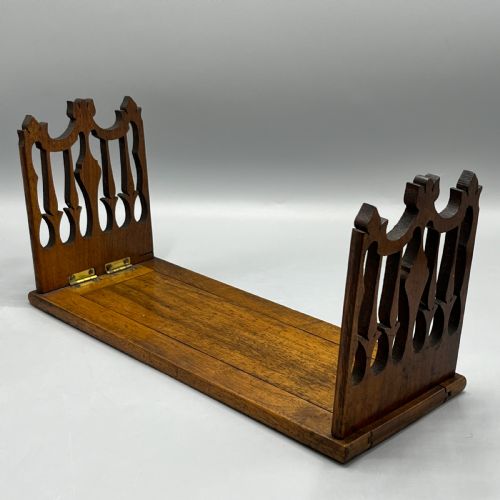
A brass book trough holds your volumes upright on a desk with metal mounts that anchor the timber frame.
Brass Book Trough
When you search for a brass book trough, you encounter desk accessories designed to hold volumes securely on a flat surface. The selection spans extending book slides, fixed troughs, and book rests that appear in various timber and metal combinations.
Victorian examples dominate the available pieces, often utilising extending mechanisms alongside mounted brass corners and hinges. You will also find earlier Regency items and later pieces incorporating porcelain or pietra dura panels.
The primary forms include folding book stands, library book holders, and novel rests intended for desktop use. Walnut, mahogany, and coromandel provide the wooden bodies, while brass provides structural bracing and decorative embellishment.
Materials and construction methods
Cabinet makers joined dense hardwoods such as walnut, mahogany, and coromandel to form the main body of each desk accessory. Burr walnut and ebonised wood also appear, offering varied grain patterns and dark surface tones.
Brass mountings, hinges, and extending actions were screwed or pinned directly into the timber framework to provide strength and movement. Patent mechanisms, such as those by Betjemanns, allowed the wooden platforms to slide smoothly outward.
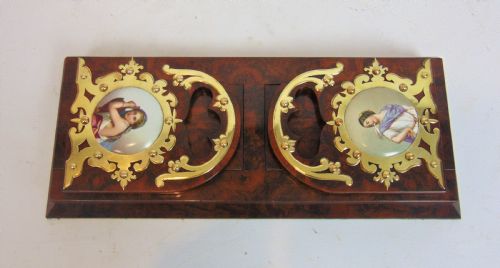
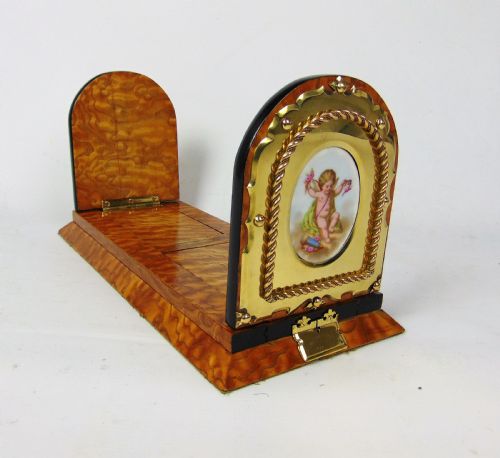
Inlaid porcelain plaques, bone details, and pietra dura stone panels were fitted into recesses within the wooden panels. These decorative elements required precise joinery to sit flush with the surrounding polished surfaces.
Some nineteenth-century makers added small folding book rests so readers could prop up heavy reference tomes without straining their wrists.
Distinguishing quality across pieces
The choice of primary timber significantly affects the standing of a piece, with figured coromandel and burr walnut sitting above standard mahogany. The density of the grain and the selection of matching veneers show the maker's initial intent.
The weight and gauge of the brass mounts dictate how substantial the hardware feels during use. Thicker cast brass work, intricate engraving, and patent extending actions indicate a higher grade of manufacture than plain stamped brackets.
Betjemanns·Tiffany & Co
The Brass Book Trough Glossary
- Book slide
- A desk accessory with extending sides designed to hold a variable number of volumes upright between metal or wooden ends.
- Pietra dura
- An artistic technique using cut and fitted polished coloured stones to create inlaid mosaic images on panels.
- Coromandel
- A dense, dark brown hardwood with contrasting black grain imported from Asia, frequently used in high-end Victorian cabinet work.
- Gothic Revival
- An architectural and decorative style drawing inspiration from medieval forms, featuring pointed arches and heavy geometric brass mounts.
- Patent mechanism
- A mechanical action protected by official registration, allowing book slides to expand and contract without binding.
Brass Book Trough: Frequently Asked Questions
How do extending book slides work?
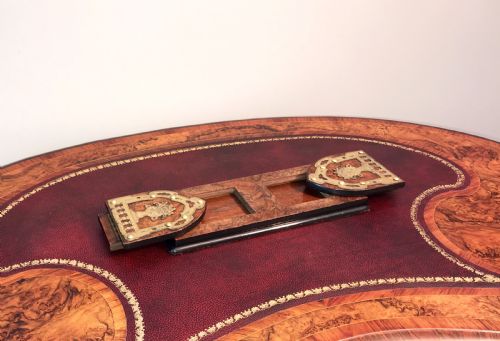
Extending book slides utilise internal wooden channels or metal scissor actions that allow the two end sections to pull apart. This adjustment accommodates a growing or shrinking row of volumes on a desk.
Patented systems ensure the movement remains balanced on both sides so the wooden platforms slide evenly without jamming.
What woods were used for these?
Cabinet makers predominantly utilised walnut, mahogany, and coromandel for the structural bodies of desk accessories. Burr walnut and ebonised wood also appear frequently across nineteenth-century examples.
Oak was occasionally employed, particularly in Arts and Crafts pieces, providing a sturdy and heavy foundation for library use.
How do I date a brass book trough?
Dating relies on combining the timber species, decorative style, and mechanical patents visible on the piece. Regency items often feature rosewood and simpler lines, while Victorian examples introduce heavy brass mounts and exotic veneers.
Patent stamps and registration marks can narrow down the production year to a specific decade during the nineteenth century.
Where should I place a book trough?
These pieces suit placement on a study desk, library table, or sideboard where they can support active reading material. Their compact footprint makes them practical for organising volumes on flat surfaces.
Keep them away from direct heat sources and strong sunlight to protect polished wood surfaces and delicate inlaid panels.