





Expanding Book Rack
An expanding book rack holds shelves steady on a desk, bringing together folding timber and sliding brass to keep working volumes close at hand.
Expanding Book Rack
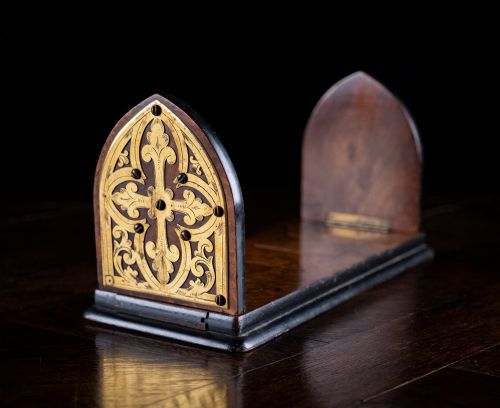
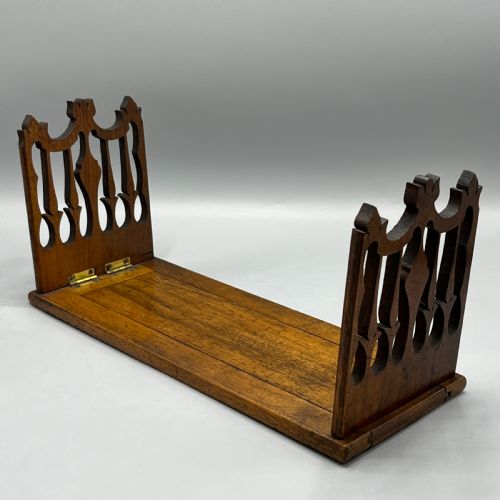
An expanding book rack, often called a book slide or book rest, provides an adjustable span for holding volumes upright on a desk or table. These pieces comprise a central folding or sliding mechanism that lengthens to accommodate more books as a library grows.
Victorian examples dominate the selection here, alongside pieces from the Regency and Edwardian eras. Common forms include hinged wooden platforms fitted with brass mounts or folding ends designed to support heavy volumes securely.
How they were made
Cabinetmakers utilised dense hardwoods such as walnut, coromandel, rosewood, oak, and olive wood to construct the expanding frames. These timbers provide the structural stability required for holding books under constant pressure.
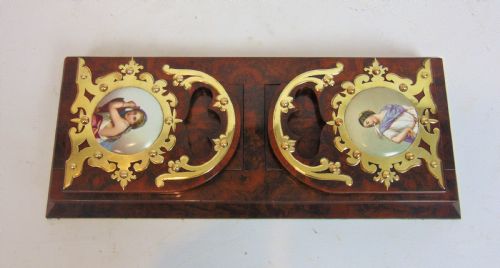
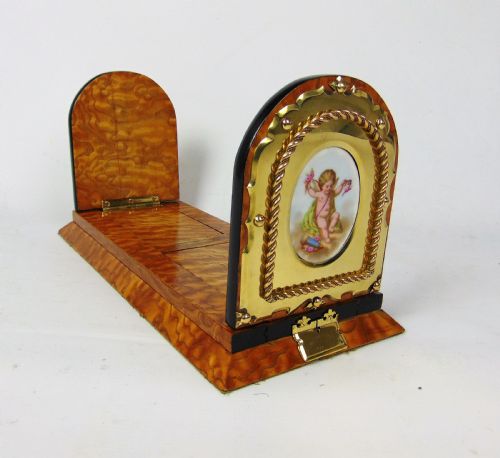
Metalwork played a crucial role, with brass hinges, mounts, and extending scissor actions integrated directly into the wooden framework. Decorative elements often incorporated porcelain plaques, inlaid Tunbridge ware, pietra dura panels, or carved bone details.
Expanding Book Rack Retail Price Guide 2026
Typical asking prices for expanding book rack among the pieces listed under this phrase on Sellingantiques today, from the lower quarter to the upper quarter. They describe what is for sale here now, not the wider market.
What varies in quality
The sophistication of the extending mechanism distinguishes standard desk accessories from finer library pieces. Smooth action in the brass scissor joints and sturdy pin hinges indicate superior workshop production.
The choice of decorative embellishment also marks out the better examples. Fine hand-painted porcelain plaques, intricate pietra dura inlay, and meticulously fitted coromandel or burr walnut veneers demonstrate higher craftsmanship.
Betjemanns·Tiffany and Co
The Expanding Book Rack Glossary
- Book slide
- A desk accessory featuring an extendable base designed to hold a row of books upright between two ends. This term appears frequently alongside book rack in historical listings.
- Tunbridge ware
- Woodworking craftsmanship characterised by minute mosaic decoration made from small pieces of naturally coloured wood. This technique creates geometric patterns or pictorial scenes on the surface.
- Pietra dura
- Inlay work utilising polished, cut-coloured stones such as marble and lapis lazuli to create pictorial panels. These plaques often adorn the folding ends of Victorian book rests.
- Coromandel
- A dense, heavily figured timber imported from Asia, prized for dark brown colouring and contrasting black streaks. Cabinetmakers utilised this material for high-end Victorian desk accessories.
- Ebonised wood
- Timber treated with a dark stain or finish to imitate ebony. This process was common in nineteenth-century workshops to create a sleek surface for brass mounts.
Expanding Book Rack: Frequently Asked Questions
How do these extend?
Most models feature a sliding wooden base or a concealed scissor mechanism beneath the platform. Pulling the ends apart expands the central channel smoothly.
Heavier versions rely on hinged folding ends that drop flat or adjust outward to increase the holding capacity.
Where were they used?
These pieces sat primarily on library tables, study desks, and Davenport writing boxes in nineteenth-century homes. They kept frequently referenced volumes within arm's reach of the reader.
Households also placed them on parlour sideboards or occasional tables to display decorative or presentation bindings.
How do I date a piece?
Dating relies on timber choice, hardware style, and decorative technique. Early nineteenth-century examples often feature Regency rosewood or coromandel with restrained brass detailing.
Later Victorian and Edwardian pieces frequently showcase elaborate brass mounts, patent mechanisms, or specific regional crafts like Kashmiri carving.
Can they hold heavy books?
Solid walnut and oak frames with robust brass hinges handle substantial reference volumes and heavy leather-bound books securely. The sliding mechanism bears the outward pressure exerted by the squeezed texts.
Lighter woods or intricate mosaic panels suit moderate volumes rather than heavy folio editions.