

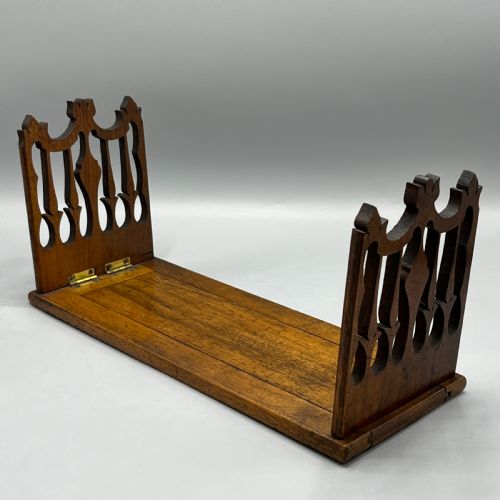


Folding Book Rack
These folding book racks offer an adjustable home for your volumes, moving smoothly from a compact rest to an extended desk display.
Folding Book Rack
A folding book rack serves the library or desk by keeping volumes upright and within reach, often expanding with a hinged or sliding mechanism. When you search for folding book racks, you encounter pieces primarily from the Victorian period alongside examples from the Regency, Edwardian, and interwar years.
The selections span various forms including book slides, book stands, and magazine racks, with the extending book slide appearing most frequently. These items originate from English workshops as well as international centres such as Jerusalem, Kashmir, and Burma.
Materials range from native timbers like oak, walnut, and mahogany to exotic woods including coromandel, teak, rosewood, and olive wood. Accents of brass, mother-of-pearl, bone, and Tunbridge ware frequently define the decorative character of these functional desktop accessories.
Materials and construction
Cabinet makers utilised dense hardwoods such as walnut, oak, coromandel, and teak to ensure the sliding and folding frames endured daily handling. These timbers were often polished to highlight natural grain patterns or ebonised for a dark, formal appearance.
Metal mounts in brass provided both structural reinforcement for the folding actions and decorative contrast against the polished wood surfaces. Inlaid details, including mother-of-pearl and bone, required precise hand-cutting to fit flush into recessed channels within the timber.
Folding Book Rack Retail Price Guide 2026
Typical asking prices for folding book rack among the pieces listed under this phrase on Sellingantiques today, from the lower quarter to the upper quarter. They describe what is for sale here now, not the wider market.
Several folding book racks bear patented mechanisms, reminding us that the Victorians loved to over-engineer even the humble task of holding a novel upright.
Assessing quality and craftsmanship
The smoothness of the extending or folding action distinguishes a superior piece from a standard one, relying on the precision of the internal mechanism. Patent designs, such as those by specific makers, often feature more sophisticated engineering that allows the rack to glide without catching.
The choice of materials and the complexity of decoration signal the tier of manufacture, from plain oak framework to elaborately carved teak or detailed Tunbridge ware mosaics. Fine specimens retain crisp carving, intact brass mountings, and unwarped wooden panels that maintain alignment along the entire extension.
Betjemanns
The Folding Book Rack Glossary
- Book slide
- A desktop stand with expanding or sliding ends designed to hold a varying number of upright volumes. It adjusts in length to secure the books between two bookends.
- Tunbridge ware
- Small wooden objects decorated with mosaic patterns formed from tiny pieces of naturally coloured timbers. This meticulous craft creates pictorial or geometric designs.
- Ebonised wood
- Timber treated with a dark stain or finish to imitate ebony. This technique was popular in the nineteenth century for achieving a formal black surface.
- Canterbury stand
- A multi-tiered piece of furniture intended for holding sheets of music, magazines, or folios. It often incorporates vertical partitions and sometimes includes a drawer or folding elements.
Folding Book Rack: Frequently Asked Questions
How do extending book slides work?
Extending book slides feature hinged or telescoping sections that pull outward to lengthen the base as more volumes are added. The upright ends remain fixed or pivot to contain the books securely.
Many nineteenth-century examples utilise a scissor action or sliding wooden tracks hidden beneath the base to maintain smooth movement when adjusted.
Where were these pieces used?
These racks found their place on library tables, gentleman's desks, and study writing surfaces where active volumes needed organisation. They kept reference books close at hand without requiring a fixed shelving bay.
Later Victorian and Edwardian variations also appeared in club lounges and drawing rooms to hold magazines, newspapers, and folios.
How do I date a folding book rack?
Dating relies on stylistic clues, timber choices, and mechanical patents rather than maker marks alone. Regency pieces often display classical proportions and rosewood or coromandel surfaces.
Victorian and later examples introduce brass mounts, eclectic revival styles, and patented sliding mechanisms stamped with maker details.
Can these racks hold heavy books?
Solid hardwood racks constructed from oak, walnut, or teak easily support standard octavo volumes and moderate reference books. The structural integrity depends on the strength of the hinges and sliding tracks.
Delicate inlaid stands or narrow novelty rests are better suited to lighter collections of poetry or thin periodicals rather than massive folios.