



Victorian Desktop Bookends
Victorian desktop bookends bring order to a study through heavy timbers and polished metals.
Victorian Desktop Bookends
Victorian desktop bookends and extending book slides serve the study and the home library by keeping volumes upright on a desk or table. The examples found here span the nineteenth century into the Edwardian period, taking the form of fixed bookends or expanding book slides with sliding wooden actions.
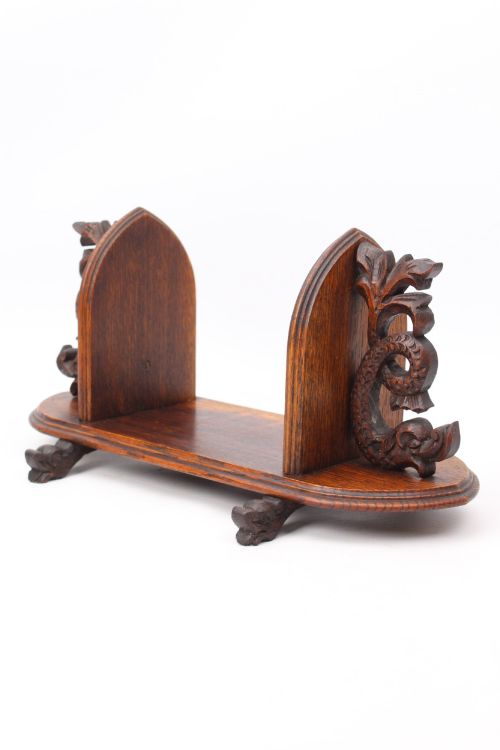
Makers of the period utilised robust native timbers alongside exotic woods, often incorporating folding mechanisms or stationary rests. Walnut and oak form the bulk of the offering, frequently reinforced with brass mounts or detailed with intricate Tunbridge ware marquetry.
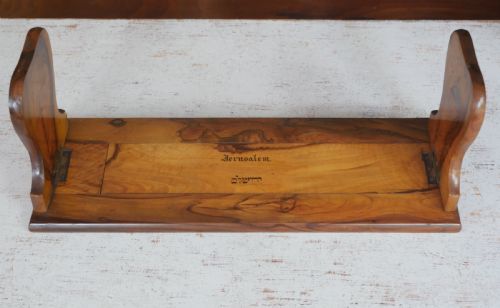
Buyers encounter regional and stylistic variations, from plain Gothic Revival oak to Kashmiri work, Olive wood from Jerusalem, and Chinese jade marble pieces. These objects reflect the breadth of nineteenth-century tastes, extending from strict British revivalism to imported decorative goods.
Materials and construction
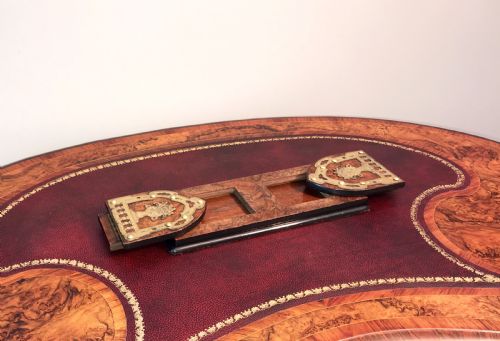
Makers constructed these pieces from dense hardwoods including walnut, oak, rosewood, and boxwood, paired with heavy brass for hinges, mounts, and extending mechanisms. Ebonised wood and olive wood also appear, providing dark surfaces or contrasting grain patterns.
Surface decoration relies on precision woodworking techniques, notably Tunbridge ware micro-mosaic tesserae and inlaid boxwood stringing. Metal components are securely fastened to timber bases to provide the weight necessary for supporting rows of heavy volumes.
The listings span three centuries of design, encompassing Victorian, Edwardian, and twentieth-century production.
Assessing quality and execution
Quality rests in the precision of the sliding mechanism and the weight of the base materials, which ensure functional stability on the desk. Heavier brass mountings and denser timbers indicate a sturdier construction designed for daily library use.
The fineness of the surface embellishment dictates the standing of an individual piece, visible in the exactness of Tunbridge ware mosaic work or the crispness of Gothic Revival carved oak details. Uniformity in grain selection and tight joinery separate standard workshop output from finer decorative examples.
The Victorian Desktop Bookends Glossary
- Book slide
- An extending desk accessory featuring two fixed ends and a sliding base that expands to hold varying numbers of books.
- Tunbridge ware
- A form of British woodwork characterised by tiny mosaic tiles assembled from different coloured woods to form geometric or pictorial scenes.
- Gothic Revival
- An architectural and decorative style drawing on medieval forms, featuring pointed arches, heavy tracery, and robust proportions.
- Ebonised
- Timber treated with a dark finish to imitate expensive ebony.
- Boxwood
- A pale, dense wood frequently used for contrasting stringing and inlay work.
Victorian Desktop Bookends: Frequently Asked Questions
What is the difference between bookends and a book slide?
Bookends consist of two separate upright supports placed at either end of a row of volumes to keep them vertical. A book slide incorporates an extending base connecting both ends into a single adjustable unit that expands or contracts as books are added or removed.
Slides often feature folding or sliding mechanisms built into the woodwork, whereas traditional bookends rely solely on their own weight and friction against the desk surface.
How were these pieces used on a Victorian desk?
Writers, scholars, and professionals placed them on desks, reading tables, and library shelves to keep frequently referenced volumes within arm's reach. They prevented heavy ledgers and reference books from sliding sideways or tipping over.
In domestic settings, smaller slides sat on parlour tables to display poetry collections, albums, or imported souvenir books brought back from foreign travel.
How can I tell the period of a book slide?
Dating relies on timber choices, decorative styles, and engineering methods visible in the sliding actions and brass mounts. Pieces from the middle of the nineteenth century frequently employ solid walnut with substantial brass brackets, whilst later items might show Edwardian Gothic Revival influences or specific regional decorative techniques.
The presence of specific regional motifs, such as Jerusalem olive wood or Kashmiri carving, also helps place an item within its era of production.
Do extending book slides require maintenance?
The wooden runners benefit from occasional light cleaning to remove dust from the tracks and keep the extension smooth. Hardwood surfaces respond well to standard wax polishing to preserve the grain and protect the timber from drying out in heated rooms.
Metal components such as brass mounts require no harsh cleaning; a gentle wipe maintains their natural aged lustre without stripping the original patina.