




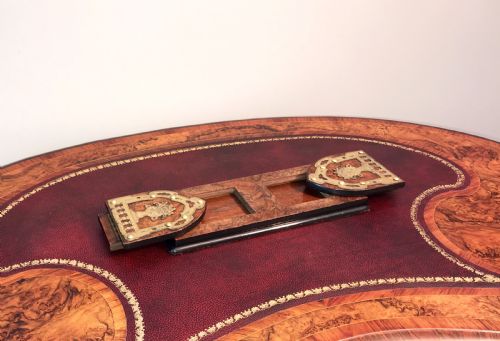
Wooden Sliding Bookends
Wooden sliding bookends are clever expanding desk accessories designed to hold row upon row of volumes upright.
Wooden Sliding Bookends
Wooden sliding bookends, often catalogued as book slides or book stands, are practical desk accessories engineered to adjust in length as your collection of volumes grows or shrinks. When you search for wooden sliding bookends, you encounter expanding platforms flanked by two upright ends that slide smoothly along a base to secure your books.
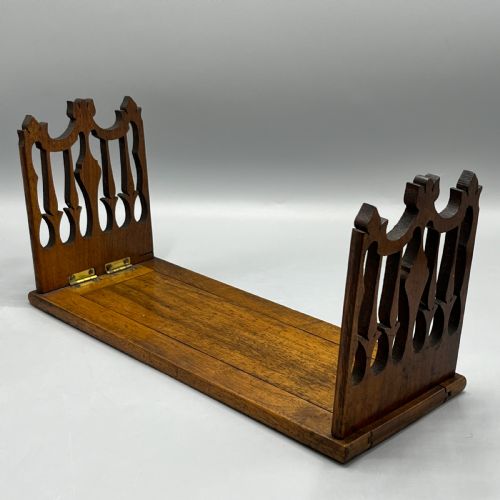
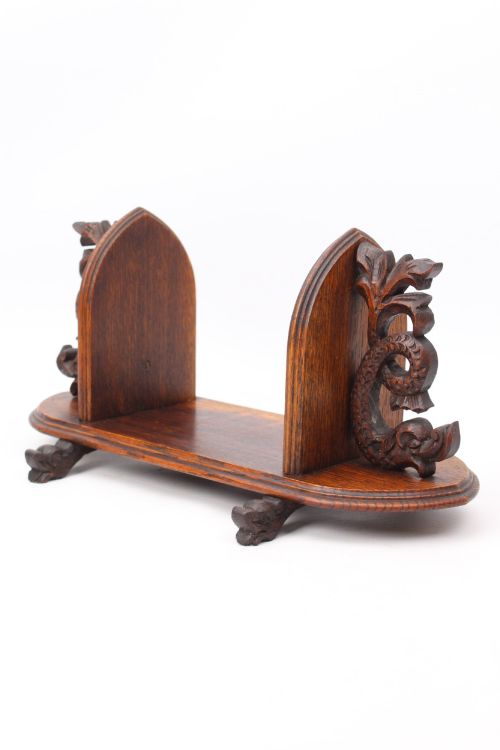
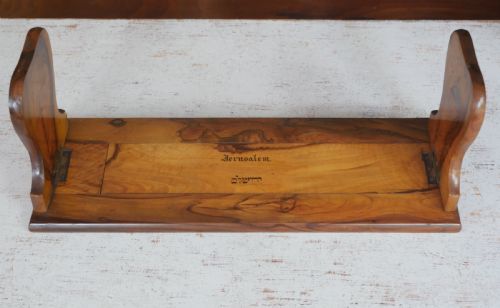
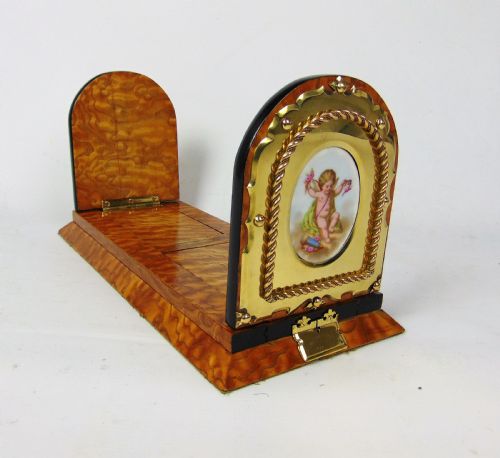
The versions you meet most frequently on this page belong to the Victorian era, spanning various regional interpretations from English workshops to Jerusalem and Kashmir. These pieces range from simple domestic library furnishings to more decorative desk accessories fitted with brass mounts or intricate inlaid details.
How they were made
Cabinet makers constructed these sliding bookends using timbers such as walnut, oak, rosewood, boxwood, ebonised wood, and olive wood, frequently pairing them with contrasting metal hinges or brass mounts to facilitate the extension mechanism. Tunbridge ware examples display meticulous mosaic woodwork, creating detailed geometric or pictorial surface patterns from small blocks of naturally coloured wood.
Makers also employed specialised carving and turning techniques, particularly seen in the Gothic Revival pieces featuring architectural tracery and in the finely detailed surface ornamentation typical of Kashmiri and Anglo-Indian production.
Several pieces are specifically described as housing a novel rest, ready to hold your latest reading matter open at the correct page.
What varies in quality
The distinction between ordinary and superior pieces rests upon the precision of the sliding mechanism and the integrity of the timber used in the base. A well-made sliding bookend operates smoothly without binding, keeping both upright ends parallel as the platform expands.
Quality also shows in the decorative execution, from the sharpness of Gothic Revival carving to the complexity of the wood mosaics on Tunbridge ware or olive wood surfaces. Finer examples display careful timber selection and robust construction that withstands the lateral pressure of heavy volumes.
The Wooden Sliding Bookends Glossary
- Book slide
- An extending desk accessory designed to hold books upright between two adjustable ends. These pieces lengthen or shorten to accommodate varying numbers of volumes.
- Tunbridge ware
- A form of nineteenth-century woodwork originating from Kent, featuring mosaic patterns built from tiny blocks of various coloured woods. This technique creates detailed pictorial or geometric designs on the surface of the object.
- Gothic Revival
- A nineteenth-century design style drawing inspiration from medieval architecture. Pieces in this style often incorporate pointed arches, trefoils, and heavy oak construction.
- Ebonised wood
- Timber treated with a dark finish to imitate expensive ebony. This process was commonly utilised in Victorian workshops to create a formal, high-contrast appearance.
Wooden Sliding Bookends: Frequently Asked Questions
How do wooden sliding bookends work?
These pieces feature a central base split into overlapping sections that glide past one another. This mechanism allows the two upright ends to move outward or inward while remaining upright.
Users adjust the span to fit the exact width of the books placed between them, providing stable support without fixed partitions.
Are these bookends sturdy enough for heavy books?
Most wooden sliding bookends are built to support standard library volumes and reference books. The internal wooden tracks and metal hinges provide adequate resistance against the weight of the row.
Heavier architectural or leather-bound volumes require sturdier timber frames, such as oak or walnut, to prevent the extending base from bowing under pressure.
How do I date a Victorian book slide?
Dating relies on observing the timber choices, decorative motifs, and construction methods characteristic of the period. Gothic Revival pieces often point toward the mid to late nineteenth century.
Makers frequently incorporated brass mounts, Tunbridge ware mosaics, or specific regional woods like olive wood or Kashmiri timbers that help narrow down the decade of manufacture.
Where were these pieces used in the home?
They typically sat upon library tables, writing desks, and drawing room sideboards where smaller collections of favourite volumes were kept close at hand. Their adjustable nature made them ideal for spaces where the book selection changed frequently.
Unlike fixed bookends, they kept disordered rows of books tidy on flat surfaces without requiring the end support of a wall or shelf divider.