

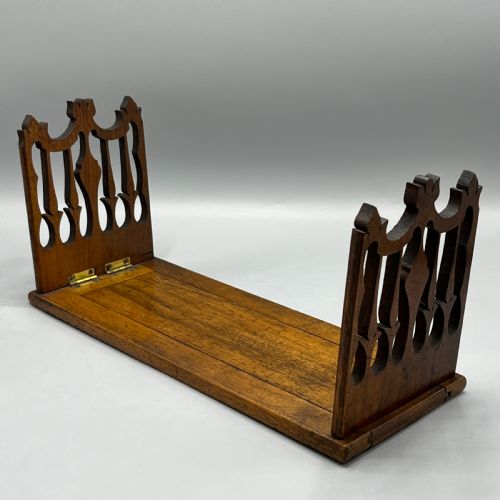


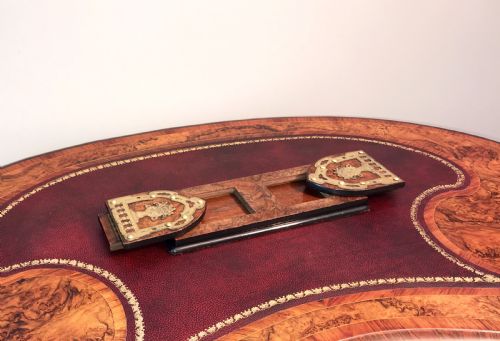
Extending Book Stand
These extending book stand pieces are practical library accessories designed to hold rows of volumes firmly on a desk.
Extending Book Stand
An extending book stand expands to fit a varying number of volumes on a desk or shelf. Most examples on this page date from the Victorian period through to the Edwardian era.
The objects take forms such as book slides, book racks, and sliding bookends. Common origins and styles include English workmanship, Anglo-Indian carving, and Tunbridge Ware.
How they were made
Cabinet makers utilised timbers such as walnut, oak, rosewood, and olive wood for the expanding bodies. Brass hinges, mounts, and extending mechanisms provided structural strength and decorative contrast.
Surface decoration involved ebonising, bone inlay, pietra dura plaques, and intricate carved teak. These techniques combined to create functional yet ornamental desk accessories for the home library.
Extending Book Stand Retail Price Guide 2026
Typical asking prices for extending book stand among the pieces listed under this phrase on Sellingantiques today, from the lower quarter to the upper quarter. They describe what is for sale here now, not the wider market.
Some book slides travelled back from Jerusalem around 1900, carved from local olive wood for travellers.
What varies in quality
The refinement of the extending mechanism and the precision of the sliding action separate standard pieces from finer examples. Solid brass mounts and smooth hinges indicate superior construction.
Decorative embellishment marks the upper tier of objects, seen in detailed pietre dure work, fine Tunbridge Ware, and deeply carved teak. Plain timber bodies sit at the simpler end of the range.
The Extending Book Stand Glossary
- Book slide
- An adjustable rack designed to hold a row of books upright between two expanding ends. This is the primary form found in this category.
- Tunbridge Ware
- Woodworking characterised by tiny mosaic tiles forming pictorial or geometric surface patterns. It originates from Tunbridge Wells in Kent.
- Pietra Dura
- Inlay work using polished coloured stones to create decorative images. It frequently appears as a floral panel inset into the timber base.
- Ebonised wood
- Timber stained or painted black to imitate ebony. This finish was popular during the Victorian era for desk accessories.
Extending Book Stand: Frequently Asked Questions
What is an extending book stand used for?
These pieces hold a variable row of books upright on a desk, table, or library shelf. The expanding mechanism adjusts to accommodate more or fewer volumes as needed.
They served as functional desk accessories in nineteenth and early twentieth century homes and offices.
How do I date an extending book slide?
Dating relies on the timber used, the style of decoration, and the manufacturing techniques visible in the piece. Victorian examples often feature brass mounts and walnut or ebonised wood.
Later pieces from the Edwardian period frequently utilise simpler oak frames.
What materials are common on these book stands?
Common materials include hardwoods such as walnut, oak, rosewood, olive wood, and teak. Metal components like brass appear frequently on the extending mechanisms and mounts.
Some examples incorporate bone inlay, pietra dura stone panels, or ebonised finishes.
Where were these book stands made?
Many examples originate from English workshops active during the nineteenth century. Other geographic styles include Anglo-Indian carved teak pieces and Tunbridge Ware items.
Specialist items also arrived from locations such as Jerusalem, utilising local olive wood.