


Edwardian Book Slide
An Edwardian book slide keeps your current reading organised on a desk with a simple extending action.
Edwardian Book Slide
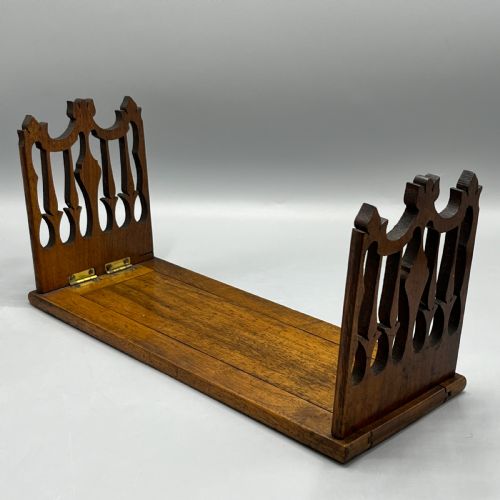
An edwardian book slide is a desk accessory designed to hold a small row of volumes upright between two hinged or sliding ends. When you browse this selection, you encounter extendable tabletop pieces that adjust in length to fit your collection.
The pieces listed here appear in dense timbers like oak and walnut, often fitted with metal mounts or novel rests. Most examples follow straightforward domestic forms intended for everyday library or study use.
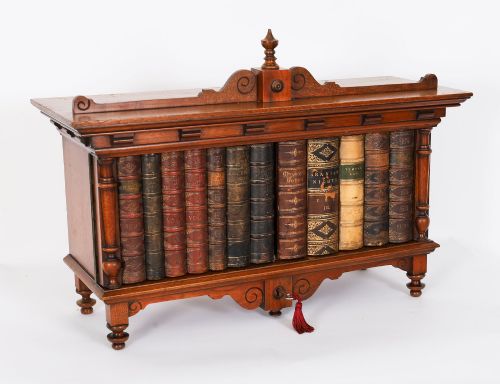
While Victorian predecessors lean towards heavy gothic revivals and coromandel finishes, edwardian versions favour cleaner timber grains and simpler operating mechanisms. You also find related items such as book troughs and desktop cabinets alongside the core slides.
Materials and Construction
Cabinet makers constructed these pieces using solid hardwoods like oak, walnut, and mahogany, frequently selecting quarter-sawn boards for stability. Timber sections were joined with precise box or mitre joints to withstand the constant pulling action of the extending mechanism.
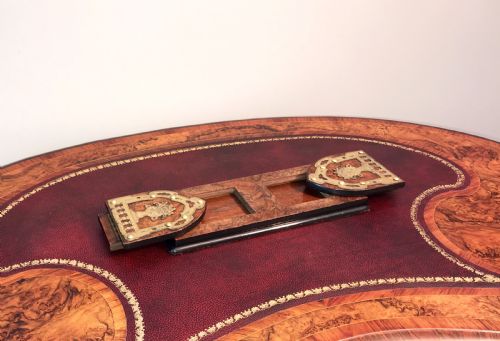
Brass formed the primary metal component for hinges, mounts, and extending scissor actions, screwed directly into the timber frame. Some variants incorporated ebonised wood or leather surfaces to add contrast to the main wooden body.
Desk accessories in this selection range from simple extending slides to occasional tables and desktop cabinets.
Evaluating Quality
The standard of a piece rests upon the smoothness of the extending action and the snugness of the joints when fully expanded. Superior items move without binding, guided by well-fitted metal tracks rather than loose wooden channels.
Material selection dictates the upper tier of execution, where figured walnut or richly grained oak displays careful grain matching across the moving leaves. Lesser examples rely on plain timber boards with minimal attention to surface finish or decorative mounts.
The Edwardian Book Slide Glossary
- Extending book slide
- A desktop stand with sliding or folding ends that expands to accommodate varying numbers of books. This design keeps volumes upright without needing full bookends.
- Novel rest
- A hinged or adjustable support attached to a book slide to hold an open volume at a readable angle. This feature was popular in studies and home libraries.
- Ebonised wood
- Timber treated with a dark stain or finish to imitate ebony. This technique provided a sharp black contrast against brass mounts.
- Book trough
- An open-topped wooden container designed to hold books upright on a table. Unlike a slide, it maintains a fixed width.
Edwardian Book Slide: Frequently Asked Questions
What is an edwardian book slide?
An edwardian book slide is an adjustable desktop accessory built to keep a small selection of books tidy between two upright ends.
These pieces feature an extending mechanism that allows the user to lengthen or shorten the base as volumes are added or removed.
How do you use a book slide?
You place the slide on a desk, table, or shelf and set your books between the two ends.
Pull the sides outward to accommodate more reading material, letting the central mechanism adjust to support the weight securely.
What woods were used for these?
Cabinet makers predominantly used oak and walnut for these desk accessories, occasionally turning to mahogany or fruitwood.
Selected examples feature ebonised finishes or brass mounts to decorative effect.
How do edwardian slides differ from victorian ones?
Edwardian pieces generally exhibit cleaner lines and simpler timber grains compared to earlier designs.
Victorian counterparts frequently display heavier gothic revival styling, coromandel veneers, or more elaborate brass ornamentation.