
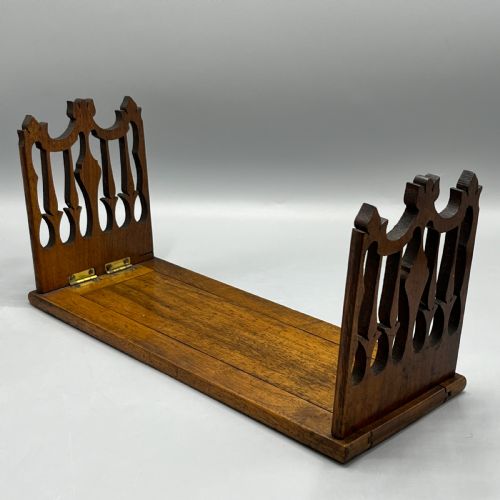



Expanding Desktop Book Rack
These expanding desktop book racks keep your volumes upright and tidy on a working desk, offering a clever mechanism that grows as your library expands.
Expanding Desktop Book Rack
An expanding desktop book rack is a practical desk accessory designed to hold books securely between two hinged or sliding ends. When you search for an expanding desktop book rack, you will find Victorian and Edwardian examples that adjust smoothly to accommodate varying numbers of volumes.
The pieces appearing on this page span several decades from the nineteenth century into the early twentieth century. Walnut, coromandel, and oak form the structural base for many items, whilst brass mounts and painted plaques provide decorative contrast.
How They Were Made
Cabinetmakers constructed these extending book racks using dense timbers such as walnut, rosewood, and coromandel to withstand the daily friction of the sliding mechanism. Brass hinges and mounts were screwed securely into the wooden bases to reinforce the moving joints.
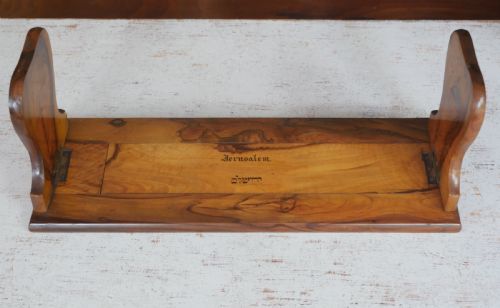
Surface decoration involved specialised techniques like Tunbridge ware mosaic, pietra dura inlay, and hand-painted porcelain plaques set flush into the timber. Skilled artisans carved teak for Anglo-Indian pieces and shaped olive wood for Jerusalem-made variants.
Materials span walnut, rosewood, oak, coromandel, and olive wood, alongside brass, bone, and porcelain.
What Varies in Quality
The fluidity of the extending action distinguishes finer examples from simpler desk accessories. Smooth sliding movement relies on precise joinery within the expanding mechanism.
Material selection dictates the upper tier of the range, where exotic woods like coromandel and burr walnut are paired with intricate pietra dura or porcelain inlays rather than plain oak.
Betjemanns patent
The Expanding Desktop Book Rack Glossary
- Book slide
- A desk accessory with expanding or sliding sections designed to hold a row of books upright. It sits easily on a table or desktop.
- Tunbridge ware
- A form of British woodwork characterised by tiny mosaic tiles forming pictorial or geometric patterns. These geometric mosaics decorate the wooden surfaces.
- Pietra dura
- An artistic technique using cut and fitted polished coloured stones to create images. This stonework appears inlaid into the wooden body of the rack.
- Coromandel
- A dense and heavily variegated timber imported from Asia, valued for rich dark brown colour and striking black grain. Cabinetmakers used it for luxury nineteenth-century boxes and book slides.
- Betjemanns patent
- A mechanical action patented by the Betjemann firm, allowing book slides to extend smoothly. This ingenious sliding mechanism is frequently found on walnut and brass pieces.
Expanding Desktop Book Rack: Frequently Asked Questions
How do expanding book racks work?
Most designs feature overlapping wooden bases or folding hinged sections that pull outward to lengthen the platform. This allows the ends to stay upright as more volumes are added.
Brass tracks and scissors mechanisms keep the movement aligned and steady during daily desk use.
Where were these book racks placed?
They sat on writing desks, library tables, and study bureaus to keep a working selection of reference books close at hand. Victorian home libraries and offices utilised them extensively.
Their compact footprint made them suitable for smaller reading spaces as well as grander rooms.
How do I care for wooden book slides?
Keep the timber away from direct heat sources and sudden temperature shifts to prevent the wood from warping. Gentle dusting with a dry cloth protects the polished surface.
Avoid using harsh chemical polishes on delicate inlays like pietra dura or painted porcelain.
How can I tell the period of a rack?
Look closely at the timber choice, decorative motifs, and patent stamps to gauge the manufacturing era. Walnut and coromandel with brass mounts typically point to mid-Victorian production.
Oak versions with simpler lines often date to the Edwardian period.