


Desktop Book Rest
These desktop book rest pieces are solid timber and metal supports designed for reading or display, offering period character for any library.
Desktop Book Rest
A desktop book rest provides a stable surface for holding volumes open upon a desk or table. When you search for a desktop book rest, you encounter practical reading aids and display stands from several distinct periods.
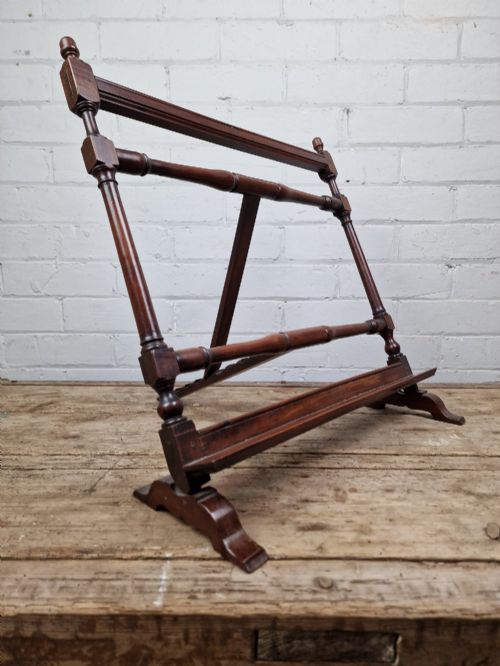
The pieces appearing here include extending book slides, table-top easels, book troughs, and folding bookstands. Mahogany, oak, and ebonised wood dominate the selection, often fitted with brass hardware.
Most examples date from the Victorian and Edwardian eras, alongside Regency pieces and a single Art Deco mahogany book trough from nineteen thirty. You also find specialised forms such as Mauchline Ware whitewood transfer lecterns and carved teak Anglo-Indian novel rests.
How they were made
Cabinet makers constructed these items primarily in timbers like mahogany, oak, walnut, coromandel, and ebony. Skilled joinery allowed extending book slides to pull smoothly via folding actions or sliding mechanisms.
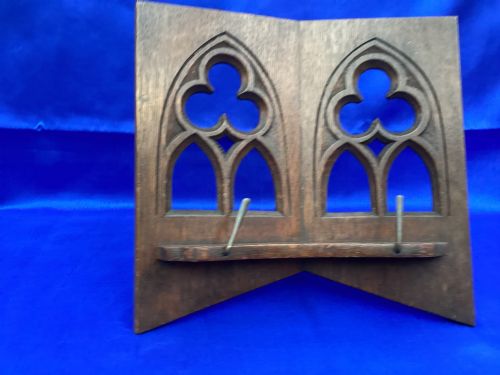
Many examples incorporate cast or polished brass components to strengthen joints, hinge reading ledges, or secure decorative panels. Detail work ranges from Gothic Revival carving and coromandel inlays to mother of pearl accents and transfer printing on Mauchline Ware.
Materials across these listings include solid brass, mahogany, oak, ebonised wood, metal, coromandel, mother of pearl, and ebony.
What varies in quality
Quality rests upon the selection of timber and the precision of the mechanics in extending slides and folding hinges. Dense woods like ebony and coromandel, paired with substantial brass fittings, separate heavier library pieces from lighter decorative items.
The refinement of decorative elements also defines the standard of the piece, from simple turned supports to intricate Gothic Revival carving or specialised Anglo-Indian teak work.
The Desktop Book Rest Glossary
- Book slide
- An extending desktop rack designed to hold a varying number of upright volumes between two ends.
- Mauchline Ware
- Souvenir items made from whitewood featuring photographic transfers of local scenes or landmarks.
- Coromandel
- A dense, heavily figured exotic timber utilised in high-end nineteenth century cabinet making.
- Gothic Revival
- An architectural and decorative style drawing on medieval forms, featuring pointed arches and heavy moulding.
- Novel rest
- A nineteenth century term for a small desktop reading stand or book slide.
Desktop Book Rest: Frequently Asked Questions
How do extending book slides work?
Extending book slides feature overlapping wooden bases that pull outward to accommodate more volumes and push inward to save space. The inner mechanism often moves smoothly on hidden tracks.
Many designs incorporate hinged ends that fold flat when not in use or remain fixed at an upright angle to keep the books secure.
What is Mauchline Ware?
Mauchline Ware consists of small wooden items, including reading stands and boxes, decorated with detailed photographic transfers. These pieces were produced as souvenirs in Scotland during the nineteenth century.
The underlying wood is typically whitewood, finished with a clear varnish to protect the printed transfer on the surface.
Where were these stands used?
These reading stands sat upon desks, library tables, and writing cabinets in private homes and offices. They kept reference volumes or current novels close at hand.
Larger folding stands and table-top easels also served to display heavy folios or Bibles in studies and drawing rooms.
How do I identify a Victorian book rest?
Victorian examples frequently combine dark timbers like mahogany or ebonised wood with heavy brass fittings and Gothic Revival motifs. The construction relies on traditional joinery methods common to the nineteenth century.
Stylistic cues such as pierced brass galleries, carved teak, or extendable slide mechanisms point directly to this period.