


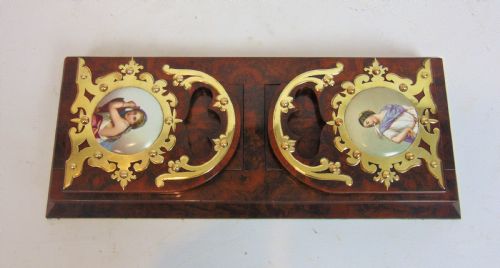


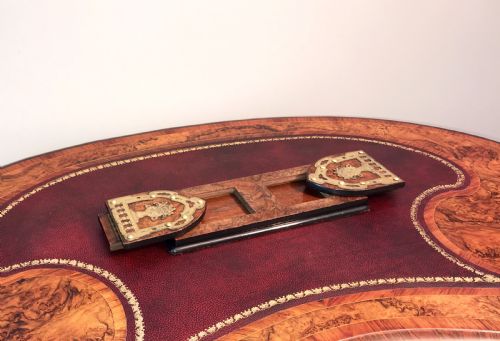
Burr Walnut Desk Accessory
A burr walnut desk accessory brings figured timber and brass to a study, offering both period utility and decorative presence on a writing table.
Burr Walnut Desk Accessory
A burr walnut desk accessory encompasses items designed for correspondence, reading, and organisation, originating mainly from the nineteenth century. The selection includes stationery boxes, writing slopes, book slides, and inkstands shaped by Victorian, French Second Empire, and Art Deco influences.
The most frequent pieces met on this page are writing slopes and stationery boxes, alongside book slides and desk sets. These items utilise burr walnut and plain walnut veneers, frequently highlighted with brass mounts, porcelain plaques, or mother-of-pearl.
Makers and craftsmen of the nineteenth century produced these desk accessories to suit the demands of the library and study. Pieces span from simple compact inkwells to grand double-sided desk sets and cigar cabinets.
Materials and construction
Makers constructed these pieces using solid walnut and decorative burr walnut veneers applied over secondary woods to display complex grain patterns. Brass escutcheons, hinges, and corner mounts provided structural reinforcement and contrast against the dark timber.
Interiors often incorporated velvet or leather writing surfaces, fitted compartments for stationery, and specialised hardware such as Bramah locks. Decorative elements like hand-painted porcelain plaques and glass inkwells were integrated into book slides and desk sets.
Burr Walnut Desk Accessory Retail Price Guide 2026
Typical asking prices for burr walnut desk accessory among the pieces listed under this phrase on Sellingantiques today, from the lower quarter to the upper quarter. They describe what is for sale here now, not the wider market.
Gentlemen tucked their cigars away in locking walnut cabinets, keeping fine tobacco safe from curious houseguests.
Assessing quality in desk accessories
Quality rests upon the selection and matching of the burr walnut veneer across the visible surfaces of the piece. Superior examples display dense, symmetrical figuring that wraps neatly around corners and lids.
The integration of secondary materials defines the tier of a piece, from plain brass banding to finely painted porcelain plaques and fitted working locks. Heavier mountings and robust internal fittings separate standard utility pieces from grander cabinetmaker productions.
The Burr Walnut Desk Accessory Glossary
- Burr walnut
- A figured wood veneer taken from the growth excrescence on a walnut tree. It produces swirling, knotty patterns highly prized by nineteenth-century cabinetmakers.
- Writing slope
- A portable box with a hinged sloping lid that opens to reveal a flat or angled surface for writing. They typically contain compartments for pens, ink, and stationery.
- Stationery box
- A desktop cabinet designed to hold envelopes, paper, and letters upright. Many feature domed or sloping lids with locking mechanisms.
- Book slide
- An expanding or fixed stand designed to hold a row of books upright on a desk or table. They frequently incorporate decorated ends made of brass, wood, or porcelain.
- Bramah lock
- A high-security cylindrical lock patented by Joseph Bramah in the late eighteenth century. They are commonly found on better-quality Victorian boxes and slopes.
Burr Walnut Desk Accessory: Frequently Asked Questions
How do I date a Victorian desk accessory?
Dating relies on stylistic clues, construction methods, and materials such as brass mounts, porcelain plaques, or specific lock types. Victorian pieces frequently feature Gothic Revival motifs or French influences.
Purchasing pieces with documented periods helps establish a reliable timeline of manufacture.
What are writing slopes used for?
Writing slopes served as portable desks for letter writing and document storage before the widespread use of fitted study furniture. The hinged lid folds down to create a slanted writing surface lined with leather or velvet.
Internal compartments store inkwells, pens, stamps, and stationery papers securely during travel.
How do I clean burr walnut?
Burr walnut requires gentle maintenance using a soft, dry cloth to remove dust. Avoid harsh chemical cleaners or excess moisture which can damage the delicate veneer and polish.
Applying a quality beeswax periodically helps nourish the wood and preserve the lustre of the grain.