
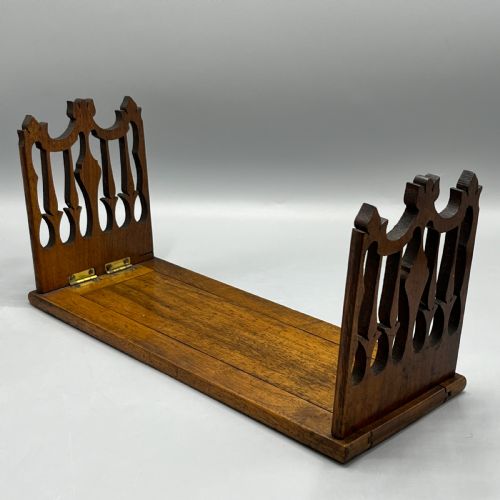
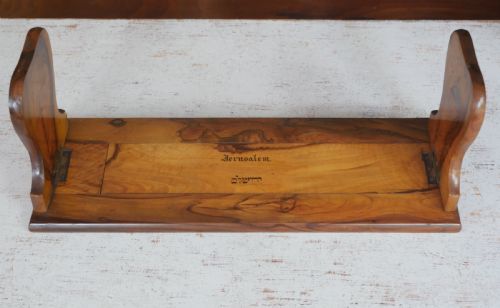


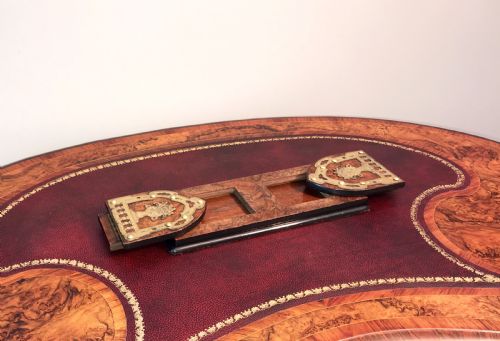
Extending Desktop Book Rack
An extending desktop book rack keeps volumes tidy on a desk, sliding out smoothly to hold a growing row.
Extending Desktop Book Rack
An extending desktop book rack offers a practical and adjustable method for keeping volumes upright and close at hand in a study or library. These desk accessories expand and contract on a sliding mechanism to fit varying numbers of books as a collection grows or shrinks.
The versions met most often on this page date from the Victorian era, spanning the mid-nineteenth century through to the early twentieth century. Walnut and oak form the foundation of many pieces, often paired with brass mounts or detailed inlays.
How they were made
Cabinet makers utilised dense hardwoods such as walnut, oak, mahogany, rosewood, and olive wood to construct the folding or sliding sides. Ebonised wood and coromandel also appear, providing deep colour and a fine surface texture.
Brass mountings reinforce the hinges and sliding actions, while specialised decoration such as pietra dura, Tunbridge ware, and carved teak mark out specific regional and workshop traditions.
Some Victorian examples incorporated folding novel rests so a reader could prop up a book while keeping the rest of the shelf closed.
What varies in quality
The smoothness of the sliding action and the precision of the brass mechanism separate simpler items from finer examples. Solid timber construction and crispness in carved or inlaid details distinguish the work of skilled makers.
The presence of decorative inlays, such as pietra dura panels or Tunbridge ware mosaics, elevates a standard desk accessory into a piece of decorative art.
The Extending Desktop Book Rack Glossary
- Book slide
- A desk accessory with expanding sides designed to hold a row of books upright. It is the primary alternative term for an extending desktop book rack.
- Pietra dura
- An inlay technique using cut and fitted polished coloured stones to form pictorial designs. It appears on select Victorian surfaces.
- Tunbridge ware
- Woodworking craftsmanship featuring tiny mosaic tiles made from different natural woods to create intricate geometric or pictorial motifs.
- Coromandel
- A dense and heavily variegated wood from Asia, prized for rich dark brown colouring and striking figure. It forms the body of select nineteenth-century pieces.
Extending Desktop Book Rack: Frequently Asked Questions
What is an extending desktop book rack?
It is an adjustable desk accessory designed to hold a row of books securely between two hinged or sliding ends. The base expands or contracts to accommodate different quantities of volumes.
These pieces sat on library tables and writing desks to keep working volumes orderly and within arm reach.
How do you use an extending book rack?
Place the rack on a flat surface and pull the two ends outward to create space for the books you wish to display or consult. Slide the ends inward until they rest firmly against the outside covers.
This keeps the volumes upright without needing traditional heavy bookends at either side.
What materials are common on these book racks?
Hardwoods form the main body of these pieces, with walnut, oak, mahogany, and rosewood appearing frequently. Exotic woods like coromandel and olive wood also feature alongside ebonised finishes.
Brass hardware is standard for the hinges, mounts, and sliding tracks that allow the mechanism to function.
How can you tell the period of a book rack?
Stylistic clues such as Gothic revival brass strapwork, Tunbridge ware mosaics, or pietra dura panels point toward the Victorian era. Oak versions often date from later periods including Edwardian and nineteen-thirty designs.
The choice of timber and the construction of the sliding mechanism also offer clear indications of date.