
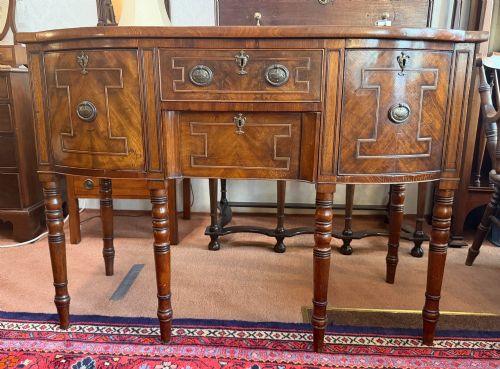
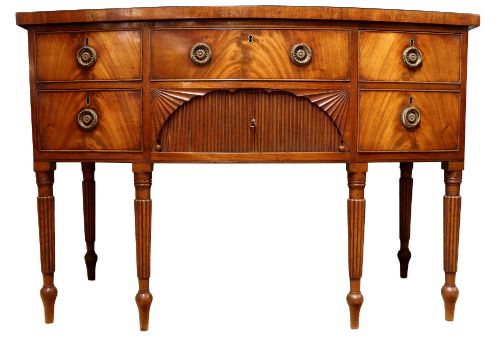
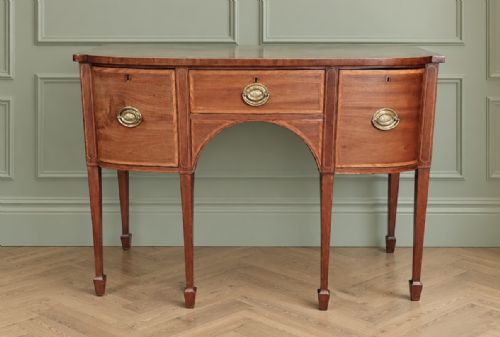
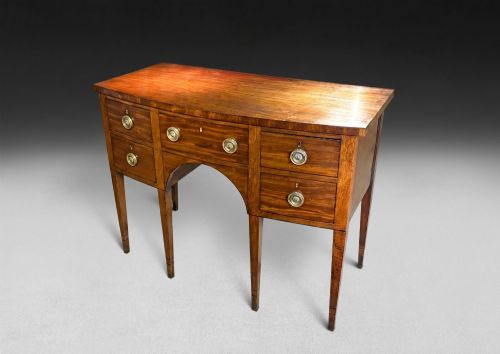
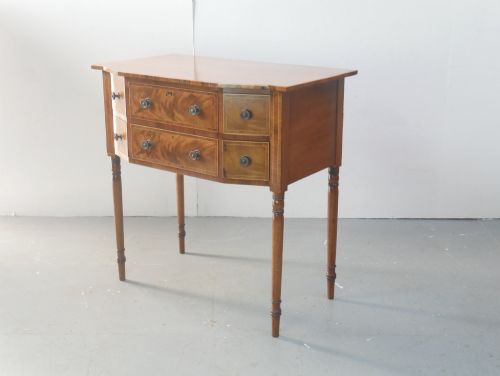
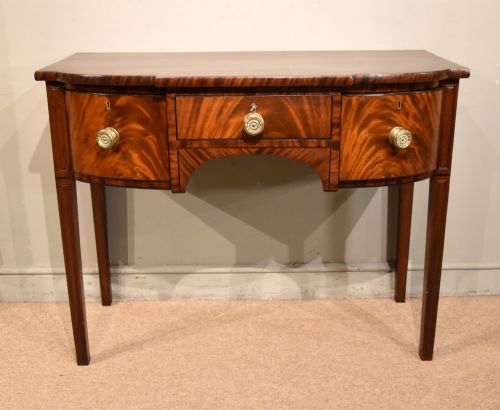
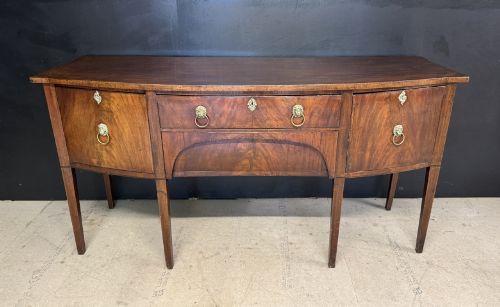
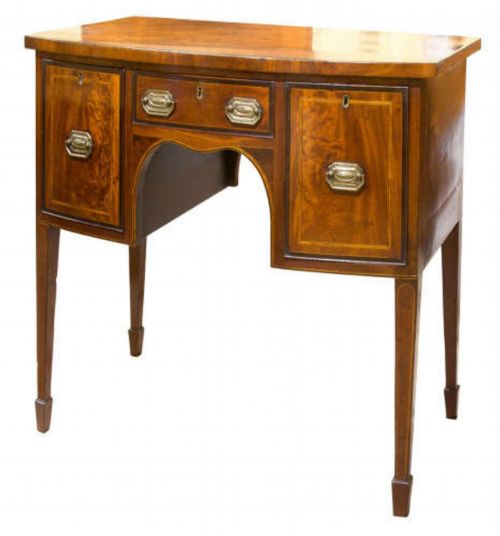
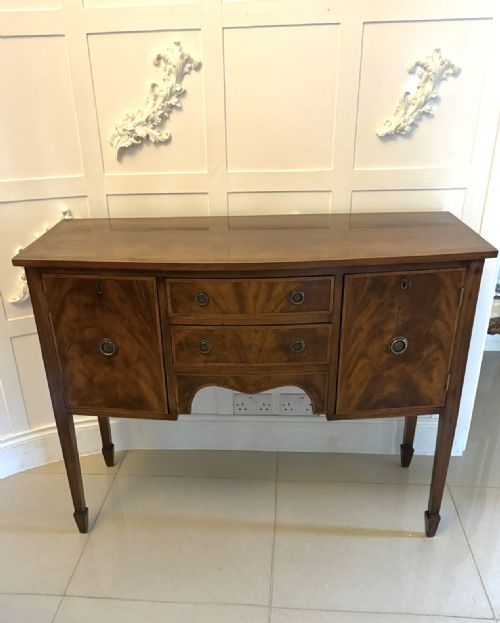

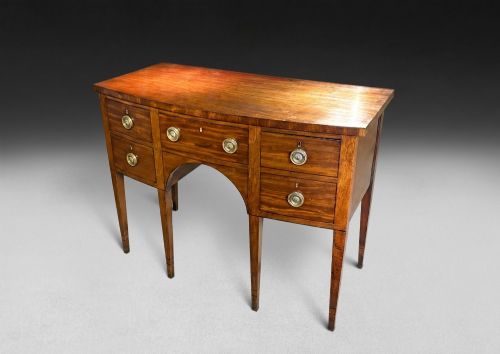
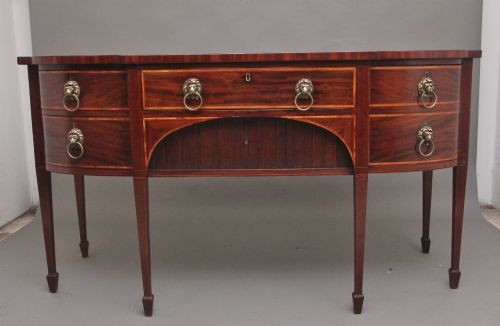


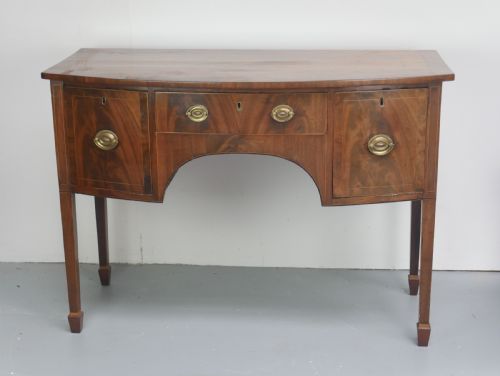
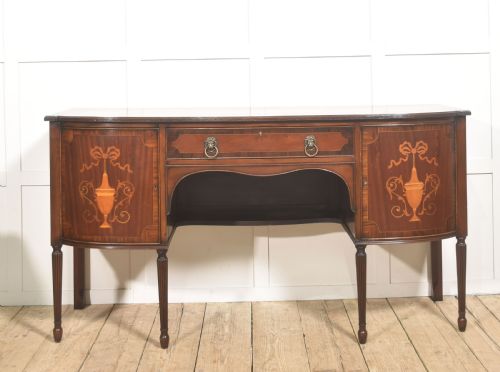
Bowfront Sideboard Table
These bowfront sideboard table designs bring curved mahogany storage and serving surfaces into the dining room.
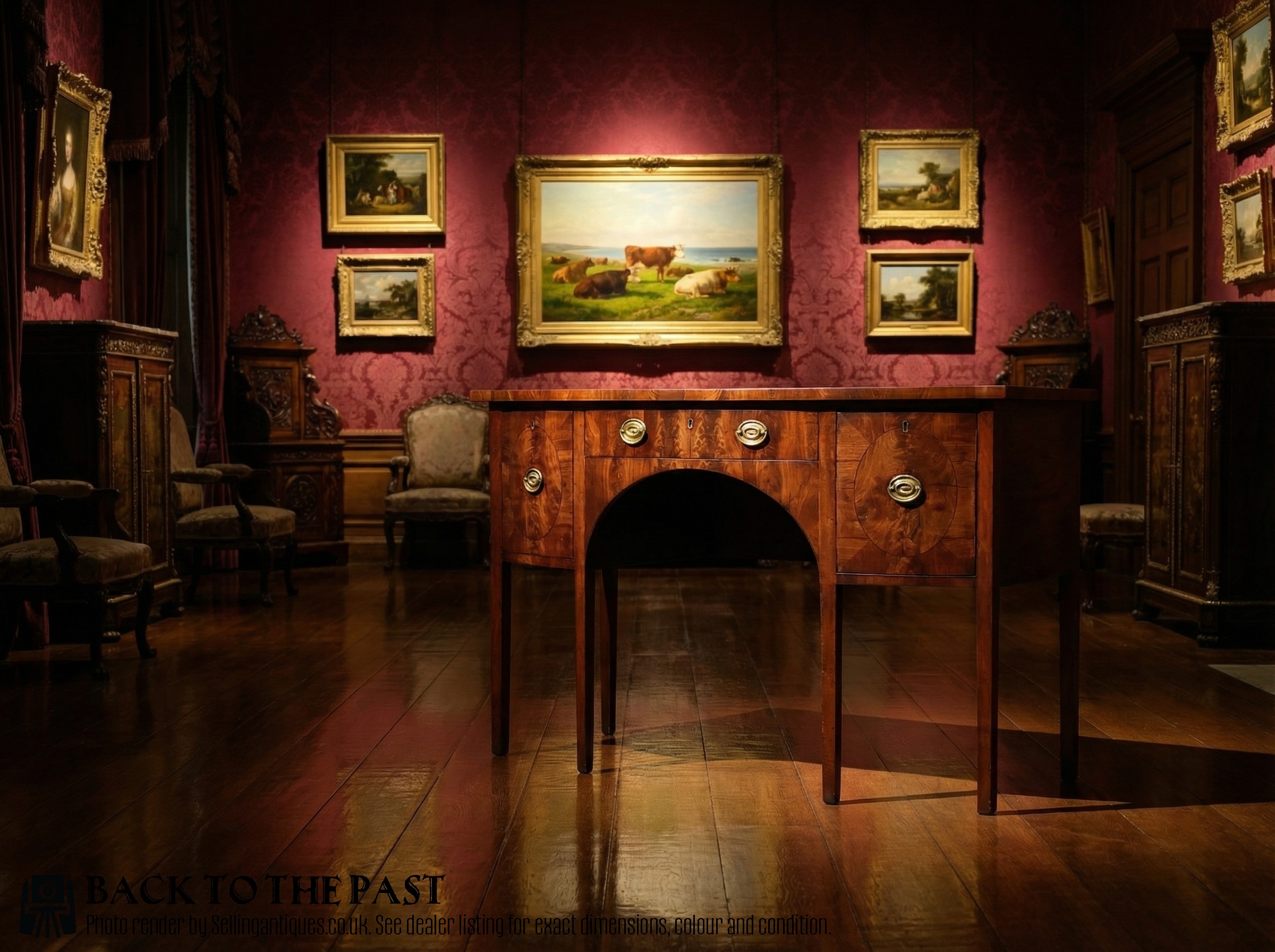
Bowfront Sideboard Table
A bowfront sideboard table is a dining room server designed with a convex curved front that projects outward into the room. You will regularly encounter Georgian and Regency examples, alongside later Edwardian interpretations.
The form functions primarily as a serving piece and storage cabinet for dining wares, often resting on four or six legs. Pieces range from compact small sideboards to larger serving tables with fitted drawers.
Originating largely in the eighteenth and nineteenth centuries, these items combine practical storage with decorative woodwork. The curved profile softens the linear geometry of traditional dining spaces.
Materials and construction methods
Cabinet makers utilised solid mahogany and flame mahogany veneer as the primary structural and visual surfaces. Artisans applied boxwood and satinwood inlay or stringing to accent the drawer fronts and borders.
Brass handles and fittings complete the hardware scheme on period pieces. Secondary details include boxwood inlay and purpleheart banding to create contrast along the curved edges.
Some six-legged sideboards offer extra stability for enthusiastic carving.
Factors that define quality
Quality rests upon the selection of timber figures and the precision of the inlay work. Finer examples display carefully matched flame mahogany veneers and crisp boxwood stringing.
Structural proportion and the integrity of the curved bowfront define the higher tier of cabinetmaking. Superior pieces maintain clean joinery and balanced proportions across six-legged or four-legged formats.
The Bowfront Sideboard Table Glossary
- Bowfront
- A convex curved furniture front that projects outward. This sweeping profile defines the primary shape of the sideboard table.
- Inlay
- A decorative technique where contrasting woods such as boxwood or satinwood are inserted into recesses in the primary timber. It creates crisp linear borders along the drawers.
- Crossbanding
- A border of veneer laid with the grain running perpendicular to the surrounding wood. This technique frames the top and drawer fronts of better cabinets.
- Flame mahogany
- A veneer cut from timber where the grain resembles flickering flames. It provides rich visual movement across the broad surfaces.
- Sheraton
- A neoclassical furniture style associated with the late eighteenth century. Pieces in this manner feature refined proportions and delicate inlay.
Bowfront Sideboard Table: Frequently Asked Questions
What is a bowfront sideboard table?
A bowfront sideboard table is a dining room storage and serving piece featuring a convex curved front. These cabinets combine surface space with internal drawers.
They emerged strongly during the Georgian and Regency periods, utilising mahogany and decorative inlay to enhance dining interiors.
How do I date a sideboard?
Dating relies upon timber selection, hardware style, and construction characteristics associated with Georgian, Regency, or Edwardian eras. Cabinetmaking techniques evolved from hand-cut joinery toward later industrial methods.
Examining the secondary woods and veneer types helps clarify the period of manufacture.
Where were these sideboards placed?
These pieces traditionally stood against the dining room wall to hold serving dishes, cutlery, and glassware during meals. Their curved profile allowed easy movement around them in crowded rooms.
They also served as display surfaces for silver and porcelain when dining rooms were not in active use.
What woods are used?
Mahogany serves as the primary structural and visible timber across the majority of pieces. Flame mahogany veneer provides figured surfaces on the main drawer fronts.
Accents of boxwood, satinwood, and purpleheart appear as inlay, stringing, and banding details.