
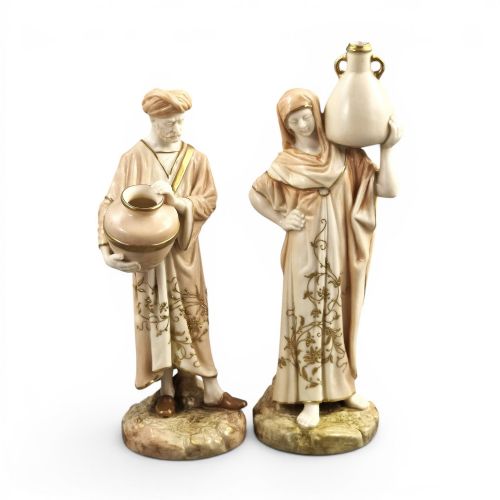


Blush Ivory Porcelain Figurine
A blush ivory porcelain figurine brings delicate late Victorian modelling and soft, creamy earthenware tones directly into a room.
Blush Ivory Porcelain Figurine
A blush ivory porcelain figurine typically takes the form of a detailed study of a human figure, ranging from classical maidens and dancers to figures from Orientalist and Indian crafts series. These pieces originate predominantly from the late nineteenth century through to the Edwardian period and the early decades of the twentieth century.
The versions most commonly met on this page are Royal Worcester productions modelled by James Hadley, often depicting named subjects like the Cairo Water Carriers, Shaban, or the Snake Charmer. Alongside standard single figures, buyers frequently encounter matched pairs, candelabra, and centrepieces sharing the same pale glaze and gilt accents.
Forms extend beyond standalone figurines to incorporate functional decorative items such as jardinieres and candlesticks mounted on circular rustic bases. The overarching aesthetic merges Victorian naturalism with classical revival and occasional Art Nouveau curves.
How they were made
The distinctive finish relies upon a specialised blush ivory glaze applied to porcelain bodies, creating a matte, skin-like softness rather than a high gloss. Artisans combined this muted glaze with hand-painted enamel colours and strategic applications of gold leaf and gilding to highlight garments, hair, and structural details.
Moulding and casting captured intricate drapery, facial expressions, and natural textures like rustic fences and circular bases. Kiln firing fixed the subtle body tints before enamel details and gold leaf were added in subsequent low-temperature firings.
Snakes, water carriers, and drum-playing ladies share shelf space with solemn satyrs holding staffs.
What varies in quality
Quality rests upon the crispness of the modelling and the sensitivity of the hand-painted enamels, where pieces signed or designed by named modellers like James Hadley command particular attention. The preservation of delicate gilt highlights and gold leaf without rubbing separates superior examples from heavily worn pieces.
Complexity of form also dictates distinction, moving from simpler single figures to large, ambitious pairs of candelabra or multi-figure groups like Egyptian musicians. The subtlety of the shaded blush ivory glaze itself, free from discolouration or uneven pooling, marks the standard of the ceramic work.
Royal Worcester·Royal Dux·James Hadley
The Blush Ivory Porcelain Figurine Glossary
- Blush ivory glaze
- A matte, tinted cream glaze developed in the late nineteenth century to mimic natural ivory. It provides the signature soft background for hand-painted enamel details.
- Gilding
- The application of gold leaf or gold paint to edges, handles, and raised relief. This technique accentuates structural lines and decorative motifs.
- Enamel
- Vitreous coloured paints fused to the porcelain surface during firing. They add naturalistic flesh tones and costume patterns to the figures.
- Candelabra
- Branched lighting fixtures designed to hold multiple candles. These often incorporate sculptural figures as the central stem or support.
- Jardinere
- An ornamental pot or stand for holding plants. In this context, they share the blush ivory and gilt palette of the figures.
Blush Ivory Porcelain Figurine: Frequently Asked Questions
What periods do these pieces date from?
The pieces span from the late nineteenth century, specifically the eighteen-eighties and nineties, through the Edwardian era up to the nineteen-thirties.
Most examples reflect Victorian tastes, particularly Victorian Orientalism and Classical Revival aesthetics.
How should I display a candelabra?
These pieces function well as formal table centrepieces or focal points on mantelpieces where their height and gilt detailing can catch the light.
Keep them away from direct heat sources and heavy foot traffic to protect the delicate hand-painted enamel and gold leaf.
Who designed these figures?
Many of the finest pieces on this page are associated with the modeller James Hadley, who created numerous Orientalist and classical subjects for Royal Worcester.
Other works emerge from factory production lines and European potteries such as Royal Dux.
How do I identify the glaze?
The blush ivory glaze is distinct for its warm, matte, skin-like tone rather than a standard glossy white porcelain finish.
It serves as a muted canvas for tinted enamel work and fine gilding.