



Blue Sky Marine Landscape
Blue sky marine landscape paintings capture the open water, coastal harbours and bustling shipping scenes of the nineteenth and twentieth centuries.
Blue Sky Marine Landscape
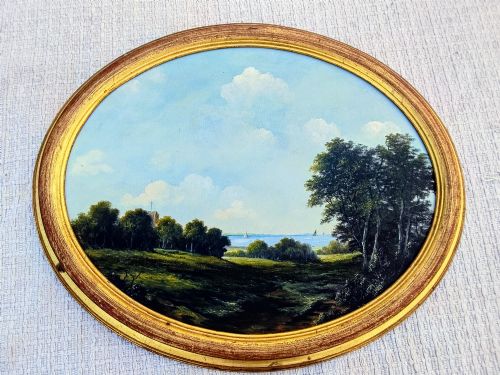
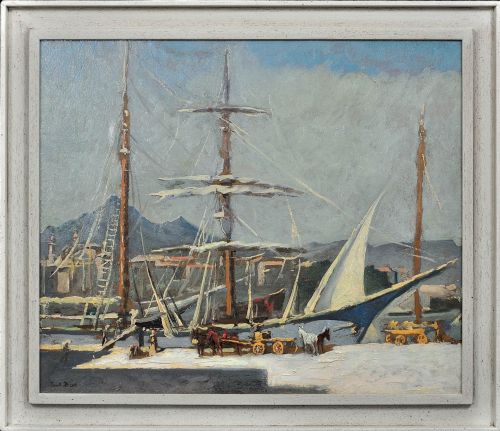
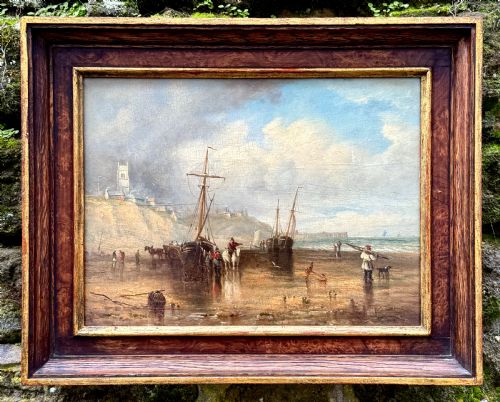
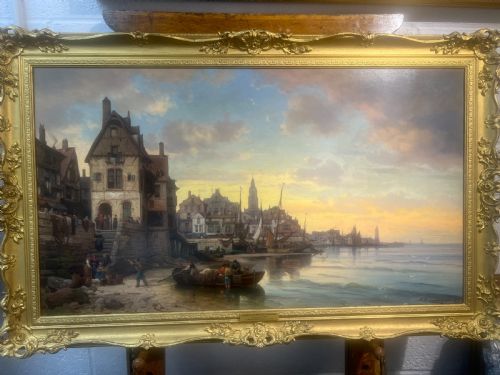
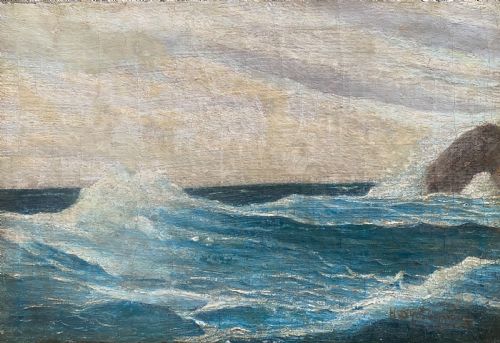
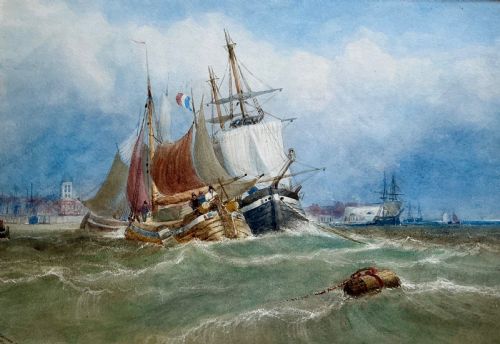
A blue sky marine landscape brings together coastal views, maritime shipping scenes and open water rendered across the nineteenth and twentieth centuries. You will encounter watercolour paintings and oil paintings on canvas, paper and wood panel depicting harbours, fishing boats and coastal villages under bright skies.
The works span traditional Victorian maritime art through to twentieth-century realism and British impressionism. Common subjects range from British coastal spots like Whitby and Scarborough to Venetian canals and Mediterranean harbours.
Materials and execution
Painters utilised oil paint on canvas or wood panel, as well as watercolour on paper, applying pigments to capture the atmospheric quality of sea and sky. Many pieces are preserved in their original giltwood frames.
Techniques vary from the detailed topographical precision of Victorian watercolours to the looser brushwork seen in later impressionist and modernist coastal oils.
Several artists clearly fancied a trip to Whitby, returning repeatedly to paint the abbey looming over the Yorkshire harbour.
Judging quality in marine works
Quality rests on the sureness of the hand in rendering water, rigging and architecture, alongside the artist's ability to balance light across open skies and reflective surfaces. Superior examples display confident brushwork and a coherent sense of atmosphere rather than mechanical repetition.
Condition of the canvas or paper, the stability of the pigment and the harmony of the framing contribute significantly to the standing of an individual piece.
John E. Aitken·Paul Bret·Thomas Creswick·Dubovsky·Henry Barlow Carter·William Frederick Settle·Charles William Adderton·Gustave De Bréanski·Thomas Bush Hardy·Stanley Leader·Edward Seago·Hendrik Willebrord Jansen·George Gregory·George Hamilton Constantine·Donald McIntyre·James Thomas Watts·R.P. Noble·Jane Vivian·Alfred Pollentine·Sam Bough·Paul Jean Clays·Denys Garle·Walter Sweet·Robert Anderson·Edmund Gouldsmith
The Blue Sky Marine Landscape Glossary
- Watercolour
- A painting method in which the paints are made of pigments suspended in a water-based solution. It is typically applied to paper to achieve translucent washes of colour.
- Giltwood
- Wood that has been covered with a thin layer of gold leaf or gold paint. It is commonly found on traditional frames enclosing nineteenth-century oils and watercolours.
- Panel
- A flat piece of wood used as a support for a painting instead of canvas. Artists utilised panels frequently for smaller oil works during the nineteenth century.
Blue Sky Marine Landscape: Frequently Asked Questions
What periods do these paintings cover?
The works primarily date from the nineteenth and twentieth centuries, encompassing Victorian maritime art, Edwardian pieces, and mid-twentieth-century modernism. You will find items ranging from the mid-eighteenth century up to the 1960s.
Victorian examples often favour precise topographical detail, whilst later twentieth-century canvases lean towards looser impressionistic interpretations of light and water.
Where were these coastal scenes painted?
Artists recorded coastal views across Britain, including Devon, Dorset, Yorkshire, and Cornwall, alongside European destinations such as Venice, the Mediterranean, and the Netherlands. These locations reflect the widespread travel of marine painters seeking out bustling ports and quiet havens.
Many works document specific maritime infrastructure, from fishing boats off Scarborough to the canals of Venice and the Doge's Palace.
How should I frame and display a watercolour?
Watercolours on paper require framing behind glass with acid-free mounts to protect the delicate pigments from ultraviolet light and humidity. Displaying them away from direct sunlight ensures the colours remain stable over time.
Many period watercolours retain their original giltwood frames, which complement the traditional character of nineteenth-century maritime art.
How do oil paintings on panel differ from canvas?
Oil paintings on wood panels provide a rigid, stable support that artists often preferred for smaller, highly detailed harbour and shipping scenes. Panels from the nineteenth century are valued for their smooth surfaces and durability.
Canvas supports, by contrast, allowed artists to work on much larger scales, accommodating expansive skies and dramatic seascapes.