


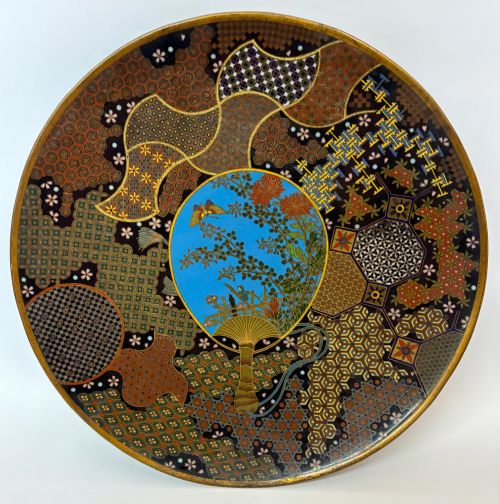


Blue Enamel Charger
A blue enamel charger is a heavy metal display plate worked in bright vitreous colour, sought after for its intricate surface design and scale.
Blue Enamel Charger
A blue enamel charger is a large decorative plate or plaque worked primarily in vitreous enamel, often combined with metal wire to create distinct compartments of colour. When you search for a blue enamel charger, you are looking at substantial display pieces originating from Japanese Meiji workshops and Qing Dynasty makers. These works measure upwards of thirty centimetres across and were made to hang on a wall or rest on a stand.
The pieces available here span the nineteenth century, including examples dated around eighteen seventy, eighteen seventy-five, eighteen eighty, and eighteen ninety, alongside an earlier nineteenth-century piece from around eighteen hundred. Forms vary between decorative plates, chargers, and plaques, utilising heavy metal foundations of copper, brass, and bronze. The visual focus centres on birds, chrysanthemums, butterflies, frogs, dragons, and phoenixes rendered against fields of blue.
Meiji period Japanese pieces dominate the selection, showcasing exceptional control over coloured glass pastes fired onto metal bases. Alongside these, the single Chinese Qing Dynasty plaque represents a different regional tradition of handling large-scale cloisonne work. Every example functions purely as a decorative display object rather than tableware.
Materials and construction
The foundation of a blue enamel charger is typically a heavy base of copper, brass, or bronze, shaped into a wide plate or plaque. Artisans applied thin ribbons of brass wire to the metal surface, soldering the wire on edge to form detailed outlines of birds, dragons, and floral motifs. These wire partitions, known as cloisons, kept the different coloured glass pastes separated during the firing process.
Vitreous enamel pastes were packed into the wire cells by hand, using finely ground coloured glass mixed with water or binding agents. The pieces underwent multiple firings in a kiln to fuse the glass paste into a smooth, durable surface that completely filled the wire compartments. After cooling, the entire face was ground down and polished until the metal wire rims sat flush with the hardened enamel fields.
Blue Enamel Charger Retail Price Guide 2026
Typical asking prices for blue enamel charger among the pieces listed under this phrase on Sellingantiques today, from the lower quarter to the upper quarter. They describe what is for sale here now, not the wider market.
Among the birds and dragons on these plates, a tiny, startled frog sits immortalised in green and blue glass for over a century.
Factors that define quality
Quality in these large decorative plates rests on the precision of the wirework and the depth of the enamel fields. Finer pieces demonstrate absolute regularity in the brass wire lines that form the design, avoiding any visible distortion or gaps in the soldered joints. The application of the blue background enamel should show an even tone and smooth texture across a wide surface.
The complexity and narrative ambition of the imagery also separate standard examples from finer works. Depictions of single dragons, ho-o birds, or composite scenes featuring chrysanthemums, butterflies, and frogs require advanced technical skill to execute at scale. Furthermore, the presence of an artist signature indicates a maker of higher standing within the nineteenth-century export workshops.
The Blue Enamel Charger Glossary
- Cloisonne enamel
- A metalworking technique where thin wire is soldered to a metal base to create compartments that are filled with glass paste and fired. This method allows for intricate pictorial designs in vibrant colours.
- Charger
- A large decorative plate or plaque intended for display on a wall or sideboard rather than for serving food. These pieces provide a wide canvas for complex artistic scenes.
- Meiji Period
- The era of Japanese history lasting from eighteen sixty-eight to nineteen twelve, characterised by the opening of trade and the export of exceptional metalwork and ceramics. Pieces from this time often feature meticulous wirework.
- Qing Dynasty
- The final imperial dynasty of China, lasting from sixteen forty-four to nineteen eleven. Works from this period demonstrate distinct imperial traditions of heavy plaque construction.
- Vitreous enamel
- A material made by fusing powdered glass to a substrate by firing, usually between seven hundred and eight hundred and fifty degrees Celsius. The resulting surface is smooth, durable, and resistant to fading.
Blue Enamel Charger: Frequently Asked Questions
What is a blue enamel charger?
A blue enamel charger is a large decorative metal plate surfaced with fused glass pastes. They were produced primarily as display objects rather than for domestic use.
These pieces rely on metal wire outlines to hold distinct regions of blue and multicoloured enamel. Their substantial scale makes them focal points in a room.
How do I display a charger safely?
Chargers are heavy objects due to their metal and glass construction, requiring sturdy wall mountings or dedicated display stands. Avoid placing them in areas of direct, harsh sunlight to protect the coloured enamel.
Keep them away from high-moisture environments like kitchens to prevent corrosion on the exposed reverse metal surfaces. Dust them gently with a soft, dry cloth.
How do I date a cloisonne charger?
Dating relies on stylistic clues, materials, and signatures left by the makers. Nineteenth-century pieces often exhibit specific colour palettes and distinct wiring densities.
Reference points include the transition from early nineteenth-century Chinese plaques to the refined Japanese Meiji production of the eighteen seventies and eighteen eighties.
Are these plates used for dining?
No, these chargers are purely decorative works of art. The enamel surface and soldered wirework are not suited for holding food or liquid.
Using them as tableware would risk damaging the delicate glass surface and the underlying metal structure. They were designed strictly for visual appreciation.