



Black Marble Clock Set
A black marble clock set brings weighty architectural presence to a mantelpiece, combining a striking central timekeeper with matching side garnitures.
Black Marble Clock Set
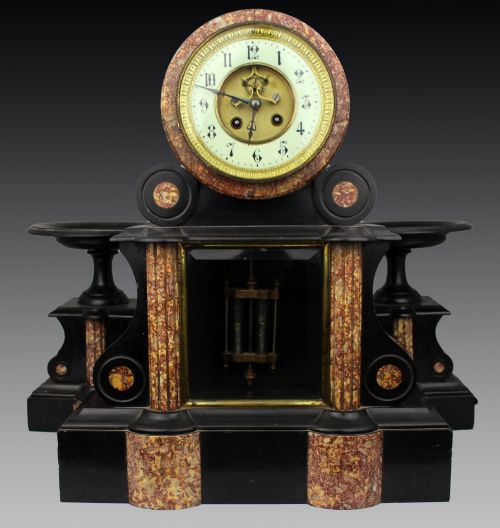
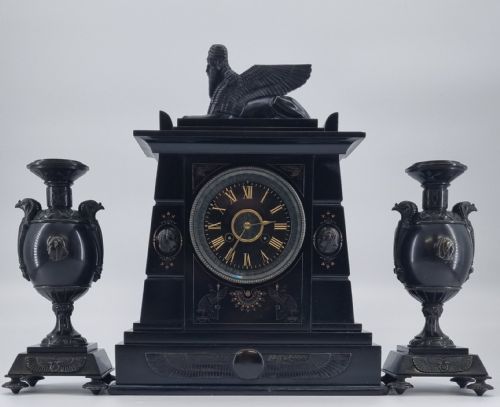
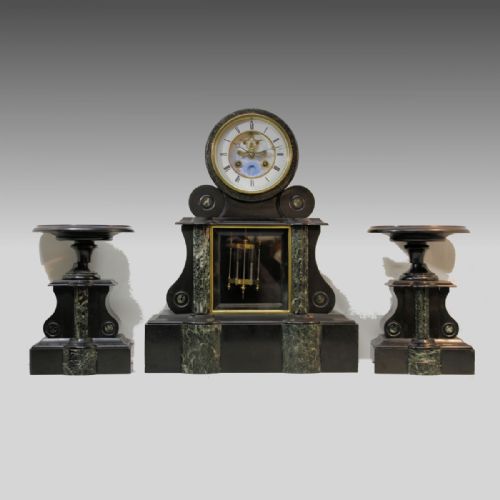
When you search for a black marble clock set, you encounter substantial mantel pieces typically paired with matching garnitures, such as side urns or figures. The examples found here originate largely from the nineteenth century, spanning Victorian, Regency, and French Empire styles.
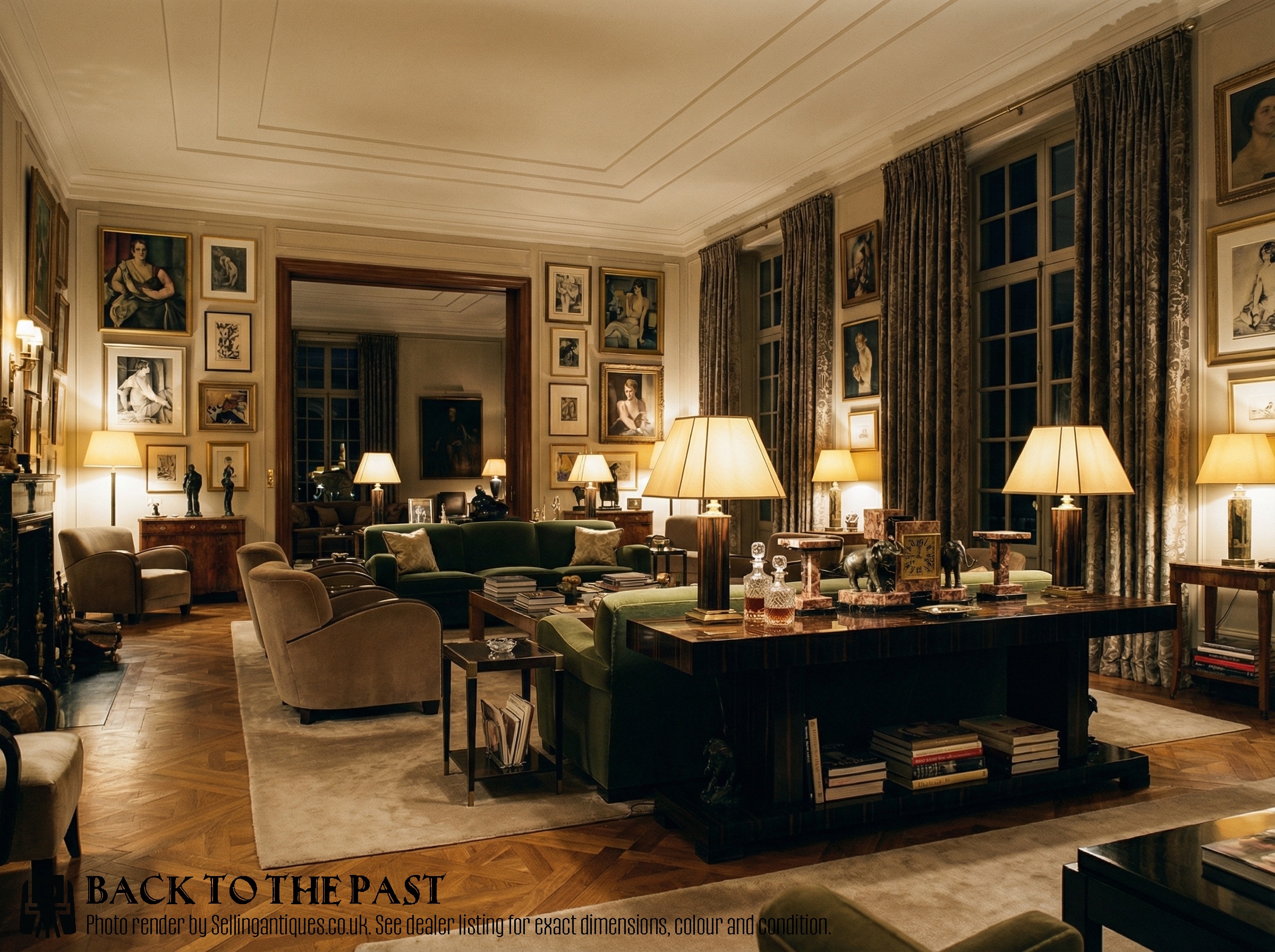
Most pieces date to the Victorian era and the mid-nineteenth century, often driven by French movement makers and neoclassical taste. You will also find occasional later pieces stretching into the early twentieth century, including Art Deco designs featuring figural elements like elephants.

Materials and construction
These sets utilise dense stones including black marble and black slate, frequently contrasted with variegated marble sections for visual depth. The heavy stone bodies are combined with cast metal components such as brass, bronze, and patinated bronze.
Many examples house eight-day mechanical movements behind protective glass dials, occasionally incorporating specialised complications like penny moon phases showing the lunar cycle. The stylistic vocabulary draws heavily on Egyptian Revival, classical revival, and French Second Empire motifs.
Black Marble Clock Set Retail Price Guide 2026
Typical asking prices for black marble clock set among the pieces listed under this phrase on Sellingantiques today, from the lower quarter to the upper quarter. They describe what is for sale here now, not the wider market.
Materials recorded across the inventory include black marble, black slate, variegated marble, brass, bronze, patinated bronze, and glass.
Judging quality and execution
The distinction between standard examples and the finest works rests on the ambition of the design and the crispness of the applied ornament. Elaborate neoclassical or Egyptian Revival detailing requires precise masonry and metal casting.
Presence of matching garniture pieces that form a unified scheme elevates a set, as does the sophistication of the movement, such as works by established makers or those featuring complex dial mechanisms.
Japy Frères
The Black Marble Clock Set Glossary
- Garniture set
- A central clock accompanied by matching decorative side pieces, such as urns or vases, designed to display together on a mantelpiece.
- Black slate
- A fine-grained metamorphic rock widely utilised as a substitute for black marble in nineteenth-century clockmaking.
- Penny moon dial
- A subsidiary dial on the clock face that displays the phases of the moon throughout its cycle.
- Egyptian Revival
- A nineteenth-century decorative style incorporating motifs derived from ancient Egyptian art and architecture.
- Eight day movement
- A mechanical clock movement that requires winding once a week to maintain operation.
Black Marble Clock Set: Frequently Asked Questions
What is a black marble clock set?
A black marble clock set consists of a central mantel clock made from dark stone, accompanied by matching side ornaments like urns or garnitures.
These coordinated groupings were designed to create a balanced, symmetrical display on a fireplace mantel or sideboard in nineteenth-century interiors.
How do I wind an antique clock set?
Antique mechanical clock sets typically utilise an eight-day movement requiring a key inserted into specific winding holes on the dial face.
Care must be taken not to overwind the mainspring, and many collectors consult a professional clockmaker for initial setup and regular servicing.
What periods do these clock sets come from?
The pieces seen here date primarily from the nineteenth century, encompassing the Victorian era, Regency period, and French Empire styles.
Later examples extend into the early twentieth century, including Art Deco designs from around nineteen thirty that introduce new sculptural subjects.
How should I care for marble and slate clocks?
Heavy stone cases require stable placement on sturdy furniture capable of supporting considerable weight without shifting.
Cleaning should be limited to gentle dusting with a dry microfibre cloth, avoiding harsh chemical cleaners that can damage the stone surface or patinated bronze mounts.