



Ormolu Clock Set
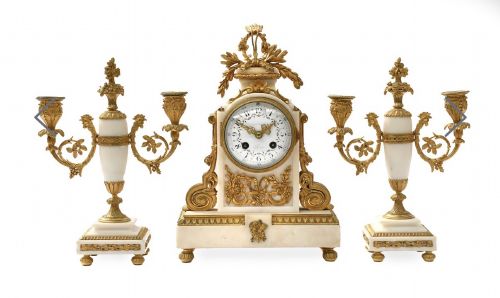
When you search for an ormolu clock set, you encounter nineteenth-century decorative ensembles designed to anchor a mantelpiece with matching candelabras or urns.
Ormolu Clock Set
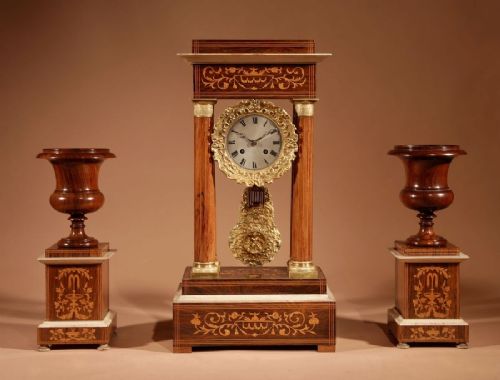
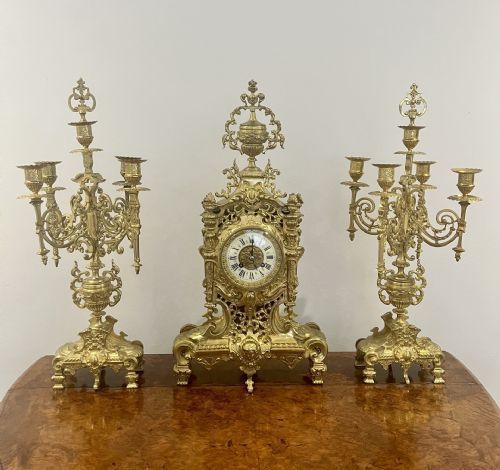
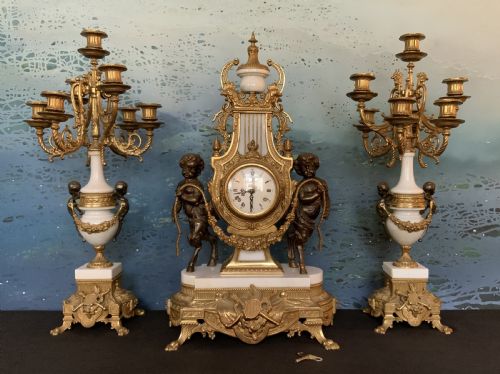
An ormolu clock set comprises a central mantel timepiece accompanied by matching side pieces such as candelabras, urns or vases, forming a unified decorative display for the home. Most examples appearing here originate from nineteenth-century France, spanning periods from the Second Empire to the late Victorian era.
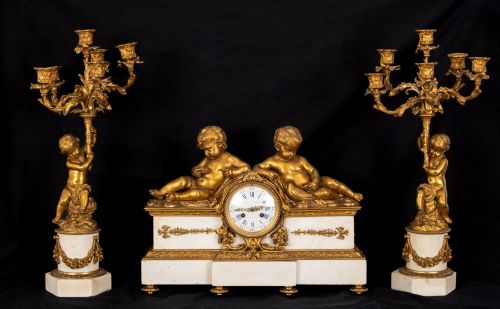
The central clock often takes the form of a portico design, a Rococo revival scrollwork case, or a structural marble housing flanked by matching ornaments. These ensembles frequently incorporate figural elements including cherubs, cupids or classical figures integrated directly into the metalwork.
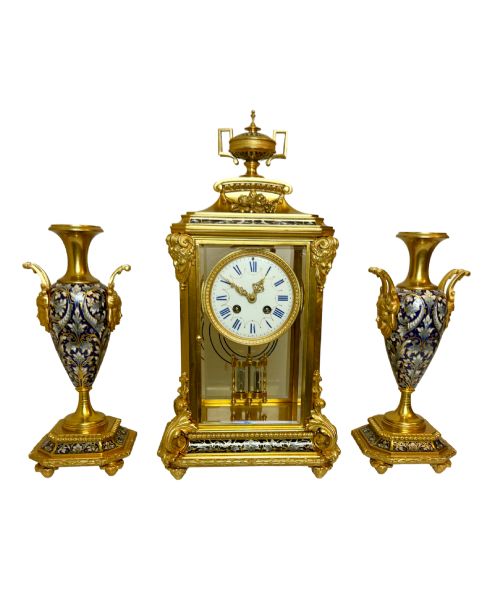
Buyers also encounter four-glass crystal regulator clocks paired with matching side ornaments, alongside porcelain-mounted lyre clocks. The matching pieces repeat the motifs, patinas and materials of the main clock to create a balanced arrangement.
Materials and Construction
The foundation of these pieces relies heavily on cast bronze or brass treated with mercury gilding or modern electroplating to achieve the characteristic bright golden ormolu surface. This metalwork is frequently combined with white, black, red, sienna or green marble, onyx and polished glass.
Many clock faces and decorative panels utilise hand-painted porcelain plaques in the Sevres style, featuring floral scenes or figures. Intricate detail is added through champleve or cloisonne enamel work embedded directly into the metallic frames.
Several nineteenth-century sets deploy cupids, cherubs and even hunting dogs across the bronze mounts to keep watch over the passing hours.
Distinguishing Factors
The distinction between standard production and exceptional quality lies in the depth and crispness of the bronze chasing, where finer examples display sharp hand-tooled details rather than soft, cast-only surface textures. The weight and grade of the underlying marble or onyx foundation also dictate the calibre of the ensemble.
Maker attribution elevates an ormolu clock set significantly, with signed movements or cases from distinguished Parisian makers commanding greater attention. The inclusion of matching original side pieces, undamaged enamel dials and intact mercury gilding preserves the integrity of the complete garniture.
Henry Dasson·A D Mougin·H Luppens Paris·Vincenti of Paris·Louis Japy·Japy Freres·Maison Bagues Paris·Emile Colin Paris·Samuel Marti
The Ormolu Clock Set Glossary
- Ormolu
- Gilded bronze produced by applying a mixture of gold and mercury to a cast brass or bronze object, then heating to vaporise the mercury. This historic fire-gilding technique yields a deep, warm golden lustre.
- Garniture
- A set of matched decorative objects for a mantelpiece, typically consisting of a central clock flanked by two matching candelabras, urns or vases. These suites were designed to coordinate visually across a room.
- Portico clock
- A architectural clock style featuring a suspended pendulum housed within a frame supported by four vertical columns. This neoclassical form is frequently executed in marble and mounted with ormolu accents.
- Champleve
- An enamelling technique where troughs or cells are hollowed out of the metal surface and filled with vitreous enamel paste before firing. The piece is subsequently polished flat to reveal the metallic outlines.
- Escapement
- The mechanical linkage within a clock movement that controls the release of power from the spring or weight. It translates the rotatory force into regulated ticks.
Ormolu Clock Set: Frequently Asked Questions
How do I identify the period?
Period identification relies on observing the stylistic indicators, such as Rococo scrollwork versus neoclassical columns, alongside the materials like Sevres porcelain or champleve enamel.
Makers' marks stamped onto the brass movement plates provide precise chronological reference points when cross-referenced with historic trade records.
How were garnitures displayed?
Garnitures were traditionally arranged across a fireplace mantelpiece, with the taller clock positioned centrally and the matching candelabras or vases flanking it at equal distances.
This symmetrical arrangement reflected interior design standards of the nineteenth century, drawing the eye toward the hearth as the focal point of the room.
Are the clocks mechanical?
The movements are mechanically driven, typically featuring eight-day spring-driven brass gear trains that require manual winding with a key.
Many examples include striking mechanisms that sound the hours and halves on a tuned bell or gong, governed by a pendulum or platform escapement.