


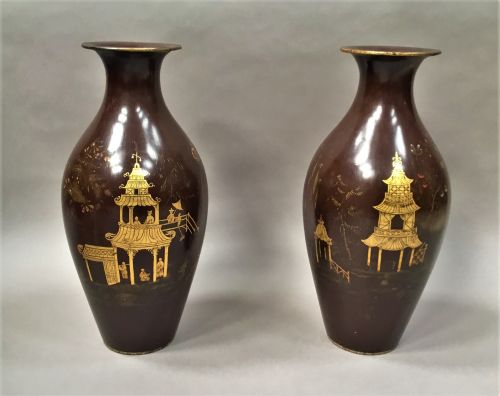


Black Lacquered Urns
These black lacquered urns bring rich Chinoiserie and Japanese Meiji aesthetic to a room through deep dark finishes and gilt highlights.
Black Lacquered Urns
When you search for black lacquered urns, you encounter a selection spanning the nineteenth century, the Edwardian era, and the nineteen thirties. These objects encompass Chinese export temple vases, Japanese porcelain with lacquer over black paint, and Regency toleware pieces.
The forms on this page range from monumental floor vases and table lamps to jardiniere stands and decorative vessels. You are most likely to meet nineteenth century Japanese porcelain pieces finished with black lacquer and koi motifs, alongside English toleware and papier-mache examples.
Origins vary from Japanese workshops and Chinese export production to British makers working in the Chinoiserie and Aesthetic Movement styles. Each piece demonstrates how makers across different regions interpreted dark lacquer and gold decoration on decorative vessels.
Materials and construction
Makers utilised wood, porcelain, metal toleware, and papier-mache as the base bodies for these vessels. Lacquer and black paint were applied to the surfaces, often enriched with gold leaf and gilt details.
Techniques combine traditional Asian lacquer application over porcelain or wood with Western manufacturing methods seen in British papier-mache and painted metal toleware. Surface decoration frequently incorporates hand-painted motifs such as koi fish and elaborate Chinoiserie scenes.
Black Lacquered Urns Retail Price Guide 2026
Typical asking prices for black lacquered urns among the pieces listed under this phrase on Sellingantiques today, from the lower quarter to the upper quarter. They describe what is for sale here now, not the wider market.
Several nineteenth-century Japanese porcelain vases on this page feature hand-painted koi fish swimming permanently through black lacquer.
Evaluating quality in black lacquered urns
The standard of a piece rests upon the depth of the black lacquer finish and the precision of the gold leaf or painted detailing. Superior examples exhibit intact surfaces where the lacquer adheres firmly to the underlying wood, metal, or porcelain without extensive flaking.
Proportion and scale distinguish finer works, particularly in monumental temple vases and large floor vessels where balance is critical. The integration of decorative elements, such as koi motifs or Chinoiserie landscapes, defines the artistic ambition of the maker.
Jennens & Bettridge
The Black Lacquered Urns Glossary
- Toleware
- Painted or enamelled metalware, often iron or steel, finished in black lacquer and gilt for decorative domestic use.
- Chinoiserie
- European artistic style reflecting Chinese motifs and techniques, popular in furniture and decorative objects during the eighteenth and nineteenth centuries.
- Papier-mache
- Composite material made of paper pulp or reinforced paper sheets mixed with glue, moulded and lacquered to form durable decorative vessels.
- Aesthetic Movement
- Nineteenth-century design movement that emphasised visual beauty and Japanese artistic influences over moral narrative in art and decoration.
- Meiji Period
- Japanese historical era spanning from eighteen sixty-eight to nineteen twelve, noted for the opening of trade and the export of fine porcelain and lacquerwork.
Black Lacquered Urns: Frequently Asked Questions
What are black lacquered urns made from?
These decorative vessels are constructed from a variety of base materials including porcelain, wood, metal toleware, and papier-mache.
Artisans applied black lacquer and paint over these cores, frequently embellishing the surfaces with gold leaf and intricate painted details.
How do I date a black lacquered urn?
Dating relies on identifying the underlying material, stylistic markers, and manufacturing techniques characteristic of periods such as the nineteenth century or the Edwardian era.
Japanese Meiji pieces, Chinese export items, and British papier-mache each display distinct stylistic signatures that indicate their era of production.
Where were these urns originally produced?
The pieces originate from diverse geographic centres, including Japanese workshops, Chinese export hubs, and British manufacturing towns.
This global exchange of styles resulted in both authentic Asian export goods and European interpretations using the Chinoiserie aesthetic.
How do I care for black lacquered urns?
Preserve the surface by keeping lacquerware away from direct sunlight, excessive heat, and moisture fluctuations which can cause cracking.
Dust gently with a soft, dry cloth and avoid using chemical cleaning products that might damage the delicate black finish and gilt highlights.