

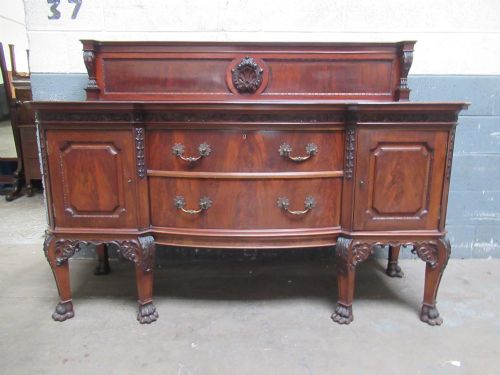
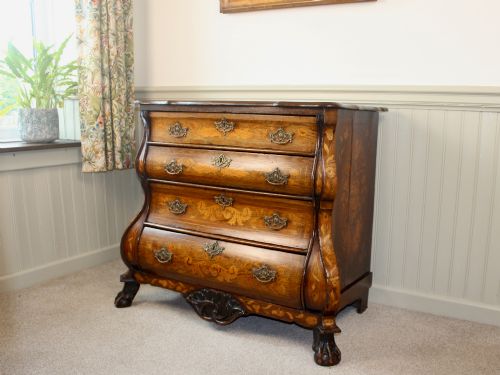


Ball and Claw Dresser
A ball and claw dresser brings substantial timber and carved feet into a room, offering both generous storage and robust historical character.
Ball and Claw Dresser
When buyers search for a ball and claw dresser, they encounter a range of heavy timber storage furniture spanning from the eighteenth century through the Edwardian era and the early twentieth century. The selection includes chests of drawers, sideboards, buffets, and Welsh dressers that share sturdy proportions and distinct carved supports.
Each piece combines practical drawer space with decorative presence, whether through simple mahogany surfaces or elaborate Dutch marquetry and fruitwood inlay. Buyers select them to anchor a room with period weight and traditional craftsmanship.
How they were made
Cabinet-makers built these items using solid hardwoods such as mahogany, oak, walnut, and stinkwood, often selecting burr walnut veneers for figured surfaces on drawer fronts and tops. Brass hardware, including drop handles and escutcheons, complemented the dark timber tones.
Makers employed marquetry and fruitwood inlay to decorate flat and curved panels, utilising meticulous hand-cutting techniques seen in Dutch bombé and serpentine forms. Structural joinery relied on traditional dovetailing for drawers and robust framing to support heavy timber tops.
Listings span four centuries of cabinet-making, featuring mahogany, oak, walnut, stinkwood, and fruitwood inlay across eight distinct historical styles.
What varies in quality
The distinction between tiers of quality rests upon the depth of the carving on the feet and the selection of timber veneers. Pieces featuring finely figured burr walnut or intricate marquetry display a higher grade of workshop execution than plain surfaces.
Proportion and structural complexity also divide standard items from superior examples, particularly where bombé curves or serpentine drawer fronts require advanced woodworking skill. The crispness of detail in the fruitwood inlay and the integration of brass fittings further indicate the standard of manufacture.
The Ball and Claw Dresser Glossary
- Bombé
- A swelling, outward-curving profile found on the front and sides of certain eighteenth-century chests. This bulging contour demands advanced woodworking skill to construct from solid oak or walnut.
- Marquetry
- Decorative patterns formed by fitting together thin veneers of wood and fruitwood inlay. Craftsmen arrange these pieces to create floral or geometric pictures across drawer fronts and tops.
- Serpentine
- A furniture front shaped with a central concave curve flanked by two convex ends. This undulating line appears on Edwardian and eighteenth-century chests of drawers.
- Welsh Dresser
- A large kitchen or dining room storage piece featuring lower cupboards or drawers surmounted by open plate shelves. Examples in oak provide substantial capacity and display space.
- Stinkwood
- A dense, dark hardwood native to South Africa utilised in colonial furniture making. It yields heavy, durable chests with a distinct grain pattern.
Ball and Claw Dresser: Frequently Asked Questions
What periods do these pieces come from?
The selection encompasses items originating from the eighteenth century, the Victorian era, the Edwardian period, and the early twentieth century up to nineteen twenty. Different decades introduced distinct regional interpretations of traditional forms.
Buyers find both genuine eighteenth-century examples and later nineteenth or twentieth-century revivals styled after earlier Georgian and Dutch periods.
How do I identify a George I style piece?
George I style items often feature walnut timbers, refined proportions, and distinctive design elements borrowed from early eighteenth-century British cabinet-making. They frequently appear as chests of drawers raised on stands.
These pieces emphasise clean lines and figured wood grains rather than heavy carving, maintaining a formal presence within a room.
Where were Dutch marquetry pieces made?
Dutch marquetry items originate from the Netherlands during the eighteenth and nineteenth centuries, characterised by elaborate floral and foliage inlay. Cabinet-makers used fruitwood inlay across walnut and oak carcases.
Such items are easily recognised by their contrasting veneer patterns and often feature bombé or shaped fronts.
What timber types are most common?
Mahogany and walnut form the majority of the timber palette, appearing both as solid wood and as decorative veneers. Oak and fruitwood also occur frequently in regional and inlaid pieces.
Stinkwood appears in colonial South African furniture, offering an uncommon alternative to standard European hardwoods.
How are sideboards different from chests?
Sideboards and buffets are designed primarily for dining rooms to serve food and store tableware, often combining cupboards with drawer space. Chests of drawers focus strictly on stacked drawer storage for clothing and linens.
Both forms share similar decorative treatments, such as mahogany construction and shaped fronts, but serve distinct functional roles in the home.