
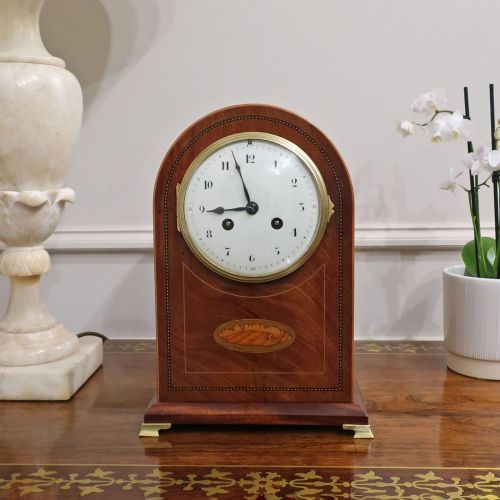


Arch Dial Bracket Clock
An arch dial bracket clock sits on a table or shelf, combining a distinctive architectural case with precise mechanical timekeeping.
Arch Dial Bracket Clock
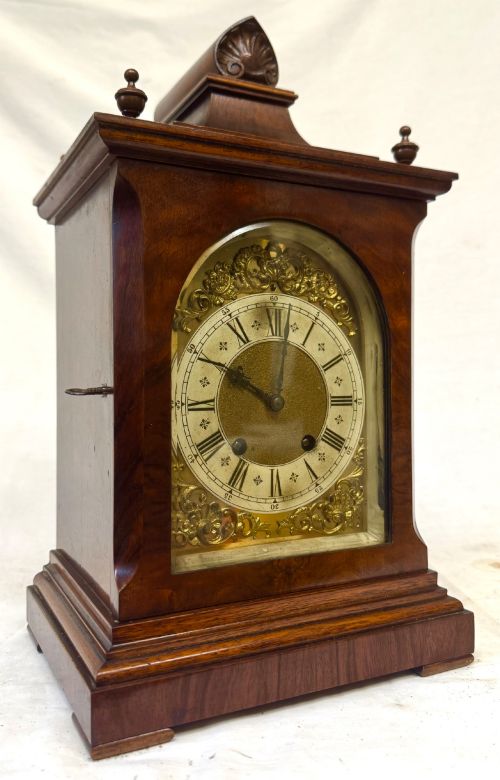
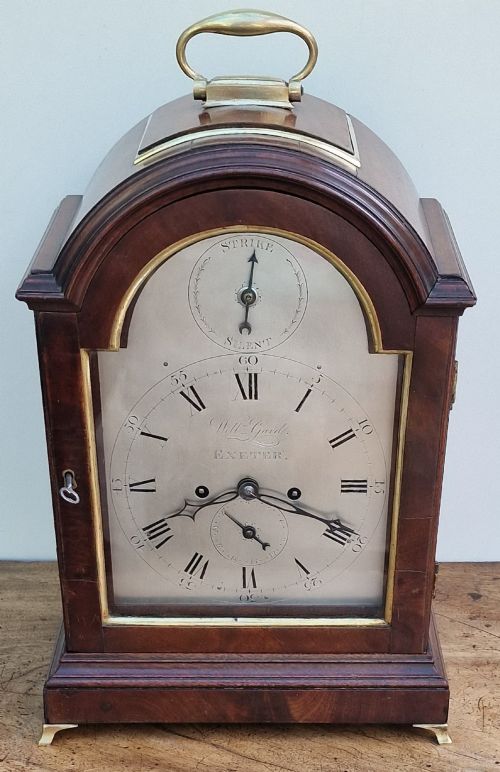
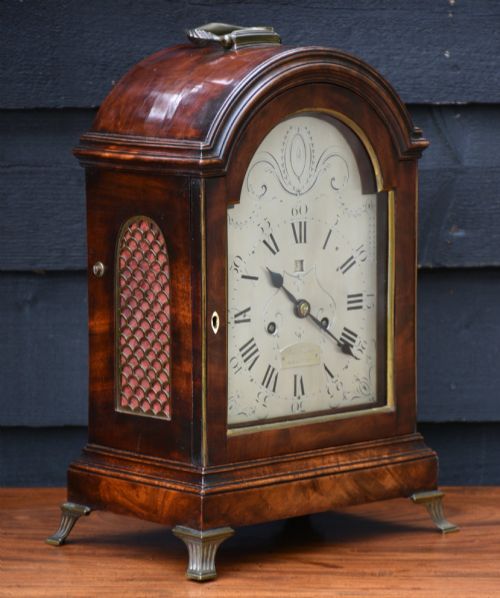
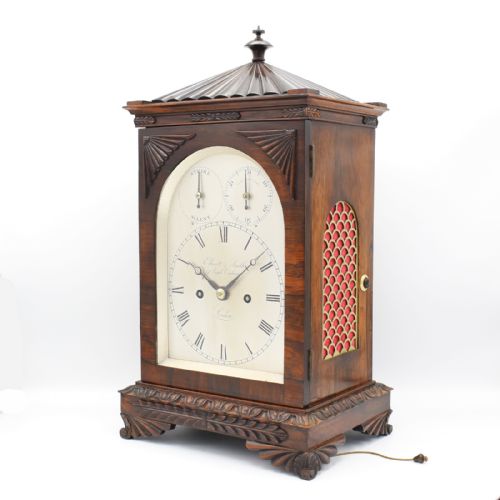
An arch dial bracket clock is a portable timepiece housed in a substantial wooden enclosure designed for placement on furniture rather than a wall. These objects span from the eighteenth century through the Victorian era and into the early twentieth century, taking forms described as mantel clocks, table clocks, or library timepieces.
The pieces appearing on this page frequently date from the Georgian, Regency, and Victorian periods, alongside Edwardian and Belle Epoque examples. Cases vary from break-arch ebonised designs to figured walnut and mahogany structures, often retaining their original brass or silvered metal dials.
How They Were Made
Maker's workshops built these clocks using dense cabinet timbers such as mahogany, walnut, and oak, frequently housing them in ebonised wood or applying fine burr veneers. Brass and silvered metal formed the dials and dial furniture, while glass protected the chapter rings and hands.
Movements relied on complex mechanical assemblies including fusee mechanisms, verge escapements, and striking trains with bells or gongs. Cabinets often featured classical architectural elements like bell-tops and break-arch profiles to frame the dial.
Some clocks feature eight bells and Westminster chimes, ensuring your living room doubles as a miniature cathedral belfry.
What Varies in Quality
Quality rests in the precision and complexity of the internal movement, from simple single fusee timepieces to massive triple fusee musical mechanisms with multiple bells. Finer examples display superior hand-engraved dial work and meticulous joinery in the wooden case.
The integrity of the original components heavily influences the standing of a piece. Retaining original escapements, matching serial numbers, and undamaged veneering distinguish workshop output of the highest order from standard commercial production.
Ellicott and Smith·Des Granges of London·Winterhalder and Hofmeier·Junghans·Lenzkirch·James Maitland London·John Seddon of London·Perigal of London·Grimaldi and Johnson
The Arch Dial Bracket Clock Glossary
- Bracket clock
- A portable table or mantel timepiece originally designed to sit upon a dedicated wall bracket or furniture surface. These clocks house spring-driven movements rather than falling weights.
- Fusee
- A conical pulley inside the clock movement that equalises the declining power of the mainspring as it unwinds. This mechanism ensures even tension and improves timekeeping accuracy.
- Verge escapement
- An early form of mechanical escapement utilising a crown wheel and vibrating balance or pendulum. It provides the characteristic ticking motion in eighteenth-century timepieces.
- Silvered metal
- A brass dial plate treated with a silver compound to create a matte white finish. Graduations and maker signatures are typically engraved and darkened for legibility.
- Ting-tang
- A two-hammer striking train that sounds two alternating notes on bells to announce the quarters or half-hours. It offers an audible signal without a full hour strike.
Arch Dial Bracket Clock: Frequently Asked Questions
Where should I place an arch dial bracket clock?
These pieces require a stable, level surface away from direct sunlight, strong draughts, and dampness. A sturdy sideboard, mantelpiece, or dedicated table allows the sound of the movement to resonate properly.
Ensure the location experiences minimal temperature fluctuation to protect the wooden case and keep the internal metal components operating smoothly over time.
What is the difference between a timepiece and a clock?
In horological terms, a timepiece is a mechanical clock that indicates the hours and minutes without a striking mechanism or chime. It focuses entirely on the primary function of tracking time.
A clock incorporates additional trains that sound the hours, quarters, or musical intervals using bells, gongs, or chimes, adding audible animation to the room.
How can I tell the age of my clock?
Dating relies on stylistic clues in the wooden case, such as break-arch proportions, bracket feet, dial materials like silvered metal or painted iron, and the signature of the maker. Eighteenth-century examples often feature verge escapements, while Victorian models frequently utilise platform escapements.
Maker signatures and hallmarks stamped on the brass backplate or dial provide direct references to historical trade directories and working periods.