
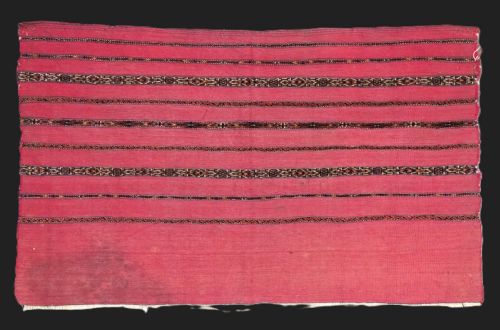


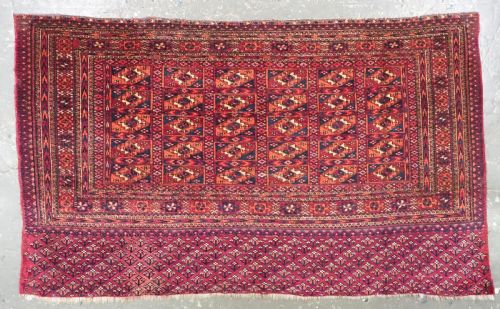


Antique Wool Chuval Face
An antique wool chuval face brings the bold tribal geometry of Central Asia into a modern interior.
Antique Wool Chuval Face
The pieces listed on this page predominantly originate from Turkmen groups such as the Tekke, Ersari, Saryk, and Yomut, alongside related tribal makers. Examples range from the mid-nineteenth century up to the early twentieth century, encompassing formats such as standard bag fronts, torba fragments, and smaller storage pieces. Regional variations emerge clearly through distinct structural layouts and tribal motifs.
Makers utilised traditional formats dominated by repeating primary medallions known as guls, often interspersed with secondary motifs and detailed lower skirts called elems. Pieces commonly feature repeating arrangements of six, nine, fifteen, or thirty guls structured across rich madder grounds. The surviving textile fragments preserve the primary decorative faces while losing their utilitarian rear plain-weave wool sections.
Materials and construction
Weavers constructed these textiles primarily from handspun sheep wool, selected for durability and dyed using natural colourants derived from local plants and minerals. Artisans achieved deep crimson and madder tones alongside dark indigo blues, browns, and contrasting ivory accents. Select examples incorporate supplementary white cotton and crimson silk highlights to accentuate specific pattern details.
The production relied on dense knotting techniques executed on wool or cotton foundation warps, producing a tight pile that preserved intricate geometric drawing over decades of nomadic use. Textile structures often feature durable finishings such as original hanging loops or reinforced side cords. The resulting fabric combines high knot density with resilient natural fibres.
Listings span tribal origins across Turkmenistan and Central Asia, concentrating heavily on Tekke and Ersari works produced in wool with natural dyes.
Quality variations in weaving
Quality separates through the precision of the drawing and the fineness of the knotting across the wool field. Superior examples display crisp, highly articulated gul medallions and balanced proportions within the border systems and lower elem panels. Weaker pieces can show compressed proportions or less rigorous symmetry in the repeat patterns.
Colour saturation and the variety of natural dye tones further distinguish finer pieces. Master weavers achieved deep, luminous grounds through careful mordanting, whereas secondary pieces display more uniform or muted colour palettes. The presence of scarce medallion variants, such as turreted Salor guls oraina designs, also marks superior artistic ambition.
Tekke Turkmen·Ersari Turkmen·Saryk Turkmen·Yomut Turkmen·Salor Turkoman
The Antique Wool Chuval Face Glossary
- Chuval
- A large tent storage bag made by Turkmen tribes for domestic use. Surviving examples typically comprise only the decorative pile face of the original sack.
- Gul
- A repeating primary medallion motif central to Turkmen and Central Asian tribal rug design. These octagonal or polygonal forms identify specific tribal origins.
- Elem
- The decorative panel woven at the lower end of a chuval face below the main field of guls. This secondary band frequently displays floral or tree motifs.
- Torba
- A smaller tribal storage bag proportioned wider than it is tall, used alongside chuvals within the nomadic tent. They share similar wool pile techniques and gul designs.
- Madder
- A natural red dye derived from the root of the Rubia tinctorum plant. It forms the primary crimson and terracotta background tones found across these textiles.
Antique Wool Chuval Face: Frequently Asked Questions
What is a chuval face?
A chuval face is the decorative front panel of a nomadic storage sack from Central Asia. These panels were cut from larger utility bags when the utilitarian backings wore away.
Collectors mount and preserve these surviving textile fragments as flat decorative wall hangings.
How were these bags used?
Nomadic families used these large wool sacks inside tents to store clothing, bedding, and household possessions. They stacked the bags neatly around the interior lattice walls of the dwelling.
The woven panels served both a practical storage function and a display of tribal identity.
How do I hang a textile?
You can mount these flexible textile pieces on fabric-wrapped wooden battens using discreet hand-stitching through the outer selvedges. Avoid applying direct weight to weak wool areas.
Professional mounting ensures the weight distributes evenly across the entire upper edge of the fragment.
How do I identify tribal designs?
Tribal identification relies primarily on the shape and arrangement of the repeating primary gul medallions across the wool field. Tekke, Yomut, and Ersari weavers each utilised distinct geometric drawing styles and colour palettes.
Secondary elem panels and border structures provide additional clues to the specific nomadic origin.