
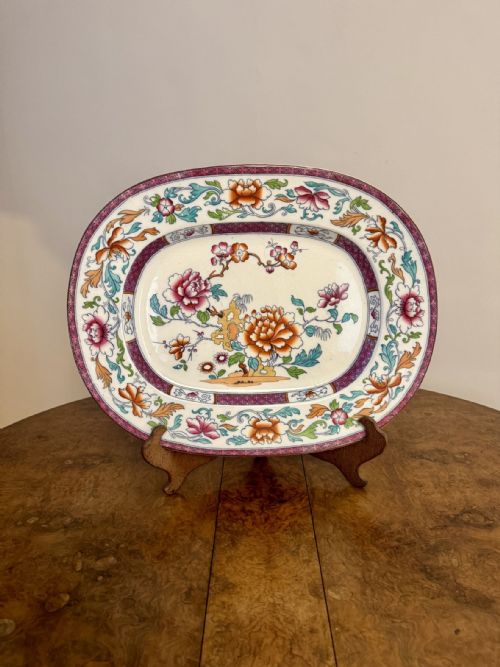


Antique Turkey Platter
These substantial pieces are an antique turkey platter, built to serve the grand joints and poultry of nineteenth-century dining tables.
Antique Turkey Platter
An antique turkey platter provides the generous surface needed for presenting large roasted birds and substantial joints at the nineteenth-century dining table. These heavy vessels take the form of large meat platters, serving plates, and well and tree platters designed to catch juices during carving.
Most examples encountered here date from the Victorian era and the nineteenth century, often decorated with blue and white transfer print patterns. Makers such as Minton and Mason's produced these durable ceramics alongside silver plated warming dishes and Old Sheffield plate meat domes.
How they were made
Potteries shaped these earthenwares, ceramics, and ironstone bodies before applying detailed transfer prints in blue and white, such as Chinese Garden scenes, Cathedral views, and Italianate landscapes. Glaze seals the porous clay body underneath the decorative surface.
Metal versions utilise silver plate, old Sheffield plate, and copper bases formed into warming dishes and heavy meat domes. Wood occasionally appears in associated serving trays and accessories.
Listings feature nineteenth-century earthenware, ironstone, and Old Sheffield plate from periods spanning the Georgian, Regency, and Victorian eras.
What varies in quality
Quality rests upon the crispness of the blue and white transfer print and the depth of the ironstone or earthenware body. Finer pieces include structural additions like well and tree grooves for drainage or matching drainer inserts.
Metal items display quality through the weight of the silver plate and the precision of applied crests, coats of arms, or maker marks. Well-preserved glaze without extensive crazing distinguishes superior ceramic examples.
Boulton·Copeland and Garrett·Minton·Mason's
The Antique Turkey Platter Glossary
- Ironstone
- A heavy, durable type of earthenware patented in the nineteenth century to rival porcelain. It resists chipping and forms a robust base for large meat dishes.
- Transfer print
- A decorative technique where an engraved copper plate transfers a design onto tissue paper, which is then rubbed onto the ceramic surface before glazing. This method allowed intricate blue and white patterns to be produced consistently.
- Well and tree
- A platter design featuring a channel around the edge and branching grooves leading to a well in the centre. This system collects meat juices away from the carved joint.
- Old Sheffield plate
- A composite material made by fusing a thin sheet of silver to a thicker copper base. It was superseded by electroplating in the mid-nineteenth century.
- Meat dome
- A large, domed cover placed over a platter to keep roasted meat warm at the table. They frequently bear engraved coats of arms or maker inscriptions.
Antique Turkey Platter: Frequently Asked Questions
How do I clean an antique turkey platter?
Wash ceramic and ironstone platters gently by hand in warm soapy water using a soft cloth. Avoid harsh scrubbing or modern dishwashers, which can damage nineteenth-century glazes and transfer prints.
Silver plated and Old Sheffield plate pieces require specialised metal cleaners applied sparingly. Store them securely to protect heavy earthenware edges from chipping.
How can I tell the period?
Dating relies on the style of the blue and white transfer print, pottery marks on the reverse, and the material composition. Ironstone gained popularity in the nineteenth century, whilst specific registration marks or maker names provide precise decades like the eighteen-eighties.
Transfer print motifs also shift from Georgian tastes towards Victorian floral and architectural subjects such as Glasgow cathedral views or Chinese garden scenes.
Can I use these platters for food?
Many nineteenth-century ceramic and ironstone platters remain suitable for serving dry foods and modern meals. However, crazed glazes can absorb liquids and stain over time with repeated use.
Metal warming dishes and silver-plated platters need careful inspection of the underlying base metal before serving food directly. Many owners choose to display them as decorative wall or sideboard pieces.