
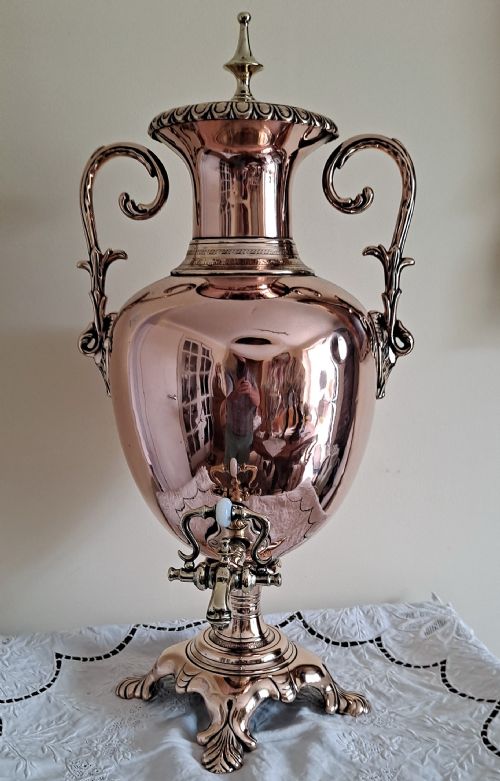


Antique Tea Urn Spigot
These antique tea urn spigot fittings and vessels are the focal points of formal hospitality, offering a tangible link to historical tea service.

Antique Tea Urn Spigot
When you search for an antique tea urn spigot, you are looking at the delivery taps and associated vessels used for dispensing hot water or brewed tea in formal domestic settings. These items span the Georgian, Regency, and Victorian periods, reflecting shifting tastes in metalwork and interior hospitality.
The pieces you are most likely to meet on this page are copper and brass samovars and water urns originating from the nineteenth and late eighteenth centuries. They range from simple utility models to ornate, heavy-gauge vessels fitted with original brass taps and handles.
Materials and construction
Makers shaped these vessels primarily from heavy gauge copper, brass, and occasionally silver plate or bell metal, hammering and soldering the seams to withstand boiling water. Ebonised wood and turned ceramic components frequently form the insulating handle grips and finials.
The spigots and taps are cast and turned from brass or bronze, often featuring intricate detailing designed to complement the main body of the samovar or water urn.
Even kettles needed to look important when guests were watching.
Judging quality and craftsmanship
Quality rests upon the weight of the metal and the integrity of the original fittings, where thicker copper sheets and intact internal heating tubes distinguish superior examples from standard production. The presence of matching original spigots, handles, and bases elevates a piece significantly.
Finer items demonstrate crisp casting on the brass taps and careful hand-finishing to the surface, whereas simpler iterations rely on plain cylindrical forms with minimal decoration.
Risler and Carré Paris
The Antique Tea Urn Spigot Glossary
- Samovar
- A heated metal urn traditionally used to boil and dispense water for tea, typically featuring a central internal chimney or heating tube.
- Spigot
- The tap or faucet fitted near the base of an urn to control the flow of liquid.
- Bell metal
- A hard alloy of copper and tin traditionally used for casting bells and durable vessel hardware like urn taps.
- Ebonised wood
- Timber treated with a dark finish to imitate expensive ebony, commonly used for insulating handles on metal vessels.
- Silver plate
- A thin layer of silver fused to a base metal core, seen on finer nineteenth-century presentation urns.
Antique Tea Urn Spigot: Frequently Asked Questions
What is an antique tea urn spigot?
An antique tea urn spigot is the functional metal tap attached near the base of a Georgian or Victorian samovar or water urn to dispense hot water.
These taps were cast from brass or bell metal, often designed with decorative turnkeys that matched the aesthetic of the main vessel.
How were these urns used historically?
These vessels were employed in wealthy households to heat and serve water for tea during formal gatherings and meals.
Hot coals placed in an internal tube kept the water boiling throughout the service, with the spigot providing controlled access to the water.
What metals are most common?
Copper is the predominant metal seen in these listings, frequently accented with brass handles, feet, and spigots.
Silver plate over base metal and bell metal also appear on specific high-status items from the nineteenth century.
How do I distinguish Georgian from Victorian pieces?
Georgian pieces often display restrained neoclassical forms with clean lines, dating from the late eighteenth or early nineteenth century.
Victorian and Regency examples tend towards heavier ornamentation, sometimes incorporating French styling or complex mixed-metal construction.