



Antique Table Globe
An antique table globe brings the geography of past centuries onto a desk, offering a tangible piece of cartographic history.
Antique Table Globe
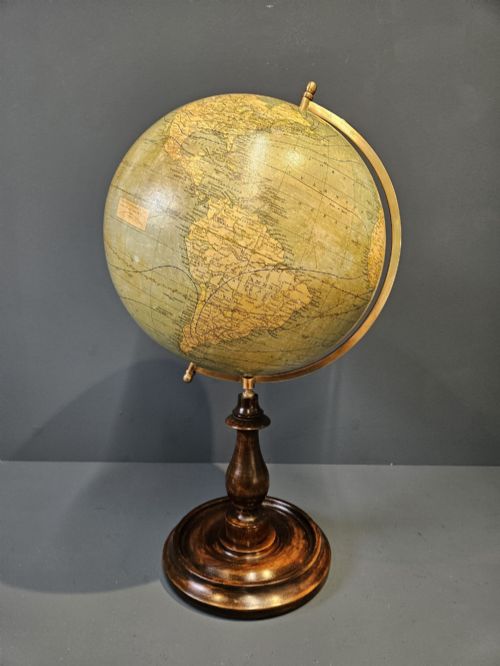
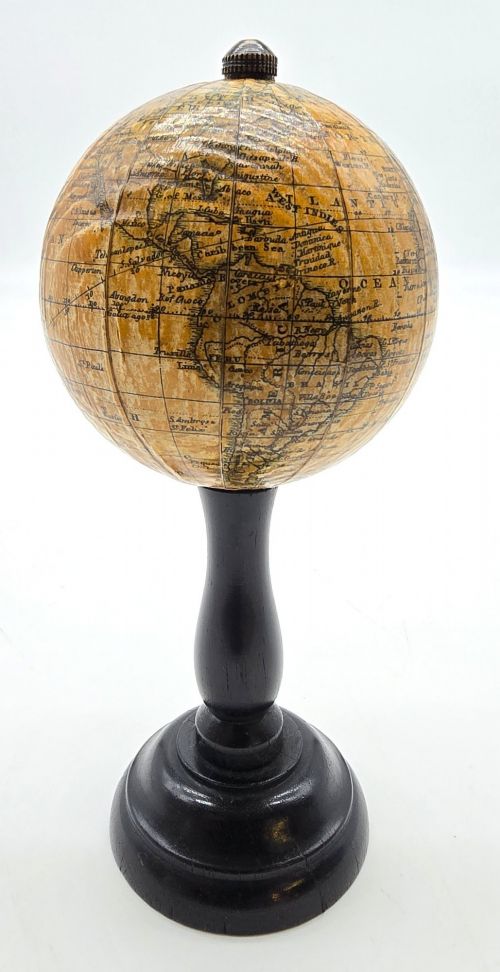
An antique table globe is a compact cartographic sphere designed to sit upon a desk, table, or library stand rather than stand independently on the floor.
When you search for an antique table globe, you encounter pieces spanning from the nineteenth century through the interwar years and the 1930s.
These instruments display geographical and terrestrial details printed on paper gores applied over plaster or papier-mâché spheres.
Makers such as Malby, Cary, Bacon, and Geographia produced these educational and decorative objects, mounting them on stands of wood or brass.
Materials and construction
Makers constructed the core sphere using plaster or papier-mâché, providing a lightweight yet durable foundation for the map.
Printed paper gores, individually curved and hand-applied, cover the sphere to form a continuous map of the terrestrial or celestial world.
Stands and mountings utilise materials like brass, walnut, ebony, and other woods to support the sphere and its meridian ring.
Listings feature nineteenth-century and early twentieth-century table globes constructed from paper, plaster, wood, and brass.
Assessing quality and craftsmanship
Quality rests heavily upon the clarity and detail of the cartography, alongside the precision with which the paper gores align at the poles.
The choice of base materials dictates the substance of the piece, distinguishing simpler wooden feet from heavier brass or bronze mountings.
The preservation of the original hand-coloured varnish and the legibility of the geographical text separate superior cartographic instruments from ordinary examples.
Bacon·Geographia·J Forest·Chandy Charan And Co·Carl Adami·Wyld·Cary·WA And AK Johnston·Newton·Philips
The Antique Table Globe Glossary
- Gores
- The paper strips printed with geographical details that are tapered to fit smoothly over a spherical globe.
- Meridian ring
- The brass or metal semi-circle surrounding the globe that holds it in place and allows it to tilt.
- Terrestrial globe
- A model of the Earth showing landmasses, oceans, and political boundaries as known at the time of manufacture.
- Papier-mâché
- A composite material made of paper paper pulp and binding adhesive, moulded to form a lightweight sphere.
Antique Table Globe: Frequently Asked Questions
How do I date an antique table globe?
Dating relies on examining the political boundaries, colonial possessions, and capital cities printed on the map itself. Cartographers often updated the plates, so specific geopolitical names provide a reliable window for the year of manufacture.
Additional clues appear in the style of the mounting, the typography used for place names, and any published makers' marks or dates printed directly on the gores.
Where should I place a table globe?
These pieces suit placement on a sturdy desk, library table, or cabinet where they can be appreciated at close range. They add a scholarly character to studies, libraries, and living spaces.
Keep them away from direct sunlight and excessive moisture to protect the delicate paper gores and underlying plaster from fading and warping.
How are terrestrial and celestial globes different?
A terrestrial globe maps the physical surface of the Earth, including oceans, countries, and shipping routes. It reflects the geographical knowledge of the era in which it was printed.
A celestial globe maps the night sky, depicting constellations and star clusters from an imaginary outward-facing perspective. These were used historically for astronomical calculations and navigation.